
Mapa mental
Incentive systems
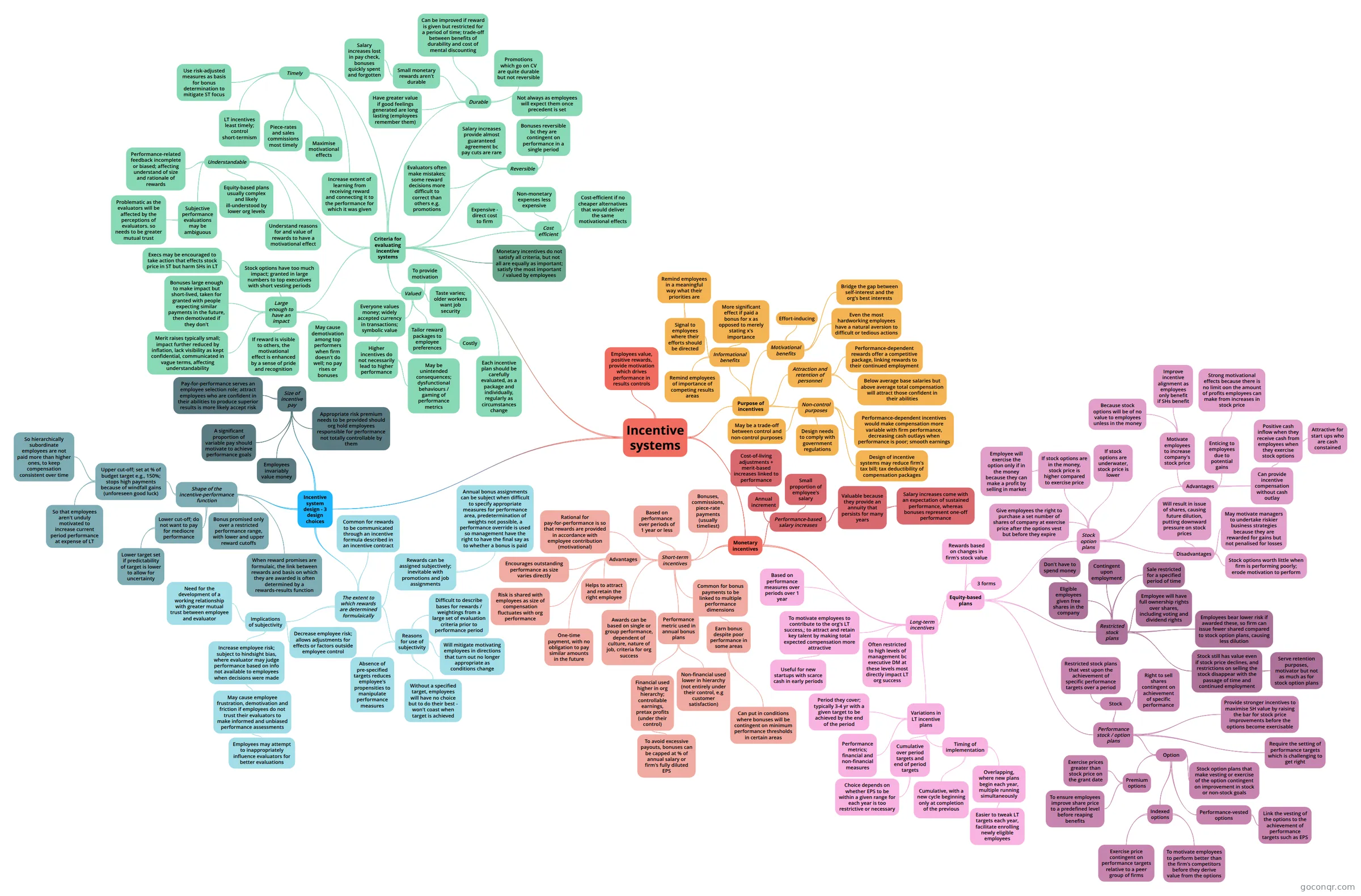
Mind map: Incentive systems
Conteúdo do mapa
Incentive systems
Employees value, positive rewards, provide motivation which drives performance in results controls
Purpose of incentives
- Informational benefits
- Remind employees of importance of competing results areas
- Signal to employees where their efforts should be directed
- Remind employees in a meaningful way what their priorities are
- More significant effect if paid a bonus for x as opposed to merely stating x's importance
- Motivational benefits
- Effort-inducing
- Bridge the gap between self-interest and the org's best interests
- Even the most hardworking employees have a natural aversion to difficult or tedious actions
- Attraction and retention of personnel
- Performance-dependent rewards offer a competitive package, linking rewards to their continued employment
- Below average base salaries but above average total compensation will attract those confident in their abilities
- Non-control purposes
- May be a trade-off between control and non-control purposes
- Performance-dependent incentives would make compensation more variable with firm performance, decreasing cash outlays when performance is poor; smooth earnings
- Design of incentive systems may reduce firm's tax bill; tax deductibility of compensation packages
- Design needs to comply with government regulations
- Informational benefits
Monetary incentives
- Performance-based salary increases
- Annual increment
- Cost-of-living adjustments + merit-based increases linked to performance
- Small proportion of employee's salary
- Valuable because they provide an annuity that persists for many years
- Salary increases come with an expectation of sustained performance, whereas bonuses represent one-off performance
- Annual increment
- Short-term incentives
- Based on performance over periods of 1 year or less
- Bonuses, commissions, piece-rate payments (usually timeliest)
- Rational for pay-for-performance is so that rewards are provided in accordance with employee contribution (motivational)
- Advantages
- Encourages outstanding performance as size varies directly
- Risk is shared with employees as size of compensation fluctuates with org performance
- One-time payment, with no obligation to pay similar amounts in the future
- Helps to attract and retain the right employee
- Awards can be based on single or group performance, dependent of culture, nature of job, criteria for org success
- Performance metric used in annual bonus plans
- Financial used higher in org hierarchy; controllable earnings, pretax profits (under their control)
- To avoid excessive payouts, bonuses can be capped at % of annual salary or firm's fully diluted EPS
- Non-financial used lower in hierarchy (not entirely under their control, e.g customer satisfaction)
- Financial used higher in org hierarchy; controllable earnings, pretax profits (under their control)
- Common for bonus payments to be linked to multiple performance dimensions
- Earn bonus despite poor performance in some areas
- Can put in conditions where bonuses will be contingent on minimum performance thresholds in certain areas
- Earn bonus despite poor performance in some areas
- Long-term incentives
- Based on performance measures over periods over 1 year
- To motivate employees to contribute to the org's LT success,; to attract and retain key talent by making total expected compensation more attractive
- Useful for new startups with scarce cash in early periods
- Often restricted to high levels of management bc executive DM at these levels most directly impact LT org success
- Variations in LT incentive plans
- Period they cover; typically 3-4 yr with a given target to be achieved by the end of the period
- Performance metrics; financial and non-financial measures
- Cumulative over period targets and end of period targets
- Choice depends on whether EPS to be within a given range for each year is too restrictive or necessary
- Timing of implementation
- Cumulative, with a new cycle beginning only at completion of the previous
- Overlapping, where new plans begin each year, multiple running simultaneously
- Easier to tweak LT targets each year, facilitate enrolling newly eligible employees
- Equity-based plans
- Rewards based on changes in firm's stock value
- 3 forms
- Stock option plans
- Give employees the right to purchase a set number of shares of company at exercise price after the options vest but before they expire
- If stock options are in the money, stock price is higher compared to exercise price
- Employee will exercise the option only if in the money because they can make a profit by selling in market
- If stock options are underwater, stock price is lower
- Advantages
- Motivate employees to increase company's stock price
- Improve incentive alignment as employees only benefit if SHs benefit
- Because stock options will be of no value to employees unless in the money
- Enticing to employees due to potential gains
- Strong motivational effects because there is no limit oon the amount of profits employees can make from increases in stock price
- Can provide incentive compensation without cash outlay
- Positive cash inflow when they receive cash from employees when they exercise stock options
- Attractive for start ups who are cash constained
- Positive cash inflow when they receive cash from employees when they exercise stock options
- Motivate employees to increase company's stock price
- Disadvantages
- Will result in issue of shares, causing future dilution, putting downward pressure on stock prices
- May motivate managers to undertake riskier business strategies because they are rewarded for gains but not penalised for losses
- Stock options worth little when firm is performing poorly; erode motivation to perform
- Restricted stock plans
- Eligible employees given free shares in the company
- Don't have to spend money
- Sale restricted for a specified period of time
- Contingent upon employment
- Employee will have full ownership rights over shares, including voting and dividend rights
- Employees bear lower risk if awarded these, so firm can issue fewer shared compared to stock option plans, causing less dilution
- Stock still has value even if stock price declines, and restrictions on selling the stock disappear with the passage of time and continued employment
- Serve retention purposes, motivator but not as much as for stock option plans
- Eligible employees given free shares in the company
- Performance stock / option plans
- Stock
- Restricted stock plans that vest upon the achievement of specific performance targets over a period
- Right to sell shares contingent on achievement of specific performance
- Option
- Stock option plans that make vesting or exercise of the option contingent on improvement in stock or non-stock goals
- Premium options
- Exercise prices greater than stock price on the grant date
- To ensure employees improve share price to a predefined level before reaping benefits
- Indexed options
- Exercise price contingent on performance targets relative to a peer group of firms
- To motivate employees to perform better than the firm's competitors before they derive value from the options
- Performance-vested options
- Link the vesting of the options to the achievement of performance targets such as EPS
- Provide stronger incentives to maximise SH value by raising the bar for stock price improvements before the options become exercisable
- Require the setting of performance targets which is challenging to get right
- Stock
- Performance-based salary increases
Incentive system design - 3 design choices
- The extent to which rewards are determined formulaically
- Common for rewards to be communicated through an incentive formula described in an incentive contract
- Rewards can be assigned subjectively; inevitable with promotions and job assignments
- Annual bonus assignments can be subject when difficult to specify appropriate measures for performance area, predetermination of weights not possible, a performance override is used so management have the right to have the final say as to whether a bonus is paid
- Reasons for use of subjectivity
- Difficult to describe bases for rewards / weightings from a large set of evaluation criteria prior to performance period
- Will mitigate motivating employees in directions that turn out no longer appropriate as conditions change
- Without a specified target, employees will have no choice but to do their best - won't coast when target is achieved
- Absence of pre-specified targets reduces employee's propensities to manipulate performance measures
- Implications of subjectivity
- Decrease employee risk; allows adjustments for effects or factors outside employee control
- Increase employee risk; subject to hindsight bias, where evaluator may judge performance based on info not available to employees when decisions were made
- May cause employee frustration, demotivation and friction if employees do not trust their evaluators to make informed and unbiased performance assessments
- Employees may attempt to inappropriately influence evaluators for better evaluations
- May cause employee frustration, demotivation and friction if employees do not trust their evaluators to make informed and unbiased performance assessments
- Need for the development of a working relationship with greater mutual trust between employee and evaluator
- Shape of the incentive-performance function
- When reward promises are formulaic, the link between rewards and basis on which they are awarded is often determined by a rewards-results function
- Bonus promised only over a restricted performance range, with lower and upper reward cutoffs
- Lower cut-off; do not want to pay for mediocre performance
- Lower target set if predictability of target is lower to allow for uncertainty
- Upper cut-off; set at % of budget target e.g., 150%; stops high payments because of windfall gains (unforeseen good luck)
- So that employees aren't unduly motivated to increase current period performance at expense of LT
- So hierarchically subordinate employees are not paid more than higher ones, to keep compensation consistent over time
- Size of incentive pay
- Employees invariably value money
- A significant proportion of variable pay should motivate to achieve performance goals
- Pay-for-performance serves an employee selection role; attract employees who are confident in their abilities to produce superior results is more likely accept risk
- Appropriate risk premium needs to be provided should org hold employees responsible for performance not totally controllable by them
- The extent to which rewards are determined formulaically
Criteria for evaluating incentive systems
- Each incentive plan should be carefully evaluated, as a package and individually, regularly as circumstances change
- Valued
- To provide motivation
- Taste varies; older workers want job security
- Tailor reward packages to employee preferences
- Costly
- Everyone values money; widely accepted currency in transactions; symbolic value
- Higher incentives do not necessarily lead to higher performance
- May be unintended consequences; dysfunctional behaviours / gaming of performance metrics
- Higher incentives do not necessarily lead to higher performance
- Large enough to have an impact
- If reward is visible to others, the motivational effect is enhanced by a sense of pride and recognition
- Merit raises typically small; impact further reduced by inflation, lack visibility as kept confidential, communicated in vague terms, affecting understandability
- Bonuses large enough to make impact but short-lived, taken for granted with people expecting similar payments in the future, then demotivated if they don't
- May cause demotivation among top performers when firm doesn't do well; no pay rises or bonuses
- Stock options have too much impact; granted in large numbers to top executives with short vesting periods
- Execs may be encouraged to take action that effects stock price in ST but harm SHs in LT
- Understandable
- Understand reasons for and value of rewards to have a motivational effect
- Equity-based plans usually complex and likely ill-understood by lower org levels
- Subjective performance evaluations may be ambiguous
- Problematic as the evaluators will be affected by the perceptions of evaluators. so needs to be greater mutual trust
- Performance-related feedback incomplete or biased; affecting understand of size and rationale of rewards
- Timely
- Maximise motivational effects
- Increase extent of learning from receiving reward and connecting it to the performance for which it was given
- Piece-rates and sales commissions most timely
- LT incentives least timely; control short-termism
- Use risk-adjusted measures as basis for bonus determination to mitigate ST focus
- Durable
- Have greater value if good feelings generated are long lasting (employees remember them)
- Small monetary rewards aren't durable
- Salary increases lost in pay check, bonuses quickly spent and forgotten
- Can be improved if reward is given but restricted for a period of time; trade-off between benefits of durability and cost of mental discounting
- Promotions which go on CV are quite durable but not reversible
- Reversible
- Evaluators often make mistakes; some reward decisions more difficult to correct than others e.g. promotions
- Bonuses reversible bc they are contingent on performance in a single period
- Not always as employees will expect them once precedent is set
- Salary increases provide almost guaranteed agreement bc pay cuts are rare
- Cost efficient
- Expensive - direct cost to firm
- Non-monetary expenses less expensive
- Cost-efficient if no cheaper alternatives that would deliver the same motivational effects
- Monetary incentives do not satisfy all criteria, but not all are equally as important; satisfy the most important / valued by employees
Informações
- Descrição
- Mapa Mental sobre Incentive systems, criado por Abbie Goffin em 07-01-2023.
- Criado por
- Abbie Goffin
- Visualizações
- 0
- Avaliação