
Mapa mental
10. Charity
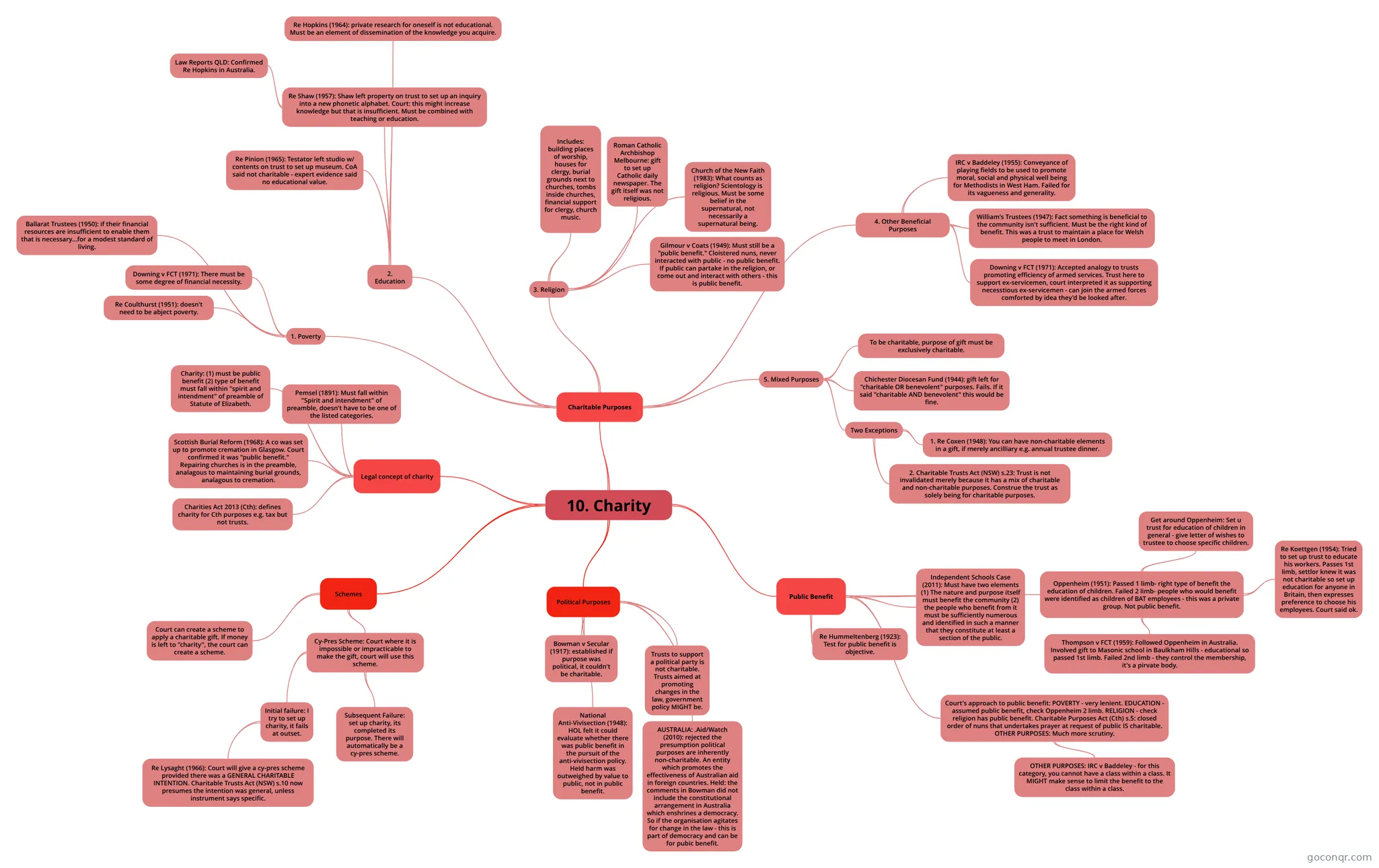
Mind map: Charity law
Conteúdo do mapa
10. Charity
Legal concept of charity
- Charity: (1) must be public benefit (2) type of benefit must fall within "spirit and intendment" of preamble of Statute of Elizabeth.
- Pemsel (1891): Must fall within "Spirit and intendment" of preamble, doesn't have to be one of the listed categories.
- Scottish Burial Reform (1968): A co was set up to promote cremation in Glasgow. Court confirmed it was "public benefit." Repairing churches is in the preamble, analagous to maintaining burial grounds, analagous to cremation.
- Charities Act 2013 (Cth): defines charity for Cth purposes e.g. tax but not trusts.
Charitable Purposes
- 1. Poverty
- Re Coulthurst (1951): doesn't need to be abject poverty.
- Downing v FCT (1971): There must be some degree of financial necessity.
- Ballarat Trustees (1950): if their financial resources are insufficient to enable them that is necessary...for a modest standard of living.
- 2. Education
- Re Pinion (1965): Testator left studio w/ contents on trust to set up museum. CoA said not charitable - expert evidence said no educational value.
- Re Shaw (1957): Shaw left property on trust to set up an inquiry into a new phonetic alphabet. Court: this might increase knowledge but that is insufficient. Must be combined with teaching or education.
- Law Reports QLD: Confirmed Re Hopkins in Australia.
- Re Hopkins (1964): private research for oneself is not educational. Must be an element of dissemination of the knowledge you acquire.
- 3. Religion
- Includes: building places of worship, houses for clergy, burial grounds next to churches, tombs inside churches, financial support for clergy, church music.
- Roman Catholic Archbishop Melbourne: gift to set up Catholic daily newspaper. The gift itself was not religious.
- Church of the New Faith (1983): What counts as religion? Scientology is religious. Must be some belief in the supernatural, not necessarily a supernatural being.
- Gilmour v Coats (1949): Must still be a "public benefit." Cloistered nuns, never interacted with public - no public benefit. If public can partake in the religion, or come out and interact with others - this is public benefit.
- 4. Other Beneficial Purposes
- IRC v Baddeley (1955): Conveyance of playing fields to be used to promote moral, social and physical well being for Methodists in West Ham. Failed for its vagueness and generality.
- William's Trustees (1947): Fact something is beneficial to the community isn't sufficient. Must be the right kind of benefit. This was a trust to maintain a place for Welsh people to meet in London.
- Downing v FCT (1971): Accepted analogy to trusts promoting efficiency of armed services. Trust here to support ex-servicemen, court interpreted it as supporting necesstious ex-servicemen - can join the armed forces comforted by idea they'd be looked after.
- 5. Mixed Purposes
- To be charitable, purpose of gift must be exclusively charitable.
- Chichester Diocesan Fund (1944): gift left for "charitable OR benevolent" purposes. Fails. If it said "charitable AND benevolent" this would be fine.
- Two Exceptions
- 1. Re Coxen (1948): You can have non-charitable elements in a gift, if merely ancilliary e.g. annual trustee dinner.
- 2. Charitable Trusts Act (NSW) s.23: Trust is not invalidated merely because it has a mix of charitable and non-charitable purposes. Construe the trust as solely being for charitable purposes.
- 1. Poverty
Public Benefit
- Re Hummeltenberg (1923): Test for public benefit is objective.
- Independent Schools Case (2011): Must have two elements (1) The nature and purpose itself must benefit the community (2) the people who benefit from it must be sufficiently numerous and identified in such a manner that they constitute at least a section of the public.
- Oppenheim (1951): Passed 1 limb- right type of benefit the education of children. Failed 2 limb- people who would benefit were identified as children of BAT employees - this was a private group. Not public benefit.
- Thompson v FCT (1959): Followed Oppenheim in Australia. Involved gift to Masonic school in Baulkham Hills - educational so passed 1st limb. Failed 2nd limb - they control the membership, it's a pirvate body.
- Get around Oppenheim: Set u trust for education of children in general - give letter of wishes to trustee to choose specific children.
- Re Koettgen (1954): Tried to set up trust to educate his workers. Passes 1st limb, settlor knew it was not charitable so set up education for anyone in Britain, then expresses preference to choose his employees. Court said ok.
- Court's approach to public benefit: POVERTY - very lenient. EDUCATION - assumed public benefit, check Oppenheim 2 limb. RELIGION - check religion has public benefit. Charitable Purposes Act (Cth) s.5: closed order of nuns that undertakes prayer at request of public IS charitable. OTHER PURPOSES: Much more scrutiny.
- OTHER PURPOSES: IRC v Baddeley - for this category, you cannot have a class within a class. It MIGHT make sense to limit the benefit to the class within a class.
Political Purposes
- Trusts to support a political party is not charitable. Trusts aimed at promoting changes in the law, government policy MIGHT be.
- Bowman v Secular (1917): established if purpose was political, it couldn't be charitable.
- National Anti-Vivisection (1948): HOL felt it could evaluate whether there was public benefit in the pursuit of the anti-vivisection policy. Held harm was outweighed by value to public, not in public benefit.
- AUSTRALIA: .Aid/Watch (2010): rejected the presumption political purposes are inherently non-charitable. An entity which promotes the effectiveness of Australian aid in foreign countries. Held: the comments in Bowman did not include the constitutional arrangement in Australia which enshrines a democracy. So if the organisation agitates for change in the law - this is part of democracy and can be for pubic benefit.
Schemes
- Court can create a scheme to apply a charitable gift. If money is left to "charity", the court can create a scheme.
- Cy-Pres Scheme: Court where it is impossible or impracticable to make the gift, court will use this scheme.
- Initial failure: I try to set up charity, it fails at outset.
- Re Lysaght (1966): Court will give a cy-pres scheme provided there was a GENERAL CHARITABLE INTENTION. Charitable Trusts Act (NSW) s.10 now presumes the intention was general, unless instrument says specific.
- Subsequent Failure: set up charity, its completed its purpose. There will automatically be a cy-pres scheme.
- Initial failure: I try to set up charity, it fails at outset.
Informações
- Descrição
- Universität EQUITY Mapa Mental sobre 10. Charity, criado por georgiafeltis em 07-11-2015.
- Criado por
- georgiafeltis
- Visualizações
- 7
- Avaliação