
Mapa mental
Evolution to TQM
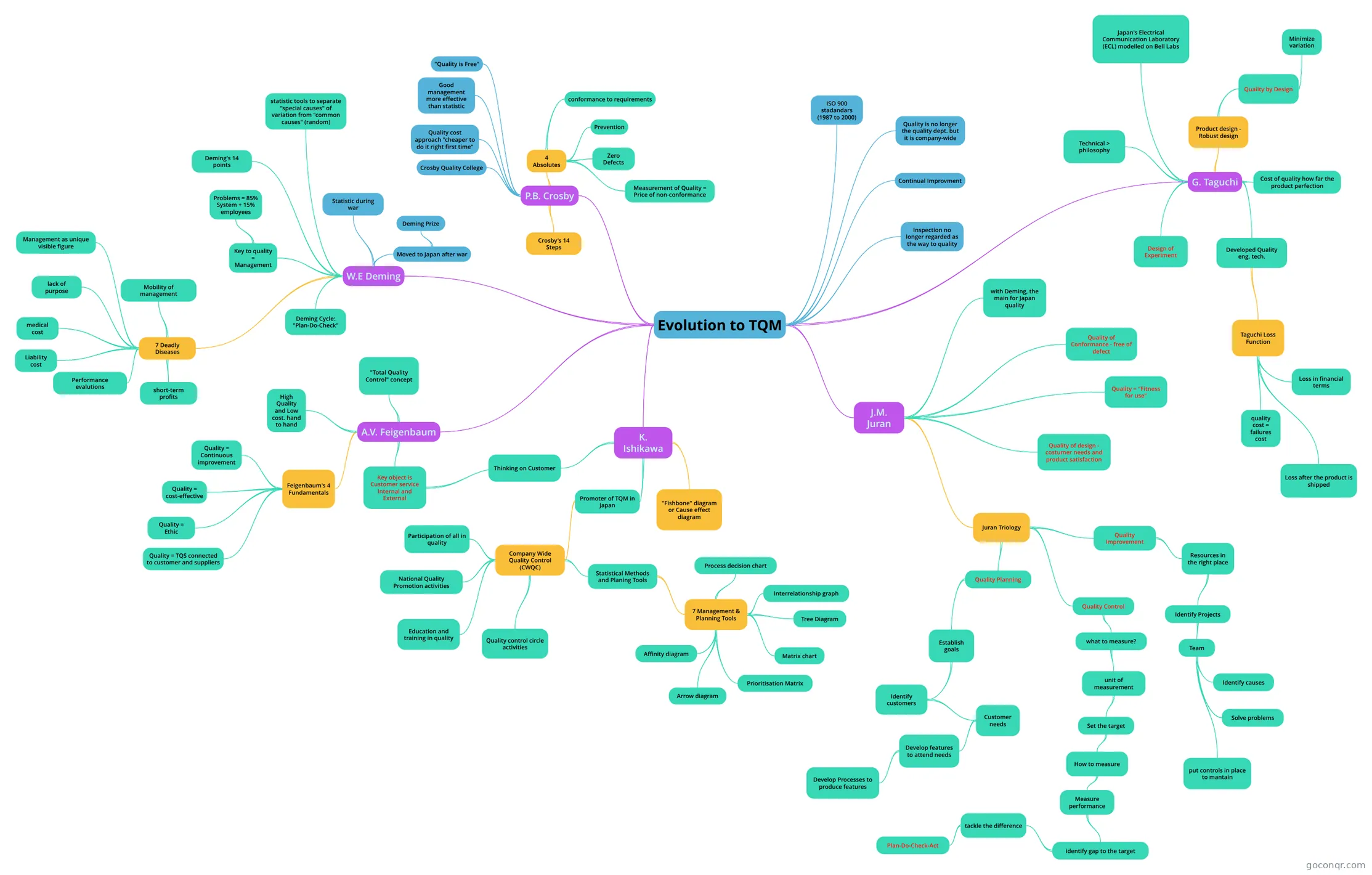
Mind map: Evolution to TQM
Conteúdo do mapa
Evolution to TQM
Inspection no longer regarded as the way to quality
Quality is no longer the quality dept. but it is company-wide
Continual Improvment
ISO 900 stadandars (1987 to 2000)
P.B. Crosby
- "Quality is Free"
- Quality cost approach "cheaper to do it right first time"
- Crosby Quality College
- Good management more effective than statistic
- 4 Absolutes
- conformance to requirements
- Prevention
- Zero Defects
- Measurement of Quality = Price of non-conformance
- Crosby's 14 Steps
- Management commitment Top Management must committed to quality and communicated downward their understandings by written policy. Everyone is expected to perform according to the requirements of the company and the customers need. Quality improvement team Figure out a team of department head to oversee and judge improvement in their concern departments and in the company as a whole. Quality measurement Certain measurement should establish appropriate to all the activities in order to identify areas where improvement in needed. Cost of quality Estimation the costs of quality in order to point out areas where improvement would be profitable. Quality awareness Employees are the backbone of any process or change. Manage must raise quality awareness among employees. They must know the importance of product performance and cost of non-conformance. Corrective action Take positive and correct steps to solve the problems identified from previous steps. Zero defects planning. Figure out a committee, which will plan program suitable to the company and its culture. Supervisor training A training program should in place for all levels of management that how to implement their part in the quality improvement program. Zero defect day Schedule a day to indicate employees that the company has a new standard. Goal setting Individuals should establish improvement goals for themselves as well as for their groups. Error-cause removal If any problem that prevent employees from performing error free work there should be clean policy to inform top management. Recognition Those who meet their goals efficiently and effectively, they must be rewarded. Quality counsel Consist of quality professionals and team leaders, quality councils should meet on regular basis to share their experiences, problems and ideas Do it all over again Repeat again and again step 1 to 13 and emphasis a continuous process of quality improvement.
W.E Deming
- Statistic during war
- Moved to Japan after war
- Deming Prize
- Key to quality = Management
- Problems = 85% System + 15% employees
- statistic tools to separate "special causes" of variation from "common causes" (random)
- Deming Cycle: "Plan-Do-Check"
- Deming's 14 points
- 1. Create constancy of purpose toward improvement of product and service, with the aim to become competitive and to stay in business, and to provide jobs. 2. Adopt the new philosophy. We are in a new economic age. Western management must awaken to the challenge, must learn their responsibilities, and take on leadership for change. 3. Cease dependence on inspection to achieve quality. Eliminate the need for inspection on a mass basis by building quality into the product in the first place. 4. End the practice of awarding business on the basis of price tag. Instead, minimize total cost. Move toward a single supplier for any one item, on a long-term relationship of loyalty and trust. 5. Improve constantly and forever the system of production and service, to improve quality and productivity, and thus constantly decrease costs. 6. Institute training on the job. 7. Institute leadership (see Point 12 and Ch. 8). The aim of supervision should be to help people and machines and gadgets to do a better job. Supervision of management is in need of overhaul, as well as supervision of production workers. 8. Drive out fear, so that everyone may work effectively for the company (see Ch. 3). 9. Break down barriers between departments. People in research, design, sales, and production must work as a team, to foresee problems of production and in use that may be encountered with the product or service. 10. Eliminate slogans, exhortations, and targets for the work force asking for zero defects and new levels of productivity. Such exhortations only create adversarial relationships, as the bulk of the causes of low quality and low productivity belong to the system and thus lie beyond the power of the work force. Eliminate work standards (quotas) on the factory floor. Substitute leadership.Eliminate management by objective. Eliminate management by numbers, numerical goals. Substitute leadership. 11. Remove barriers that rob the hourly worker of his right to pride of workmanship. The responsibility of supervisors must be changed from sheer numbers to quality. 12. Remove barriers that rob people in management and in engineering of their right to pride of workmanship. This means, inter alia, abolishment of the annual or merit rating and of management by objective (see Ch. 3). 13. Institute a vigorous program of education and self-improvement. 14. Put everybody in the company to work to accomplish the transformation. The transformation is everybody's job.
- 7 Deadly Diseases
- 1. Lack of constancy of purpose to plan product and service that will have a market and keep the company in business, and provide jobs. 2. Emphasis on short-term profits: short-term thinking (just the opposite from constancy of purpose to stay in business), fed by fear of unfriendly takeover, and by push from bankers and owners for dividends. 3. Evaluation of performance, merit rating, or annual review. 4. Mobility of management; job hopping. 5. Management by use only of visible figures, with little or no consideration of figures that are unknown or unknowable. 6. Excessive medical costs. 7. Excessive costs of liability, swelled by lawyers that work on contingency fees.
- lack of purpose
- short-term profits
- Performance evalutions
- Mobility of management
- Management as unique visible figure
- medical cost
- Liability cost
A.V. Feigenbaum
- "Total Quality Control" concept
- Key object is Customer service Internal and External
- High Quality and Low cost. hand to hand
- Feigenbaum's 4 Fundamentals
- Quality = Ethic
- Quality = Continuous improvement
- Quality = cost-effective
- Quality = TQS connected to customer and suppliers
K. Ishikawa
- Promoter of TQM in Japan
- Company Wide Quality Control (CWQC)
- Participation of all in quality
- Education and training in quality
- Quality control circle activities
- Statistical Methods and Planing Tools
- 7 Management & Planning Tools
- Affinity diagram
- Arrow diagram
- Matrix chart
- Prioritisation Matrix
- Process decision chart
- Interrelationship graph
- Tree Diagram
- 7 Management & Planning Tools
- National Quality Promotion activities
- Company Wide Quality Control (CWQC)
- Thinking on Customer
- "Fishbone" diagram or Cause effect diagram
- Promoter of TQM in Japan
J.M. Juran
- with Deming, the main for Japan quality
- Quality = "Fitness for use"
- Quality of design - costumer needs and product satisfaction
- Quality of Conformance - free of defect
- Juran Triology
- Quality Planning
- Establish goals
- Identify customers
- Customer needs
- Develop features to attend needs
- Develop Processes to produce features
- Develop features to attend needs
- Customer needs
- Identify customers
- Establish goals
- Quality Control
- what to measure?
- unit of measurement
- Set the target
- How to measure
- Measure performance
- identify gap to the target
- tackle the difference
- Plan-Do-Check-Act
- tackle the difference
- identify gap to the target
- Measure performance
- How to measure
- Set the target
- unit of measurement
- what to measure?
- Quality Improvement
- Resources in the right place
- Identify Projects
- Team
- Identify causes
- Solve problems
- put controls in place to mantain
- Team
- Identify Projects
- Resources in the right place
- Quality Planning
G. Taguchi
- Technical > philosophy
- Japan's Electrical Communication Laboratory (ECL) modelled on Bell Labs
- Developed Quality eng. tech.
- Taguchi Loss Function
- Loss in financial terms
- Loss after the product is shipped
- quality cost = failures cost
- Taguchi Loss Function
- Design of Experiment
- Product design - Robust design
- Quality by Design
- Minimize variation
- Quality by Design
- Cost of quality how far the product perfection
Informações
- Descrição
- Mapa Mental sobre Evolution to TQM, criado por togashi em 26-11-2015.
- Criado por
- togashi
- Visualizações
- 0
- Avaliação