
Mapa mental
Evolution by Natural Selection: Evidence, History and Adaptation
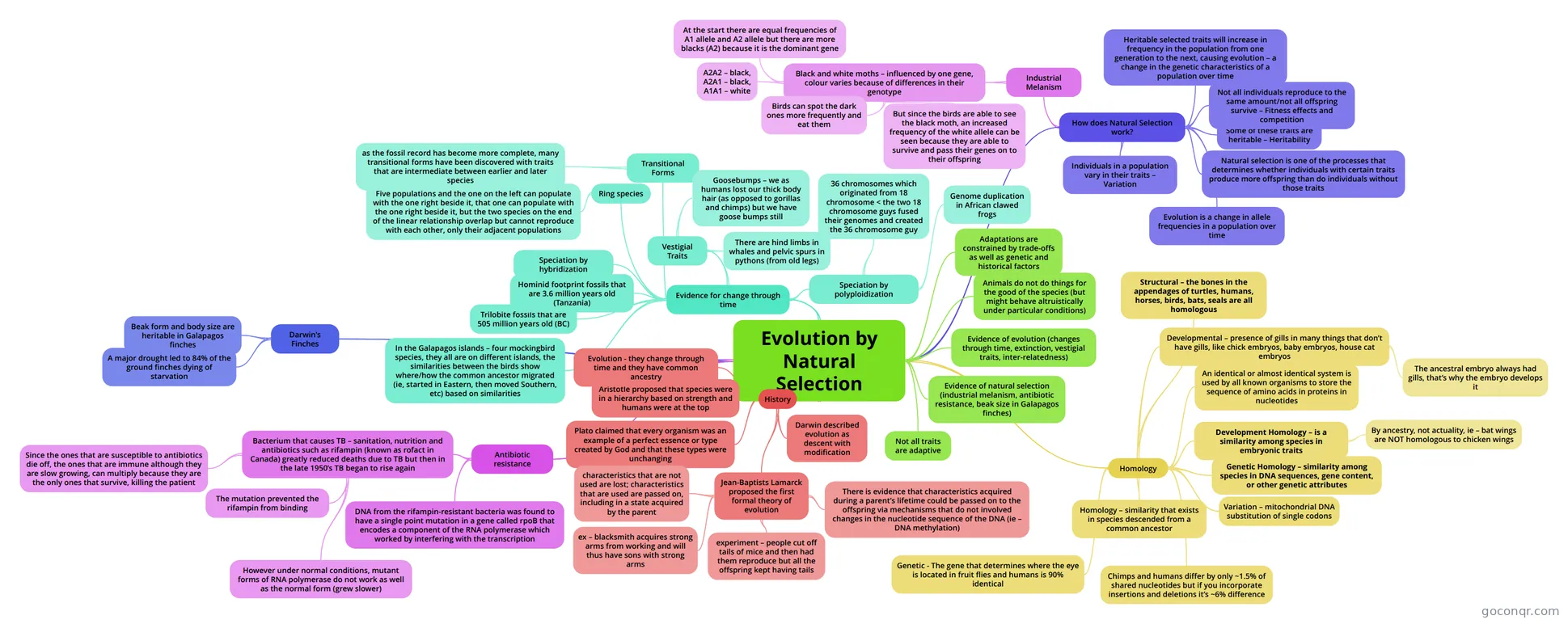
Mind map: Evolution by natural selection
Conteúdo do mapa
Evolution by Natural Selection
Evidence of evolution (changes through time, extinction, vestigial traits, inter-relatedness)
Evidence of natural selection (industrial melanism, antibiotic resistance, beak size in Galapagos finches)
Animals do not do things for the good of the species (but might behave altruistically under particular conditions)
Not all traits are adaptive
Adaptations are constrained by trade-offs as well as genetic and historical factors
History
- Plato claimed that every organism was an example of a perfect essence or type created by God and that these types were unchanging
- Aristotle proposed that species were in a hierarchy based on strength and humans were at the top
- Jean-Baptists Lamarck proposed the first formal theory of evolution
- characteristics that are not used are lost; characteristics that are used are passed on, including in a state acquired by the parent
- ex – blacksmith acquires strong arms from working and will thus have sons with strong arms
- experiment – people cut off tails of mice and then had them reproduce but all the offspring kept having tails
- There is evidence that characteristics acquired during a parent’s lifetime could be passed on to the offspring via mechanisms that do not involved changes in the nucleotide sequence of the DNA (ie – DNA methylation)
- Darwin described evolution as descent with modification
- Evolution - they change through time and they have common ancestry
Evidence for change through time
- Trilobite fossils that are 505 million years old (BC)
- Hominid footprint fossils that are 3.6 million years old (Tanzania)
- Speciation by hybridization
- Ring species
- Five populations and the one on the left can populate with the one right beside it, that one can populate with the one right beside it, but the two species on the end of the linear relationship overlap but cannot reproduce with each other, only their adjacent populations
- Speciation by polyploidization
- Genome duplication in African clawed frogs
- 36 chromosomes which originated from 18 chromosome < the two 18 chromosome guys fused their genomes and created the 36 chromosome guy
- Transitional Forms
- as the fossil record has become more complete, many transitional forms have been discovered with traits that are intermediate between earlier and later species
- Vestigial Traits
- Goosebumps – we as humans lost our thick body hair (as opposed to gorillas and chimps) but we have goose bumps still
- There are hind limbs in whales and pelvic spurs in pythons (from old legs)
- In the Galapagos islands – four mockingbird species, they all are on different islands, the similarities between the birds show where/how the common ancestor migrated (ie, started in Eastern, then moved Southern, etc) based on similarities
Homology
- Homology – similarity that exists in species descended from a common ancestor
- Genetic Homology – similarity among species in DNA sequences, gene content, or other genetic attributes
- Development Homology – is a similarity among species in embryonic traits
- By ancestry, not actuality, ie – bat wings are NOT homologous to chicken wings
- An identical or almost identical system is used by all known organisms to store the sequence of amino acids in proteins in nucleotides
- Variation – mitochondrial DNA substitution of single codons
- Chimps and humans differ by only ~1.5% of shared nucleotides but if you incorporate insertions and deletions it’s ~6% difference
- Genetic - The gene that determines where the eye is located in fruit flies and humans is 90% identical
- Developmental – presence of gills in many things that don’t have gills, like chick embryos, baby embryos, house cat embryos
- The ancestral embryo always had gills, that’s why the embryo develops it
- Structural – the bones in the appendages of turtles, humans, horses, birds, bats, seals are all homologous
How does Natural Selection work?
- Individuals in a population vary in their traits – Variation
- Some of these traits are heritable – Heritability
- Not all individuals reproduce to the same amount/not all offspring survive – Fitness effects and competition
- Natural selection is one of the processes that determines whether individuals with certain traits produce more offspring than do individuals without those traits
- Heritable selected traits will increase in frequency in the population from one generation to the next, causing evolution – a change in the genetic characteristics of a population over time
- Evolution is a change in allele frequencies in a population over time
- Industrial Melanism
- Black and white moths – influenced by one gene, colour varies because of differences in their genotype
- A2A2 – black, A2A1 – black, A1A1 – white
- Birds can spot the dark ones more frequently and eat them
- At the start there are equal frequencies of A1 allele and A2 allele but there are more blacks (A2) because it is the dominant gene
- But since the birds are able to see the black moth, an increased frequency of the white allele can be seen because they are able to survive and pass their genes on to their offspring
- Black and white moths – influenced by one gene, colour varies because of differences in their genotype
Antibiotic resistance
- Bacterium that causes TB – sanitation, nutrition and antibiotics such as rifampin (known as rofact in Canada) greatly reduced deaths due to TB but then in the late 1950’s TB began to rise again
- The mutation prevented the rifampin from binding
- However under normal conditions, mutant forms of RNA polymerase do not work as well as the normal form (grew slower)
- Since the ones that are susceptible to antibiotics die off, the ones that are immune although they are slow growing, can multiply because they are the only ones that survive, killing the patient
- DNA from the rifampin-resistant bacteria was found to have a single point mutation in a gene called rpoB that encodes a component of the RNA polymerase which worked by interfering with the transcription
- Bacterium that causes TB – sanitation, nutrition and antibiotics such as rifampin (known as rofact in Canada) greatly reduced deaths due to TB but then in the late 1950’s TB began to rise again
Darwin's Finches
- Beak form and body size are heritable in Galapagos finches
- A major drought led to 84% of the ground finches dying of starvation
Informações
- Descrição
- Mapa Mental sobre Sem título, criado por khans77 em 09-12-2013.
- Criado por
- khans77
- Visualizações
- 2
- Avaliação