
Mapa mental
Photosynthesis
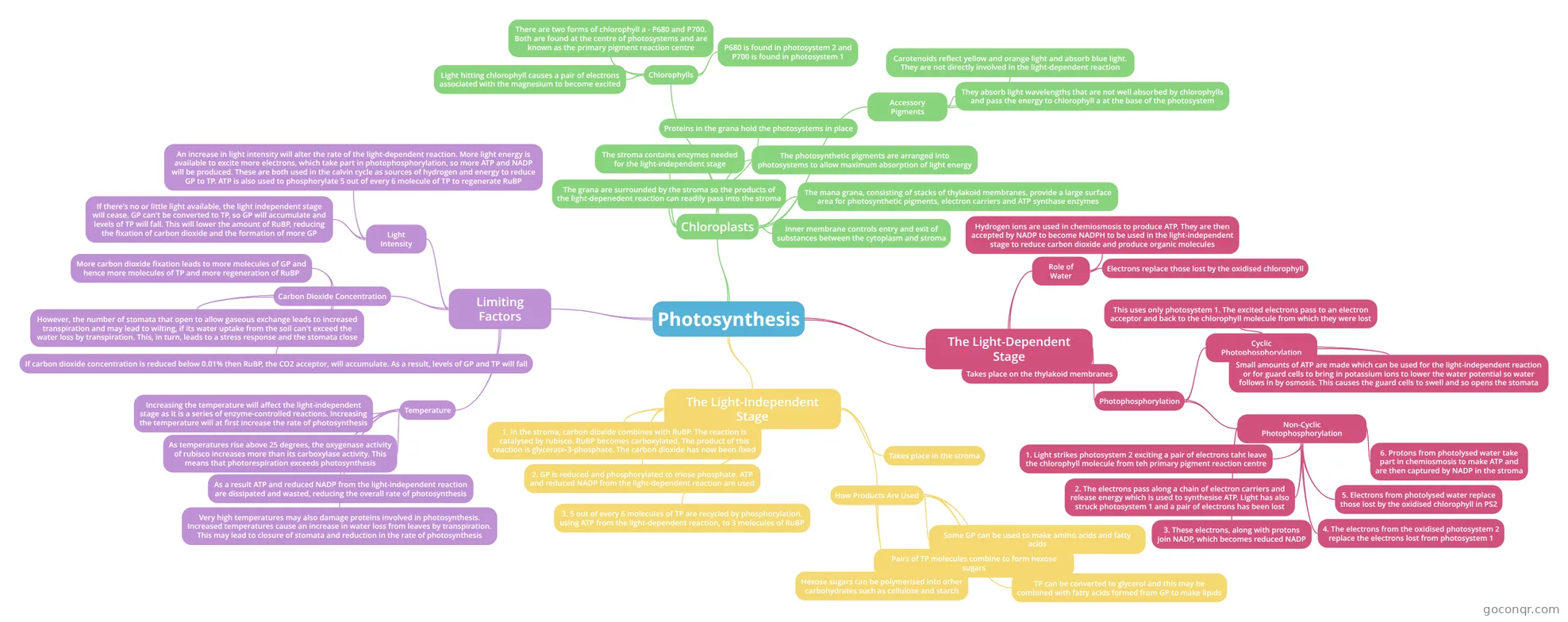
Mind map: Photosynthesis
Conteúdo do mapa
Photosynthesis
Chloroplasts
- Inner membrane controls entry and exit of substances between the cytoplasm and stroma
- The mana grana, consisting of stacks of thylakoid membranes, provide a large surface area for photosynthetic pigments, electron carriers and ATP synthase enzymes
- The photosynthetic pigments are arranged into photosystems to allow maximum absorption of light energy
- Proteins in the grana hold the photosystems in place
- The stroma contains enzymes needed for the light-independent stage
- The grana are surrounded by the stroma so the products of the light-depenedent reaction can readily pass into the stroma
- Chlorophylls
- Light hitting chlorophyll causes a pair of electrons associated with the magnesium to become excited
- There are two forms of chlorophyll a - P680 and P700. Both are found at the centre of photosystems and are known as the primary pigment reaction centre
- P680 is found in photosystem 2 and P700 is found in photosystem 1
- Accessory Pigments
- Carotenoids reflect yellow and orange light and absorb blue light. They are not directly involved in the light-dependent reaction
- They absorb light wavelengths that are not well absorbed by chlorophylls and pass the energy to chlorophyll a at the base of the photosystem
The Light-Dependent Stage
- Role of Water
- Hydrogen ions are used in chemiosmosis to produce ATP. They are then accepted by NADP to become NADPH to be used in the light-independent stage to reduce carbon dioxide and produce organic molecules
- Electrons replace those lost by the oxidised chlorophyll
- Photophosphorylation
- Cyclic Photophosphorylation
- This uses only photosystem 1. The excited electrons pass to an electron acceptor and back to the chlorophyll molecule from which they were lost
- Small amounts of ATP are made which can be used for the light-independent reaction or for guard cells to bring in potassium ions to lower the water potential so water follows in by osmosis. This causes the guard cells to swell and so opens the stomata
- Non-Cyclic Photophosphorylation
- 1. Light strikes photosystem 2 exciting a pair of electrons taht leave the chlorophyll molecule from teh primary pigment reaction centre
- 2. The electrons pass along a chain of electron carriers and release energy which is used to synthesise ATP. Light has also struck photosystem 1 and a pair of electrons has been lost
- 3. These electrons, along with protons join NADP, which becomes reduced NADP
- 4. The electrons from the oxidised photosystem 2 replace the electrons lost from photosystem 1
- 5. Electrons from photolysed water replace those lost by the oxidised chlorophyll in PS2
- 6. Protons from photolysed water take part in chemiosmosis to make ATP and are then captured by NADP in the stroma
- Cyclic Photophosphorylation
- Takes place on the thylakoid membranes
- Role of Water
The Light-Independent Stage
- Takes place in the stroma
- 1. In the stroma, carbon dioxide combines with RuBP. The reaction is catalysed by rubisco. RuBP becomes carboxylated. The product of this reaction is glycerate-3-phosphate. The carbon dioxide has now been fixed
- 2. GP is reduced and phosphorylated to triose phosphate. ATP and reduced NADP from the light-dependent reaction are used
- 3. 5 out of every 6 molecules of TP are recycled by phosphorylation, using ATP from the light-dependent reaction, to 3 molecules of RuBP
- How Products Are Used
- Some GP can be used to make amino acids and fatty acids
- Pairs of TP molecules combine to form hexose sugars
- Hexose sugars can be polymerised into other carbohydrates such as cellulose and starch
- TP can be converted to glycerol and this may be combined with fatty acids formed from GP to make lipids
Limiting Factors
- Light Intensity
- An increase in light intensity will alter the rate of the light-dependent reaction. More light energy is available to excite more electrons, which take part in photophosphorylation, so more ATP and NADP will be produced. These are both used in the calvin cycle as sources of hydrogen and energy to reduce GP to TP. ATP is also used to phosphorylate 5 out of every 6 molecule of TP to regenerate RuBP
- If there's no or little light available, the light independent stage will cease. GP can't be converted to TP, so GP will accumulate and levels of TP will fall. This will lower the amount of RuBP, reducing the fixation of carbon dioxide and the formation of more GP
- Carbon Dioxide Concentration
- More carbon dioxide fixation leads to more molecules of GP and hence more molecules of TP and more regeneration of RuBP
- However, the number of stomata that open to allow gaseous exchange leads to increased transpiration and may lead to wilting, if its water uptake from the soil can't exceed the water loss by transpiration. This, in turn, leads to a stress response and the stomata close
- If carbon dioxide concentration is reduced below 0.01% then RuBP, the CO2 acceptor, will accumulate. As a result, levels of GP and TP will fall
- Temperature
- Increasing the temperature will affect the light-independent stage as it is a series of enzyme-controlled reactions. Increasing the temperature will at first increase the rate of photosynthesis
- As temperatures rise above 25 degrees, the oxygenase activity of rubisco increases more than its carboxylase activity. This means that photorespiration exceeds photosynthesis
- As a result ATP and reduced NADP from the light-independent reaction are dissipated and wasted, reducing the overall rate of photosynthesis
- Very high temperatures may also damage proteins involved in photosynthesis. Increased temperatures cause an increase in water loss from leaves by transpiration. This may lead to closure of stomata and reduction in the rate of photosynthesis
- Light Intensity
Informações
- Descrição
- Mapa Mental sobre Photosynthesis, criado por katiekenney11 em 06-01-2016.
- Criado por
- katiekenney11
- Visualizações
- 0
- Avaliação