
Mapa mental
Virtue Ethics
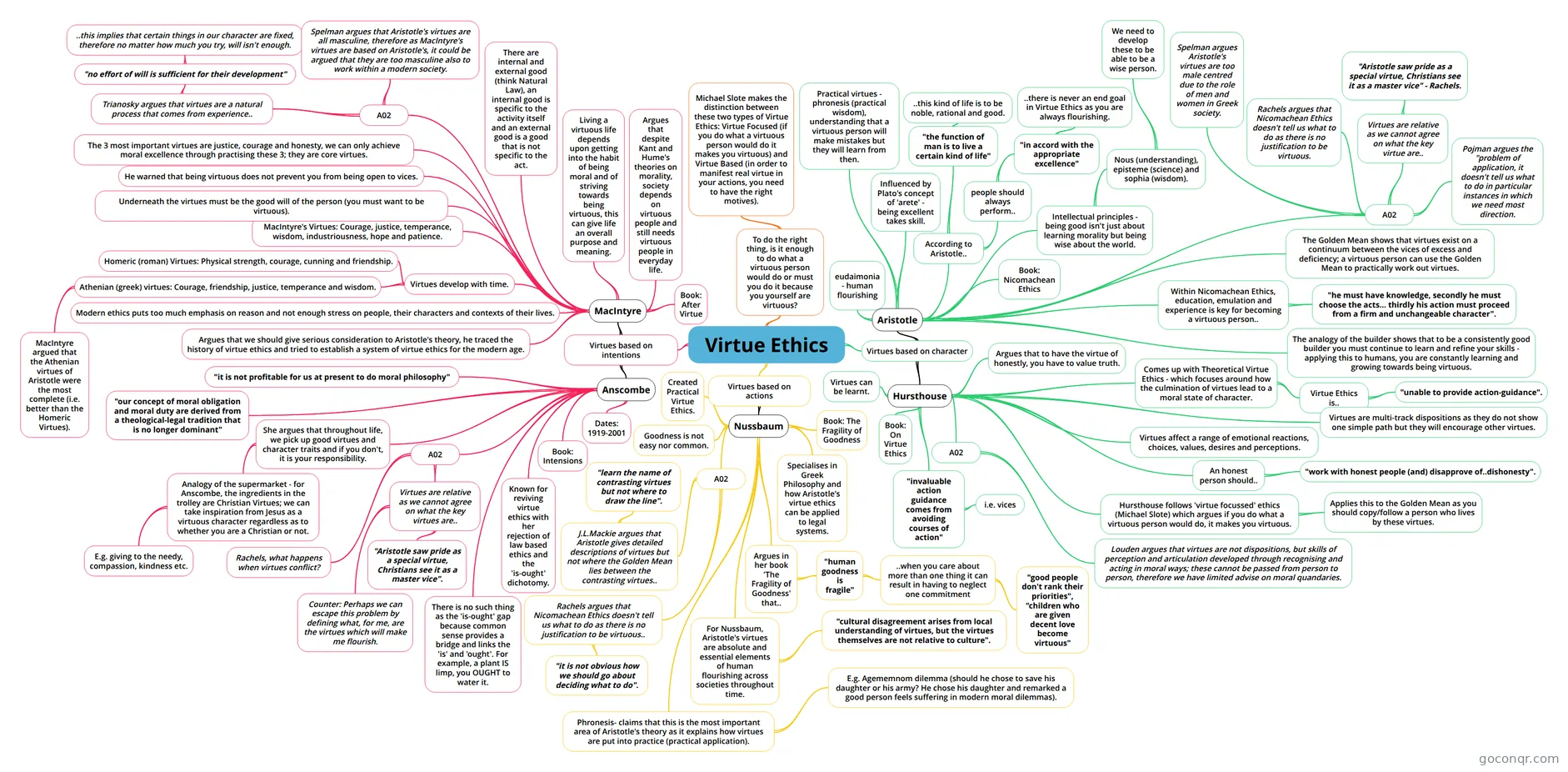
Mind map: Virtue ethics
Conteúdo do mapa
Virtue Ethics
Virtues based on character
- Aristotle
- Influenced by Plato's concept of 'arete' - being excellent takes skill.
- According to Aristotle..
- "the function of man is to live a certain kind of life"
- ..this kind of life is to be noble, rational and good.
- people should always perform..
- "in accord with the appropriate excellence"
- ..there is never an end goal in Virtue Ethics as you are always flourishing.
- "in accord with the appropriate excellence"
- "the function of man is to live a certain kind of life"
- Intellectual principles - being good isn't just about learning morality but being wise about the world.
- Nous (understanding), episteme (science) and sophia (wisdom).
- We need to develop these to be able to be a wise person.
- Nous (understanding), episteme (science) and sophia (wisdom).
- Practical virtues - phronesis (practical wisdom), understanding that a virtuous person will make mistakes but they will learn from then.
- The Golden Mean shows that virtues exist on a continuum between the vices of excess and deficiency; a virtuous person can use the Golden Mean to practically work out virtues.
- The analogy of the builder shows that to be a consistently good builder you must continue to learn and refine your skills - applying this to humans, you are constantly learning and growing towards being virtuous.
- eudaimonia - human flourishing
- Within Nicomachean Ethics, education, emulation and experience is key for becoming a virtuous person..
- "he must have knowledge, secondly he must choose the acts... thirdly his action must proceed from a firm and unchangeable character".
- A02
- Spelman argues Aristotle's virtues are too male centred due to the role of men and women in Greek society.
- Rachels argues that Nicomachean Ethics doesn't tell us what to do as there is no justification to be virtuous.
- Virtues are relative as we cannot agree on what the key virtue are..
- "Aristotle saw pride as a special virtue, Christians see it as a master vice" - Rachels.
- Pojman argues the "problem of application, it doesn't tell us what to do in particular instances in which we need most direction.
- Book: Nicomachean Ethics
- Hursthouse
- Comes up with Theoretical Virtue Ethics - which focuses around how the culmination of virtues lead to a moral state of character.
- Virtue Ethics is..
- "unable to provide action-guidance".
- Virtue Ethics is..
- Argues that to have the virtue of honestly, you have to value truth.
- Virtues are multi-track dispositions as they do not show one simple path but they will encourage other virtues.
- Virtues affect a range of emotional reactions, choices, values, desires and perceptions.
- An honest person should..
- "work with honest people (and) disapprove of..dishonesty".
- Hursthouse follows 'virtue focussed' ethics (Michael Slote) which argues if you do what a virtuous person would do, it makes you virtuous.
- Applies this to the Golden Mean as you should copy/follow a person who lives by these virtues.
- Virtues can be learnt.
- "invaluable action guidance comes from avoiding courses of action"
- i.e. vices
- A02
- Louden argues that virtues are not dispositions, but skills of perception and articulation developed through recognising and acting in moral ways; these cannot be passed from person to person, therefore we have limited advise on moral quandaries.
- Book: On Virtue Ethics
- Comes up with Theoretical Virtue Ethics - which focuses around how the culmination of virtues lead to a moral state of character.
- Aristotle
Virtues based on actions
- Nussbaum
- Book: The Fragility of Goodness
- Specialises in Greek Philosophy and how Aristotle's virtue ethics can be applied to legal systems.
- Created Practical Virtue Ethics.
- Argues in her book 'The Fragility of Goodness' that..
- "human goodness is fragile"
- ..when you care about more than one thing it can result in having to neglect one commitment
- "good people don't rank their priorities", "children who are given decent love become virtuous"
- ..when you care about more than one thing it can result in having to neglect one commitment
- "human goodness is fragile"
- Goodness is not easy nor common.
- For Nussbaum, Aristotle's virtues are absolute and essential elements of human flourishing across societies throughout time.
- "cultural disagreement arises from local understanding of virtues, but the virtues themselves are not relative to culture".
- Phronesis- claims that this is the most important area of Aristotle's theory as it explains how virtues are put into practice (practical application).
- E.g. Agememnom dilemma (should he chose to save his daughter or his army? He chose his daughter and remarked a good person feels suffering in modern moral dilemmas).
- A02
- J.L.Mackie argues that Aristotle gives detailed descriptions of virtues but not where the Golden Mean lies between the contrasting virtues..
- "learn the name of contrasting virtues but not where to draw the line".
- Rachels argues that Nicomachean Ethics doesn't tell us what to do as there is no justification to be virtuous..
- "it is not obvious how we should go about deciding what to do".
- J.L.Mackie argues that Aristotle gives detailed descriptions of virtues but not where the Golden Mean lies between the contrasting virtues..
- Nussbaum
Virtues based on intentions
- Anscombe
- Book: Intensions
- Dates: 1919-2001
- Known for reviving virtue ethics with her rejection of law based ethics and the 'is-ought' dichotomy.
- "it is not profitable for us at present to do moral philosophy"
- "our concept of moral obligation and moral duty are derived from a theological-legal tradition that is no longer dominant"
- There is no such thing as the 'is-ought' gap because common sense provides a bridge and links the 'is' and 'ought'. For example, a plant IS limp, you OUGHT to water it.
- She argues that throughout life, we pick up good virtues and character traits and if you don't, it is your responsibility.
- Analogy of the supermarket - for Anscombe, the ingredients in the trolley are Christian Virtues; we can take inspiration from Jesus as a virtuous character regardless as to whether you are a Christian or not.
- E.g. giving to the needy, compassion, kindness etc.
- Analogy of the supermarket - for Anscombe, the ingredients in the trolley are Christian Virtues; we can take inspiration from Jesus as a virtuous character regardless as to whether you are a Christian or not.
- A02
- Virtues are relative as we cannot agree on what the key virtues are..
- "Aristotle saw pride as a special virtue, Christians see it as a master vice".
- Counter: Perhaps we can escape this problem by defining what, for me, are the virtues which will make me flourish.
- Rachels, what happens when virtues conflict?
- Virtues are relative as we cannot agree on what the key virtues are..
- MacIntyre
- Book: After Virtue
- Argues that we should give serious consideration to Aristotle's theory, he traced the history of virtue ethics and tried to establish a system of virtue ethics for the modern age.
- Modern ethics puts too much emphasis on reason and not enough stress on people, their characters and contexts of their lives.
- Virtues develop with time.
- Homeric (roman) Virtues: Physical strength, courage, cunning and friendship.
- Athenian (greek) virtues: Courage, friendship, justice, temperance and wisdom.
- MacIntyre argued that the Athenian virtues of Aristotle were the most complete (i.e. better than the Homeric Virtues).
- Argues that despite Kant and Hume's theories on morality, society depends on virtuous people and still needs virtuous people in everyday life.
- Living a virtuous life depends upon getting into the habit of being moral and of striving towards being virtuous, this can give life an overall purpose and meaning.
- MacIntyre's Virtues: Courage, justice, temperance, wisdom, industriousness, hope and patience.
- Underneath the virtues must be the good will of the person (you must want to be virtuous).
- There are internal and external good (think Natural Law), an internal good is specific to the activity itself and an external good is a good that is not specific to the act.
- He warned that being virtuous does not prevent you from being open to vices.
- The 3 most important virtues are justice, courage and honesty, we can only achieve moral excellence through practising these 3; they are core virtues.
- A02
- Trianosky argues that virtues are a natural process that comes from experience..
- "no effort of will is sufficient for their development"
- ..this implies that certain things in our character are fixed, therefore no matter how much you try, will isn't enough.
- "no effort of will is sufficient for their development"
- Spelman argues that Aristotle's virtues are all masculine, therefore as MacIntyre's virtues are based on Aristotle's, it could be argued that they are too masculine also to work within a modern society.
- Trianosky argues that virtues are a natural process that comes from experience..
- Anscombe
To do the right thing, is it enough to do what a virtuous person would do or must you do it because you yourself are virtuous?
- Michael Slote makes the distinction between these two types of Virtue Ethics: Virtue Focused (if you do what a virtuous person would do it makes you virtuous) and Virtue Based (in order to manifest real virtue in your actions, you need to have the right motives).
Informações
- Descrição
- Mapa Mental sobre Virtue Ethics, criado por Libbie Davies em 07-01-2016.
- Criado por
- Libbie Davies
- Visualizações
- 0
- Histórico
-
- Criado por hollyhocks18 · 7 jan 2016
- Copiado por Libbie Davies · 7 jan 2016
- Avaliação
Mais sobre Aristotle's Nicomachean Ethics