
Mapa mental
1_Internal Factors for Class Differences in Achievement
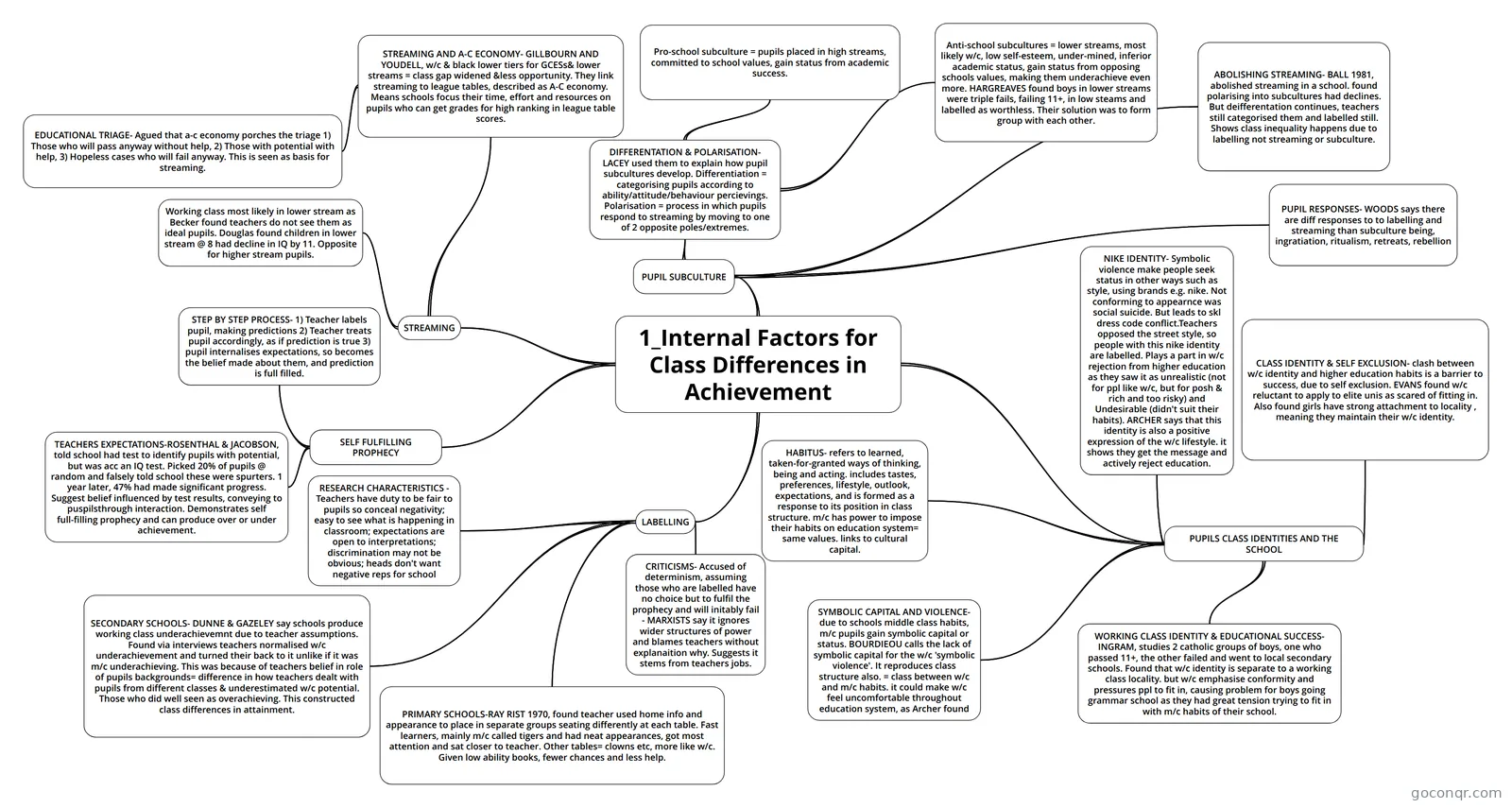
Mind map: internal factors for class differences in achievement
Conteúdo do mapa
1_Internal Factors for Class Differences in Achievement
LABELLING
- RESEARCH CHARACTERISTICS - Teachers have duty to be fair to pupils so conceal negativity; easy to see what is happening in classroom; expectations are open to interpretations; discrimination may not be obvious; heads don't want negative reps for school
- SECONDARY SCHOOLS- DUNNE & GAZELEY say schools produce working class underachievemnt due to teacher assumptions. Found via interviews teachers normalised w/c underachievement and turned their back to it unlike if it was m/c underachieving. This was because of teachers belief in role of pupils backgrounds= difference in how teachers dealt with pupils from different classes & underestimated w/c potential. Those who did well seen as overachieving. This constructed class differences in attainment.
- PRIMARY SCHOOLS-RAY RIST 1970, found teacher used home info and appearance to place in separate groups seating differently at each table. Fast learners, mainly m/c called tigers and had neat appearances, got most attention and sat closer to teacher. Other tables= clowns etc, more like w/c. Given low ability books, fewer chances and less help.
- CRITICISMS- Accused of determinism, assuming those who are labelled have no choice but to fulfil the prophecy and will initably fail - MARXISTS say it ignores wider structures of power and blames teachers without explanaition why. Suggests it stems from teachers jobs.
SELF FULFILLING PROPHECY
- STEP BY STEP PROCESS- 1) Teacher labels pupil, making predictions 2) Teacher treats pupil accordingly, as if prediction is true 3) pupil internalises expectations, so becomes the belief made about them, and prediction is full filled.
- TEACHERS EXPECTATIONS-ROSENTHAL & JACOBSON, told school had test to identify pupils with potential, but was acc an IQ test. Picked 20% of pupils @ random and falsely told school these were spurters. 1 year later, 47% had made significant progress. Suggest belief influenced by test results, conveying to puspilsthrough interaction. Demonstrates self full-filling prophecy and can produce over or under achievement.
STREAMING
- Working class most likely in lower stream as Becker found teachers do not see them as ideal pupils. Douglas found children in lower stream @ 8 had decline in IQ by 11. Opposite for higher stream pupils.
- STREAMING AND A-C ECONOMY- GILLBOURN AND YOUDELL, w/c & black lower tiers for GCESs& lower streams = class gap widened &less opportunity. They link streaming to league tables, described as A-C economy. Means schools focus their time, effort and resources on pupils who can get grades for high ranking in league table scores.
- EDUCATIONAL TRIAGE- Agued that a-c economy porches the triage 1) Those who will pass anyway without help, 2) Those with potential with help, 3) Hopeless cases who will fail anyway. This is seen as basis for streaming.
PUPIL SUBCULTURE
- DIFFERENTATION & POLARISATION- LACEY used them to explain how pupil subcultures develop. Differentiation = categorising pupils according to ability/attitude/behaviour percievings. Polarisation = process in which pupils respond to streaming by moving to one of 2 opposite poles/extremes.
- Pro-school subculture = pupils placed in high streams, committed to school values, gain status from academic success.
- Anti-school subcultures = lower streams, most likely w/c, low self-esteem, under-mined, inferior academic status, gain status from opposing schools values, making them underachieve even more. HARGREAVES found boys in lower streams were triple fails, failing 11+, in low steams and labelled as worthless. Their solution was to form group with each other.
- ABOLISHING STREAMING- BALL 1981, abolished streaming in a school. found polarising into subcultures had declines. But deifferentation continues, teachers still categorised them and labelled still. Shows class inequality happens due to labelling not streaming or subculture.
- PUPIL RESPONSES- WOODS says there are diff responses to to labelling and streaming than subculture being, ingratiation, ritualism, retreats, rebellion
- DIFFERENTATION & POLARISATION- LACEY used them to explain how pupil subcultures develop. Differentiation = categorising pupils according to ability/attitude/behaviour percievings. Polarisation = process in which pupils respond to streaming by moving to one of 2 opposite poles/extremes.
PUPILS CLASS IDENTITIES AND THE SCHOOL
- HABITUS- refers to learned, taken-for-granted ways of thinking, being and acting. includes tastes, preferences, lifestyle, outlook, expectations, and is formed as a response to its position in class structure. m/c has power to impose their habits on education system= same values. links to cultural capital.
- SYMBOLIC CAPITAL AND VIOLENCE- due to schools middle class habits, m/c pupils gain symbolic capital or status. BOURDIEOU calls the lack of symbolic capital for the w/c 'symbolic violence'. It reproduces class structure also. = class between w/c and m/c habits. it could make w/c feel uncomfortable throughout education system, as Archer found
- NIKE IDENTITY- Symbolic violence make people seek status in other ways such as style, using brands e.g. nike. Not conforming to appearnce was social suicide. But leads to skl dress code conflict.Teachers opposed the street style, so people with this nike identity are labelled. Plays a part in w/c rejection from higher education as they saw it as unrealistic (not for ppl like w/c, but for posh & rich and too risky) and Undesirable (didn't suit their habits). ARCHER says that this identity is also a positive expression of the w/c lifestyle. it shows they get the message and actively reject education.
- WORKING CLASS IDENTITY & EDUCATIONAL SUCCESS- INGRAM, studies 2 catholic groups of boys, one who passed 11+, the other failed and went to local secondary schools. Found that w/c identity is separate to a working class locality. but w/c emphasise conformity and pressures ppl to fit in, causing problem for boys going grammar school as they had great tension trying to fit in with m/c habits of their school.
- CLASS IDENTITY & SELF EXCLUSION- clash between w/c identity and higher education habits is a barrier to success, due to self exclusion. EVANS found w/c reluctant to apply to elite unis as scared of fitting in. Also found girls have strong attachment to locality , meaning they maintain their w/c identity.
Informações
- Descrição
- A-Level Mujeres Mapa Mental sobre 1_Internal Factors for Class Differences in Achievement, criado por pri9494 em 07-01-2016.
- Criado por
- pri9494
- Visualizações
- 2
- Histórico
-
- Criado por pri9494 · 7 jan 2016
- Copiado por pri9494 · 7 jan 2016
- Avaliação
Mais sobre Internal Factors in Class Achievement