
Mapa mental
Situation Ethics
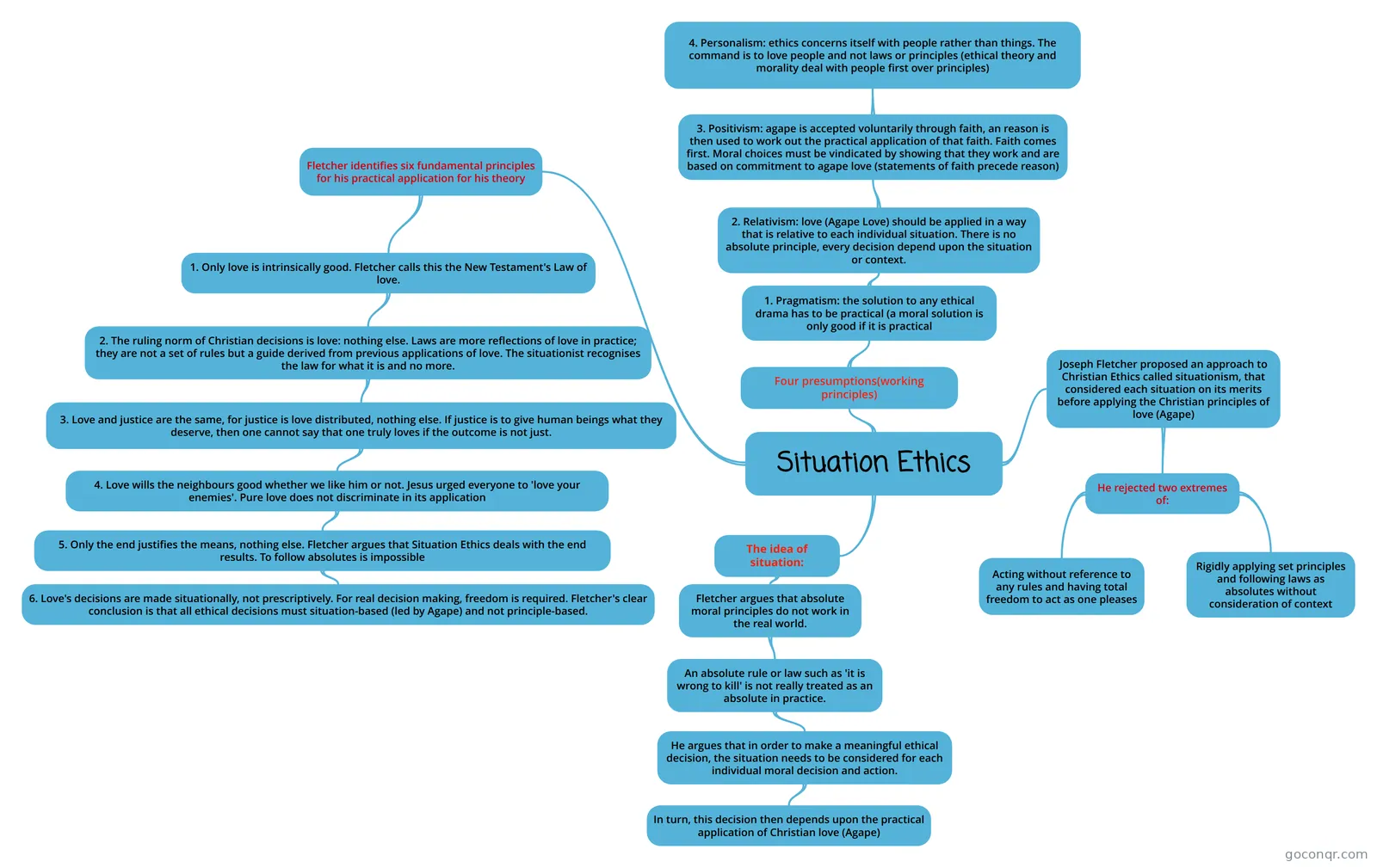
Mind map: Situation ethics
Conteúdo do mapa
Situation Ethics
Joseph Fletcher proposed an approach to Christian Ethics called situationism, that considered each situation on its merits before applying the Christian principles of love (Agape)
- He rejected two extremes of:
- Rigidly applying set principles and following laws as absolutes without consideration of context
- Acting without reference to any rules and having total freedom to act as one pleases
- He rejected two extremes of:
The idea of situation:
- Fletcher argues that absolute moral principles do not work in the real world.
- An absolute rule or law such as 'it is wrong to kill' is not really treated as an absolute in practice.
- He argues that in order to make a meaningful ethical decision, the situation needs to be considered for each individual moral decision and action.
- In turn, this decision then depends upon the practical application of Christian love (Agape)
- He argues that in order to make a meaningful ethical decision, the situation needs to be considered for each individual moral decision and action.
- An absolute rule or law such as 'it is wrong to kill' is not really treated as an absolute in practice.
- Fletcher argues that absolute moral principles do not work in the real world.
Four presumptions(working principles)
- 1. Pragmatism: the solution to any ethical drama has to be practical (a moral solution is only good if it is practical
- 2. Relativism: love (Agape Love) should be applied in a way that is relative to each individual situation. There is no absolute principle, every decision depend upon the situation or context.
- 3. Positivism: agape is accepted voluntarily through faith, an reason is then used to work out the practical application of that faith. Faith comes first. Moral choices must be vindicated by showing that they work and are based on commitment to agape love (statements of faith precede reason)
- 4. Personalism: ethics concerns itself with people rather than things. The command is to love people and not laws or principles (ethical theory and morality deal with people first over principles)
- 3. Positivism: agape is accepted voluntarily through faith, an reason is then used to work out the practical application of that faith. Faith comes first. Moral choices must be vindicated by showing that they work and are based on commitment to agape love (statements of faith precede reason)
- 2. Relativism: love (Agape Love) should be applied in a way that is relative to each individual situation. There is no absolute principle, every decision depend upon the situation or context.
- 1. Pragmatism: the solution to any ethical drama has to be practical (a moral solution is only good if it is practical
Fletcher identifies six fundamental principles for his practical application for his theory
- 1. Only love is intrinsically good. Fletcher calls this the New Testament's Law of love.
- 2. The ruling norm of Christian decisions is love: nothing else. Laws are more reflections of love in practice; they are not a set of rules but a guide derived from previous applications of love. The situationist recognises the law for what it is and no more.
- 3. Love and justice are the same, for justice is love distributed, nothing else. If justice is to give human beings what they deserve, then one cannot say that one truly loves if the outcome is not just.
- 4. Love wills the neighbours good whether we like him or not. Jesus urged everyone to 'love your enemies'. Pure love does not discriminate in its application
- 5. Only the end justifies the means, nothing else. Fletcher argues that Situation Ethics deals with the end results. To follow absolutes is impossible
- 6. Love's decisions are made situationally, not prescriptively. For real decision making, freedom is required. Fletcher's clear conclusion is that all ethical decisions must situation-based (led by Agape) and not principle-based.
- 5. Only the end justifies the means, nothing else. Fletcher argues that Situation Ethics deals with the end results. To follow absolutes is impossible
- 4. Love wills the neighbours good whether we like him or not. Jesus urged everyone to 'love your enemies'. Pure love does not discriminate in its application
- 3. Love and justice are the same, for justice is love distributed, nothing else. If justice is to give human beings what they deserve, then one cannot say that one truly loves if the outcome is not just.
- 2. The ruling norm of Christian decisions is love: nothing else. Laws are more reflections of love in practice; they are not a set of rules but a guide derived from previous applications of love. The situationist recognises the law for what it is and no more.
- 1. Only love is intrinsically good. Fletcher calls this the New Testament's Law of love.
Informações
- Descrição
- Mapa Mental sobre Situation Ethics, criado por kauira12 em 14-01-2016.
- Criado por
- kauira12
- Visualizações
- 0
- Avaliação