
Mapa mental
Stress
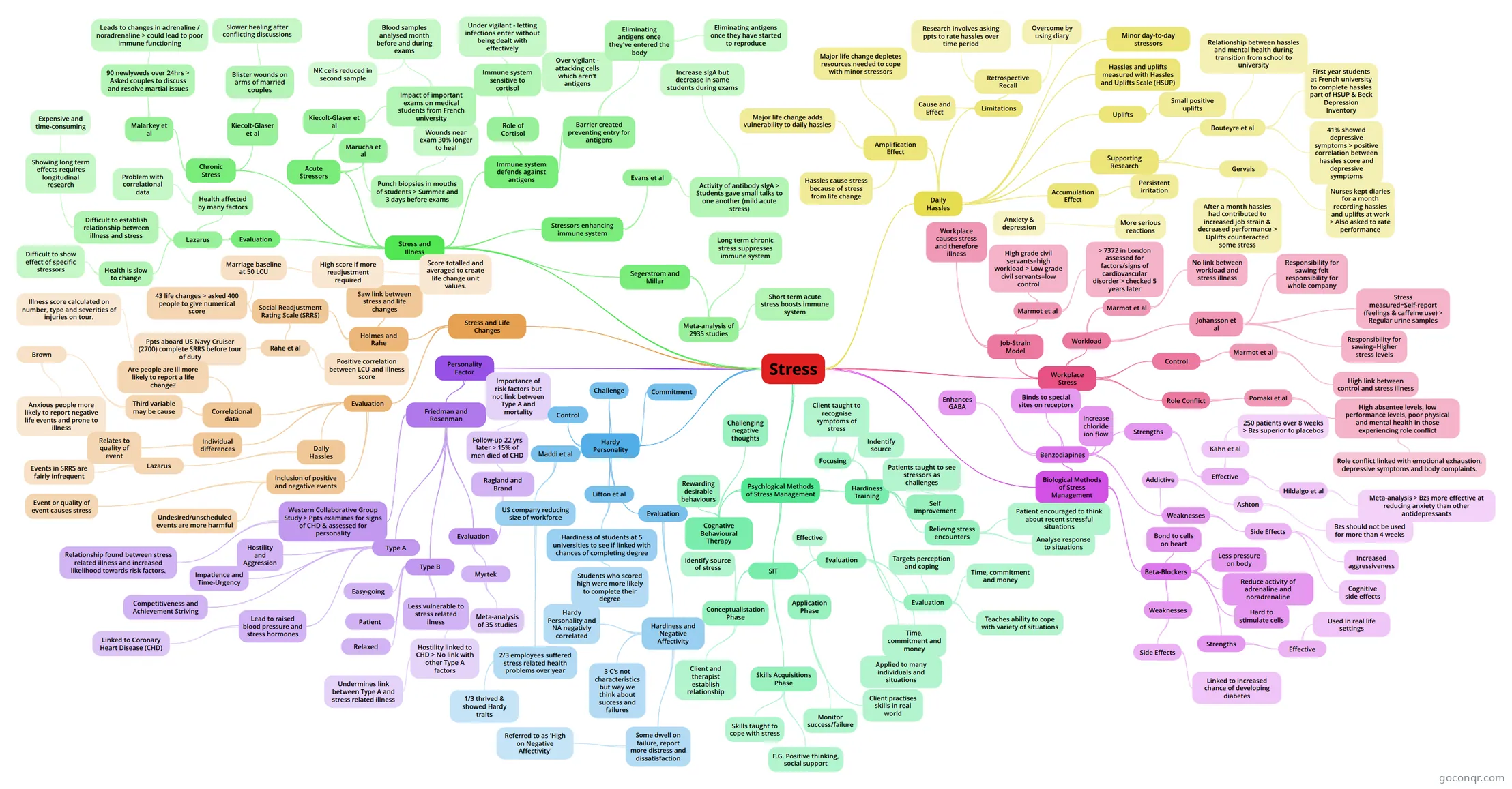
Mind map: Stress
Conteúdo do mapa
Stress
Daily Hassles
- Minor day-to-day stressors
- Uplifts
- Small positive uplifts
- Hassles and uplifts measured with Hassles and Uplifts Scale (HSUP)
- Supporting Research
- Bouteyre et al
- Relationship between hassles and mental health during transition from school to university
- First year students at French university to complete hassles part of HSUP & Beck Depression Inventory
- 41% showed depressive symptoms > positive correlation between hassles score and depressive symptoms
- Gervais
- Nurses kept diaries for a month recording hassles and uplifts at work > Also asked to rate performance
- After a month hassles had contributed to increased job strain & decreased performance > Uplifts counteracted some stress
- Bouteyre et al
- Accumulation Effect
- Persistent irritation
- More serious reactions
- Anxiety & depression
- More serious reactions
- Persistent irritation
- Amplification Effect
- Major life change adds vulnerability to daily hassles
- Major life change depletes resources needed to cope with minor stressors
- Hassles cause stress because of stress from life change
- Limitations
- Retrospective Recall
- Research involves asking ppts to rate hassles over time period
- Overcome by using diary
- Cause and Effect
- Retrospective Recall
Workplace Stress
- Job-Strain Model
- Workplace causes stress and therefore illness
- Marmot et al
- High grade civil servants=high workload > Low grade civil servants=low control
- > 7372 in London assessed for factors/signs of cardiovascular disorder > checked 5 years later
- Workload
- Marmot et al
- No link between workload and stress illness
- Johansson et al
- Responsibility for sawing felt responsibility for whole company
- Stress measured=Self-report (feelings & caffeine use) > Regular urine samples
- Responsibility for sawing=Higher stress levels
- Marmot et al
- Control
- Marmot et al
- High link between control and stress illness
- Marmot et al
- Role Conflict
- Pomaki et al
- High absentee levels, low performance levels, poor physical and mental health in those experiencing role conflict
- Role conflict linked with emotional exhaustion, depressive symptoms and body complaints.
- High absentee levels, low performance levels, poor physical and mental health in those experiencing role conflict
- Pomaki et al
- Job-Strain Model
Stress and Illness
- Immune system defends against antigens
- Role of Cortisol
- Immune system sensitive to cortisol
- Under vigilant - letting infections enter without being dealt with effectively
- Over vigilant - attacking cells which aren't antigens
- Immune system sensitive to cortisol
- Barrier created preventing entry for antigens
- Eliminating antigens once they've entered the body
- Eliminating antigens once they have started to reproduce
- Eliminating antigens once they've entered the body
- Role of Cortisol
- Acute Stressors
- Marucha et al
- Punch biopsies in mouths of students > Summer and 3 days before exams
- Wounds near exam 30% longer to heal
- Punch biopsies in mouths of students > Summer and 3 days before exams
- Kiecolt-Glaser et al
- Impact of important exams on medical students from French university
- Blood samples analysed month before and during exams
- NK cells reduced in second sample
- Blood samples analysed month before and during exams
- Impact of important exams on medical students from French university
- Marucha et al
- Chronic Stress
- Kiecolt-Glaser et al
- Blister wounds on arms of married couples
- Slower healing after conflicting discussions
- Blister wounds on arms of married couples
- Malarkey et al
- 90 newlyweds over 24hrs > Asked couples to discuss and resolve martial issues
- Leads to changes in adrenaline / noradrenaline > could lead to poor immune functioning
- 90 newlyweds over 24hrs > Asked couples to discuss and resolve martial issues
- Kiecolt-Glaser et al
- Stressors enhancing immune system
- Evans et al
- Activity of antibody sIgA > Students gave small talks to one another (mild acute stress)
- Increase sIgA but decrease in same students during exams
- Activity of antibody sIgA > Students gave small talks to one another (mild acute stress)
- Evans et al
- Segerstrom and Millar
- Meta-analysis of 2935 studies
- Long term chronic stress suppresses immune system
- Short term acute stress boosts immune system
- Meta-analysis of 2935 studies
- Evaluation
- Lazarus
- Difficult to establish relationship between illness and stress
- Showing long term effects requires longitudinal research
- Expensive and time-consuming
- Showing long term effects requires longitudinal research
- Health affected by many factors
- Problem with correlational data
- Health is slow to change
- Difficult to show effect of specific stressors
- Difficult to establish relationship between illness and stress
- Lazarus
- Immune system defends against antigens
Stress and Life Changes
- Holmes and Rahe
- Saw link between stress and life changes
- Social Readjustment Rating Scale (SRRS)
- Rahe et al
- Positive correlation between LCU and illness score
- Ppts aboard US Navy Cruiser (2700) complete SRRS before tour of duty
- Illness score calculated on number, type and severities of injuries on tour.
- 43 life changes > asked 400 people to give numerical score
- Marriage baseline at 50 LCU
- High score if more readjustment required
- Score totalled and averaged to create life change unit values.
- High score if more readjustment required
- Marriage baseline at 50 LCU
- Rahe et al
- Evaluation
- Daily Hassles
- Lazarus
- Events in SRRS are fairly infrequent
- Lazarus
- Inclusion of positive and negative events
- Event or quality of event causes stress
- Undesired/unscheduled events are more harmful
- Correlational data
- Are people are ill more likely to report a life change?
- Third variable may be cause
- Brown
- Anxious people more likely to report negative life events and prone to illness
- Brown
- Individual differences
- Relates to quality of event
- Daily Hassles
- Holmes and Rahe
Personality Factor
- Friedman and Rosenman
- Type A
- Impatience and Time-Urgency
- Competitiveness and Achievement Striving
- Hostility and Aggression
- Lead to raised blood pressure and stress hormones
- Linked to Coronary Heart Disease (CHD)
- Type B
- Patient
- Relaxed
- Easy-going
- Less vulnerable to stress related ilness
- Western Collaborative Group Study > Ppts examines for signs of CHD & assessed for personality
- Relationship found between stress related illness and increased likelihood towards risk factors.
- Evaluation
- Ragland and Brand
- Follow-up 22 yrs later > 15% of men died of CHD
- Importance of risk factors but not link between Type A and mortality
- Follow-up 22 yrs later > 15% of men died of CHD
- Myrtek
- Meta-analysis of 35 studies
- Hostility linked to CHD > No link with other Type A factors
- Undermines link between Type A and stress related illness
- Hostility linked to CHD > No link with other Type A factors
- Meta-analysis of 35 studies
- Ragland and Brand
- Type A
- Friedman and Rosenman
Hardy Personality
- Control
- Challenge
- Commitment
- Maddi et al
- US company reducing size of workforce
- 2/3 employees suffered stress related health problems over year
- 1/3 thrived & showed Hardy traits
- 2/3 employees suffered stress related health problems over year
- US company reducing size of workforce
- Lifton et al
- Hardiness of students at 5 universities to see if linked with chances of completing degree
- Students who scored high were more likely to complete their degree
- Hardiness of students at 5 universities to see if linked with chances of completing degree
- Evaluation
- Hardiness and Negative Affectivity
- 3 C's not characteristics but way we think about success and failures
- Some dwell on failure, report more distress and dissatisfaction
- Referred to as 'High on Negative Affectivity'
- Hardy Personality and NA negativly correlated
- Hardiness and Negative Affectivity
Psychlogical Methods of Stress Management
- Cognative Behavioural Therapy
- Challenging negative thoughts
- Rewarding desirable behaviours
- SIT
- Conceptualistation Phase
- Client and therapist establish relationship
- Identify source of stress
- Skills Acquisitions Phase
- Skills taught to cope with stress
- E.G. Positive thinking, social support
- Application Phase
- Client practises skills in real world
- Monitor success/failure
- Evaluation
- Applied to many individuals and situations
- Effective
- Time, commitment and money
- Conceptualistation Phase
- Hardiness Training
- Focusing
- Client taught to recognise symptoms of stress
- Indentify source
- Relievng stress encounters
- Patient encouraged to think about recent stressful situations
- Analyse response to situations
- Self Improvement
- Patients taught to see stressors as challenges
- Evaluation
- Targets perception and coping
- Time, commitment and money
- Teaches ability to cope with variety of situations
- Focusing
- Cognative Behavioural Therapy
Biological Methods of Stress Management
- Benzodiapines
- Enhances GABA
- Binds to special sites on receptors
- Increase chloride ion flow
- Strengths
- Effective
- Kahn et al
- 250 patients over 8 weeks > Bzs superior to placebos
- Hildalgo et al
- Meta-analysis > Bzs more effective at reducing anxiety than other antidepressants
- Kahn et al
- Effective
- Weaknesses
- Addictive
- Ashton
- Bzs should not be used for more than 4 weeks
- Ashton
- Side Effects
- Increased aggressiveness
- Cognitive side effects
- Addictive
- Beta-Blockers
- Reduce activity of adrenaline and noradrenaline
- Bond to cells on heart
- Hard to stimulate cells
- Less pressure on body
- Strengths
- Effective
- Used in real life settings
- Effective
- Weaknesses
- Side Effects
- Linked to increased chance of developing diabetes
- Side Effects
- Benzodiapines
Informações
- Descrição
- PSYA2 Mapa Mental sobre Stress, criado por doyea001 em 11-04-2013.
- Criado por
- doyea001
- Visualizações
- 102
- Tags
- Avaliação