
Mapa mental
Sensation and Perception
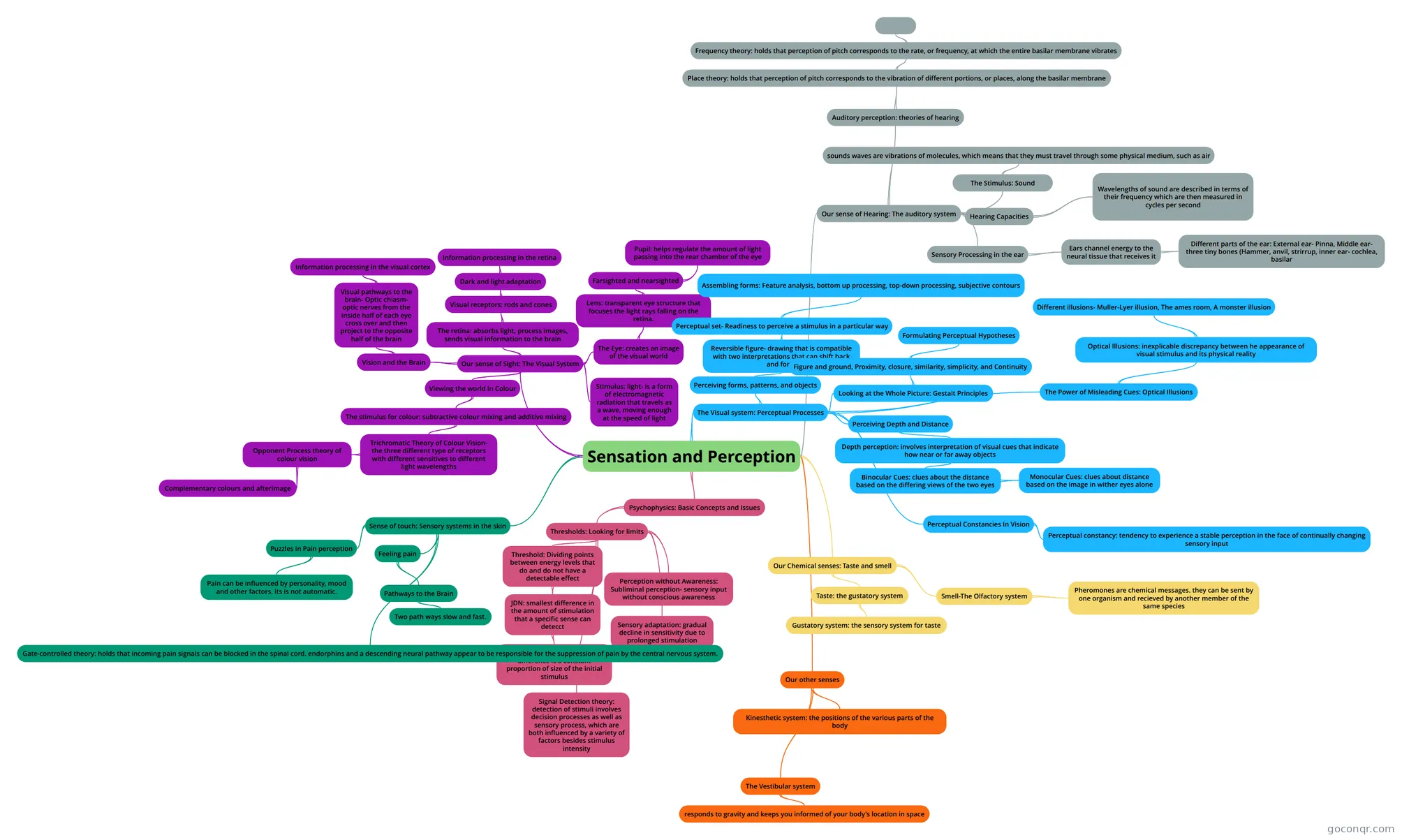
Mind map: Sensation and perception
Conteúdo do mapa
Sensation and Perception
Psychophysics: Basic Concepts and Issues
- Thresholds: Looking for limits
- Threshold: Dividing points between energy levels that do and do not have a detectable effect
- JDN: smallest difference in the amount of stimulation that a specific sense can detecct
- Weber's law: size of noticeable difference is a constant proportion of size of the initial stimulus
- JDN: smallest difference in the amount of stimulation that a specific sense can detecct
- Signal Detection theory: detection of stimuli involves decision processes as well as sensory process, which are both influenced by a variety of factors besides stimulus intensity
- Perception without Awareness: Subliminal perception- sensory input without conscious awareness
- Sensory adaptation: gradual decline in sensitivity due to prolonged stimulation
- Threshold: Dividing points between energy levels that do and do not have a detectable effect
- Thresholds: Looking for limits
Our sense of Sight: The Visual System
- Stimulus: light- is a form of electromagnetic radiation that travels as a wave, moving enough at the speed of light
- The Eye: creates an image of the visual world
- Lens: transparent eye structure that focuses the light rays falling on the retina.
- Farsighted and nearsighted
- Pupil: helps regulate the amount of light passing into the rear chamber of the eye
- Farsighted and nearsighted
- Lens: transparent eye structure that focuses the light rays falling on the retina.
- The retina: absorbs light, process images, sends visual information to the brain
- Visual receptors: rods and cones
- Dark and light adaptation
- Information processing in the retina
- Dark and light adaptation
- Visual receptors: rods and cones
- Vision and the Brain
- Visual pathways to the brain- Optic chiasm- optic nerves from the inside half of each eye cross over and then project to the opposite half of the brain
- Information processing in the visual cortex
- Visual pathways to the brain- Optic chiasm- optic nerves from the inside half of each eye cross over and then project to the opposite half of the brain
- Viewing the world in Colour
- The stimulus for colour: subtractive colour mixing and additive mixing
- Trichromatic Theory of Colour Vision- the three different type of receptors with different sensitives to different light wavelengths
- Opponent Process theory of colour vision
- Complementary colours and afterimage
- Opponent Process theory of colour vision
- Trichromatic Theory of Colour Vision- the three different type of receptors with different sensitives to different light wavelengths
- The stimulus for colour: subtractive colour mixing and additive mixing
The Visual system: Perceptual Processes
- Perceiving forms, patterns, and objects
- Reversible figure- drawing that is compatible with two interpretations that can shift back and forth
- Perceptual set- Readiness to perceive a stimulus in a particular way
- Assembling forms: Feature analysis, bottom up processing, top-down processing, subjective contours
- Perceptual set- Readiness to perceive a stimulus in a particular way
- Reversible figure- drawing that is compatible with two interpretations that can shift back and forth
- Looking at the Whole Picture: Gestait Principles
- Figure and ground, Proximity, closure, similarity, simplicity, and Continuity
- Formulating Perceptual Hypotheses
- Figure and ground, Proximity, closure, similarity, simplicity, and Continuity
- Perceiving Depth and Distance
- Depth perception: involves interpretation of visual cues that indicate how near or far away objects
- Binocular Cues: clues about the distance based on the differing views of the two eyes
- Monocular Cues: clues about distance based on the image in wither eyes alone
- Binocular Cues: clues about the distance based on the differing views of the two eyes
- Depth perception: involves interpretation of visual cues that indicate how near or far away objects
- Perceptual Constancies In Vision
- Perceptual constancy: tendency to experience a stable perception in the face of continually changing sensory input
- The Power of Misleading Cues: Optical Illusions
- Optical Illusions: inexplicable discrepancy between he appearance of visual stimulus and its physical reality
- Different illusions- Muller-Lyer illusion, The ames room, A monster illusion
- Optical Illusions: inexplicable discrepancy between he appearance of visual stimulus and its physical reality
- Perceiving forms, patterns, and objects
Our sense of Hearing: The auditory system
- The Stimulus: Sound
- sounds waves are vibrations of molecules, which means that they must travel through some physical medium, such as air
- Hearing Capacities
- Wavelengths of sound are described in terms of their frequency which are then measured in cycles per second
- Sensory Processing in the ear
- Ears channel energy to the neural tissue that receives it
- Different parts of the ear: External ear- Pinna, Middle ear- three tiny bones (Hammer, anvil, strirrup, inner ear- cochlea, basilar
- Ears channel energy to the neural tissue that receives it
- Auditory perception: theories of hearing
- Place theory: holds that perception of pitch corresponds to the vibration of different portions, or places, along the basilar membrane
- Frequency theory: holds that perception of pitch corresponds to the rate, or frequency, at which the entire basilar membrane vibrates
- Frequency theory: holds that perception of pitch corresponds to the rate, or frequency, at which the entire basilar membrane vibrates
- Place theory: holds that perception of pitch corresponds to the vibration of different portions, or places, along the basilar membrane
- The Stimulus: Sound
Our Chemical senses: Taste and smell
- Taste: the gustatory system
- Gustatory system: the sensory system for taste
- Smell-The Olfactory system
- Pheromones are chemical messages. they can be sent by one organism and recieved by another member of the same species
- Taste: the gustatory system
Sense of touch: Sensory systems in the skin
- Feeling pain
- Pathways to the Brain
- Two path ways slow and fast.
- Pathways to the Brain
- Puzzles in Pain perception
- Pain can be influenced by personality, mood and other factors. its is not automatic.
- Gate-controlled theory: holds that incoming pain signals can be blocked in the spinal cord. endorphins and a descending neural pathway appear to be responsible for the suppression of pain by the central nervous system.
- Feeling pain
Our other senses
- Kinesthetic system: the positions of the various parts of the body
- The Vestibular system
- responds to gravity and keeps you informed of your body's location in space