
Mapa mental
Textual Analysis
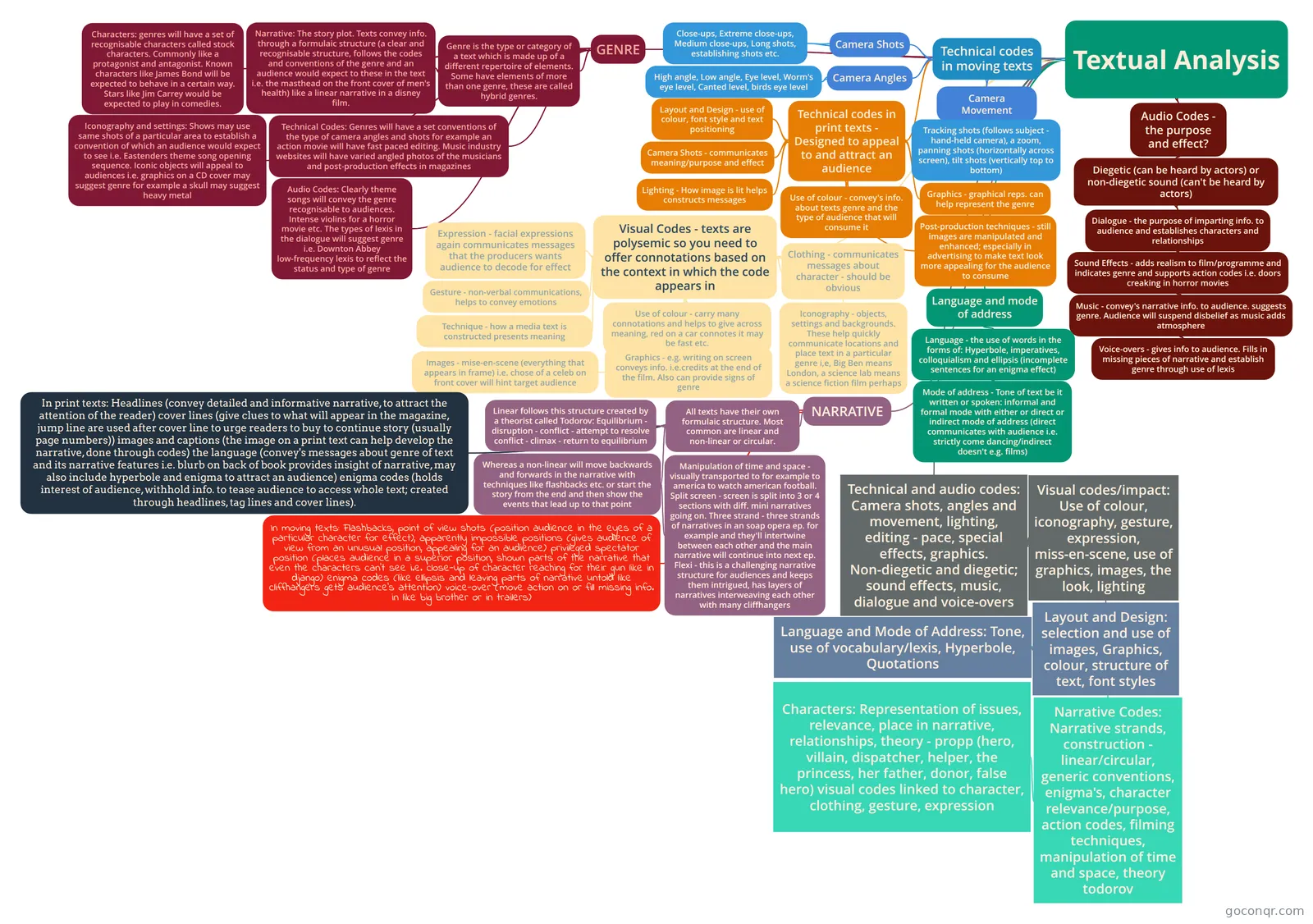
Mind map: Textual analysis
Conteúdo do mapa
Textual Analysis
Technical codes in moving texts
- Camera Shots
- Close-ups, Extreme close-ups, Medium close-ups, Long shots, establishing shots etc.
- Camera Angles
- High angle, Low angle, Eye level, Worm's eye level, Canted level, birds eye level
- Camera Movement
- Tracking shots (follows subject - hand-held camera), a zoom, panning shots (horizontally across screen), tilt shots (vertically top to bottom)
- Technical codes in print texts - Designed to appeal to and attract an audience
- Layout and Design - use of colour, font style and text positioning
- Camera Shots - communicates meaning/purpose and effect
- Lighting - How image is lit helps constructs messages
- Use of colour - convey's info. about texts genre and the type of audience that will consume it
- Graphics - graphical reps. can help represent the genre
- Post-production techniques - still images are manipulated and enhanced; especially in advertising to make text look more appealing for the audience to consume
- Camera Shots
Audio Codes - the purpose and effect?
- Diegetic (can be heard by actors) or non-diegetic sound (can't be heard by actors)
- Dialogue - the purpose of imparting info. to audience and establishes characters and relationships
- Sound Effects - adds realism to film/programme and indicates genre and supports action codes i.e. doors creaking in horror movies
- Music - convey's narrative info. to audience. suggests genre. Audience will suspend disbelief as music adds atmosphere
- Voice-overs - gives info to audience. Fills in missing pieces of narrative and establish genre through use of lexis
- Music - convey's narrative info. to audience. suggests genre. Audience will suspend disbelief as music adds atmosphere
- Sound Effects - adds realism to film/programme and indicates genre and supports action codes i.e. doors creaking in horror movies
- Dialogue - the purpose of imparting info. to audience and establishes characters and relationships
- Diegetic (can be heard by actors) or non-diegetic sound (can't be heard by actors)
Visual Codes - texts are polysemic so you need to offer connotations based on the context in which the code appears in
- Clothing - communicates messages about character - should be obvious
- Expression - facial expressions again communicates messages that the producers wants audience to decode for effect
- Gesture - non-verbal communications, helps to convey emotions
- Technique - how a media text is constructed presents meaning
- Use of colour - carry many connotations and helps to give across meaning, red on a car connotes it may be fast etc.
- Iconography - objects, settings and backgrounds. These help quickly communicate locations and place text in a particular genre i,e, Big Ben means London, a science lab means a science fiction film perhaps
- Images - mise-en-scene (everything that appears in frame) i.e. chose of a celeb on front cover will hint target audience
- Graphics - e.g. writing on screen conveys info. i.e.credits at the end of the film. Also can provide signs of genre
Language and mode of address
- Language - the use of words in the forms of: Hyperbole, imperatives, colloquialism and ellipsis (incomplete sentences for an enigma effect)
- Mode of address - Tone of text be it written or spoken: informal and formal mode with either or direct or indirect mode of address (direct communicates with audience i.e. strictly come dancing/indirect doesn't e.g. films)
- Language - the use of words in the forms of: Hyperbole, imperatives, colloquialism and ellipsis (incomplete sentences for an enigma effect)
GENRE
- Genre is the type or category of a text which is made up of a different repertoire of elements. Some have elements of more than one genre, these are called hybrid genres.
- Narrative: The story plot. Texts convey info. through a formulaic structure (a clear and recognisable structure, follows the codes and conventions of the genre and an audience would expect to these in the text i.e. the masthead on the front cover of men's health) like a linear narrative in a disney film.
- Characters: genres will have a set of recognisable characters called stock characters. Commonly like a protagonist and antagonist. Known characters like James Bond will be expected to behave in a certain way. Stars like Jim Carrey would be expected to play in comedies.
- Iconography and settings: Shows may use same shots of a particular area to establish a convention of which an audience would expect to see i.e. Eastenders theme song opening sequence. Iconic objects will appeal to audiences i.e. graphics on a CD cover may suggest genre for example a skull may suggest heavy metal
- Technical Codes: Genres will have a set conventions of the type of camera angles and shots for example an action movie will have fast paced editing. Music industry websites will have varied angled photos of the musicians and post-production effects in magazines
- Audio Codes: Clearly theme songs will convey the genre recognisable to audiences. Intense violins for a horror movie etc. The types of lexis in the dialogue will suggest genre i.e. Downton Abbey low-frequency lexis to reflect the status and type of genre
- Genre is the type or category of a text which is made up of a different repertoire of elements. Some have elements of more than one genre, these are called hybrid genres.
NARRATIVE
- All texts have their own formulaic structure. Most common are linear and non-linear or circular.
- Linear follows this structure created by a theorist called Todorov: Equilibrium - disruption - conflict - attempt to resolve conflict - climax - return to equilibrium
- Whereas a non-linear will move backwards and forwards in the narrative with techniques like flashbacks etc. or start the story from the end and then show the events that lead up to that point
- Manipulation of time and space - visually transported to for example to america to watch american football. Split screen - screen is split into 3 or 4 sections with diff. mini narratives going on. Three strand - three strands of narratives in an soap opera ep. for example and they'll intertwine between each other and the main narrative will continue into next ep. Flexi - this is a challenging narrative structure for audiences and keeps them intrigued, has layers of narratives interweaving each other with many cliffhangers
- In moving texts: Flashbacks, point of view shots (position audience in the eyes of a particular character for effect), apparently impossible positions (gives audience of view from an unusual position, appealing for an audience) privileged spectator position (places audience in a superior position, shown parts of the narrative that even the characters can't see i.e. close-up of character reaching for their gun like in django) enigma codes (like ellipsis and leaving parts of narrative untold like cliffhangers gets audience's attention) voice-over (move action on or fill missing info. in like big brother or in trailers)
- In print texts: Headlines (convey detailed and informative narrative, to attract the attention of the reader) cover lines (give clues to what will appear in the magazine, jump line are used after cover line to urge readers to buy to continue story (usually page numbers)) images and captions (the image on a print text can help develop the narrative, done through codes) the language (convey's messages about genre of text and its narrative features i.e. blurb on back of book provides insight of narrative, may also include hyperbole and enigma to attract an audience) enigma codes (holds interest of audience, withhold info. to tease audience to access whole text; created through headlines, tag lines and cover lines).
- All texts have their own formulaic structure. Most common are linear and non-linear or circular.
Technical and audio codes: Camera shots, angles and movement, lighting, editing - pace, special effects, graphics. Non-diegetic and diegetic; sound effects, music, dialogue and voice-overs
- Visual codes/impact: Use of colour, iconography, gesture, expression, miss-en-scene, use of graphics, images, the look, lighting
- Layout and Design: selection and use of images, Graphics, colour, structure of text, font styles
- Language and Mode of Address: Tone, use of vocabulary/lexis, Hyperbole, Quotations
- Narrative Codes: Narrative strands, construction - linear/circular, generic conventions, enigma's, character relevance/purpose, action codes, filming techniques, manipulation of time and space, theory todorov
- Characters: Representation of issues, relevance, place in narrative, relationships, theory - propp (hero, villain, dispatcher, helper, the princess, her father, donor, false hero) visual codes linked to character, clothing, gesture, expression
- Narrative Codes: Narrative strands, construction - linear/circular, generic conventions, enigma's, character relevance/purpose, action codes, filming techniques, manipulation of time and space, theory todorov
- Language and Mode of Address: Tone, use of vocabulary/lexis, Hyperbole, Quotations
Informações
- Descrição
- Mapa Mental sobre Textual Analysis, criado por Claire Cotter em 31-03-2016.
- Criado por
- Claire Cotter
- Visualizações
- 0
- Avaliação