
Mapa mental
Natural Selection and Evolution
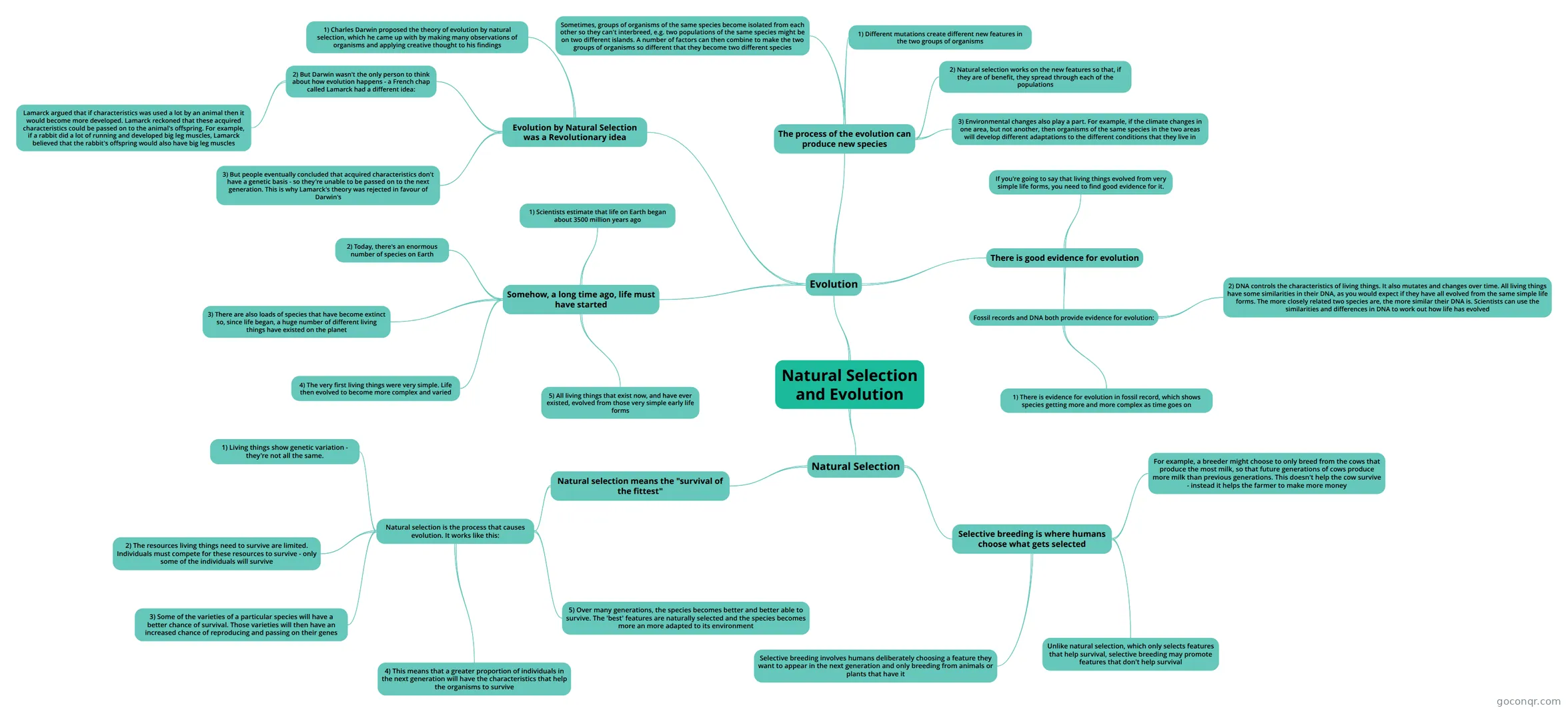
Mind map: Natural selection and evolution
Conteúdo do mapa
Natural Selection and Evolution
Natural Selection
- Natural selection means the "survival of the fittest"
- Natural selection is the process that causes evolution. It works like this:
- 1) Living things show genetic variation - they're not all the same.
- 2) The resources living things need to survive are limited. Individuals must compete for these resources to survive - only some of the individuals will survive
- 3) Some of the varieties of a particular species will have a better chance of survival. Those varieties will then have an increased chance of reproducing and passing on their genes
- 4) This means that a greater proportion of individuals in the next generation will have the characteristics that help the organisms to survive
- 5) Over many generations, the species becomes better and better able to survive. The 'best' features are naturally selected and the species becomes more an more adapted to its environment
- Natural selection is the process that causes evolution. It works like this:
- Selective breeding is where humans choose what gets selected
- Selective breeding involves humans deliberately choosing a feature they want to appear in the next generation and only breeding from animals or plants that have it
- Unlike natural selection, which only selects features that help survival, selective breeding may promote features that don't help survival
- For example, a breeder might choose to only breed from the cows that produce the most milk, so that future generations of cows produce more milk than previous generations. This doesn't help the cow survive - instead it helps the farmer to make more money
- Natural selection means the "survival of the fittest"
Evolution
- Somehow, a long time ago, life must have started
- 1) Scientists estimate that life on Earth began about 3500 million years ago
- 2) Today, there's an enormous number of species on Earth
- 3) There are also loads of species that have become extinct so, since life began, a huge number of different living things have existed on the planet
- 4) The very first living things were very simple. Life then evolved to become more complex and varied
- 5) All living things that exist now, and have ever existed, evolved from those very simple early life forms
- The process of the evolution can produce new species
- Sometimes, groups of organisms of the same species become isolated from each other so they can't interbreed, e.g. two populations of the same species might be on two different islands. A number of factors can then combine to make the two groups of organisms so different that they become two different species
- 1) Different mutations create different new features in the two groups of organisms
- 2) Natural selection works on the new features so that, if they are of benefit, they spread through each of the populations
- 3) Environmental changes also play a part. For example, if the climate changes in one area, but not another, then organisms of the same species in the two areas will develop different adaptations to the different conditions that they live in
- There is good evidence for evolution
- If you're going to say that living things evolved from very simple life forms, you need to find good evidence for it.
- Fossil records and DNA both provide evidence for evolution:
- 1) There is evidence for evolution in fossil record, which shows species getting more and more complex as time goes on
- 2) DNA controls the characteristics of living things. It also mutates and changes over time. All living things have some similarities in their DNA, as you would expect if they have all evolved from the same simple life forms. The more closely related two species are, the more similar their DNA is. Scientists can use the similarities and differences in DNA to work out how life has evolved
- Evolution by Natural Selection was a Revolutionary idea
- 1) Charles Darwin proposed the theory of evolution by natural selection, which he came up with by making many observations of organisms and applying creative thought to his findings
- 2) But Darwin wasn't the only person to think about how evolution happens - a French chap called Lamarck had a different idea:
- Lamarck argued that if characteristics was used a lot by an animal then it would become more developed. Lamarck reckoned that these acquired characteristics could be passed on to the animal's offspring. For example, if a rabbit did a lot of running and developed big leg muscles, Lamarck believed that the rabbit's offspring would also have big leg muscles
- 3) But people eventually concluded that acquired characteristics don't have a genetic basis - so they're unable to be passed on to the next generation. This is why Lamarck's theory was rejected in favour of Darwin's
- Somehow, a long time ago, life must have started
Informações
- Descrição
- Mapa Mental sobre Natural Selection and Evolution, criado por ygreent12 em 01-04-2016.
- Criado por
- ygreent12
- Visualizações
- 0
- Avaliação