
Mapa mental
English language Teaching Methodology
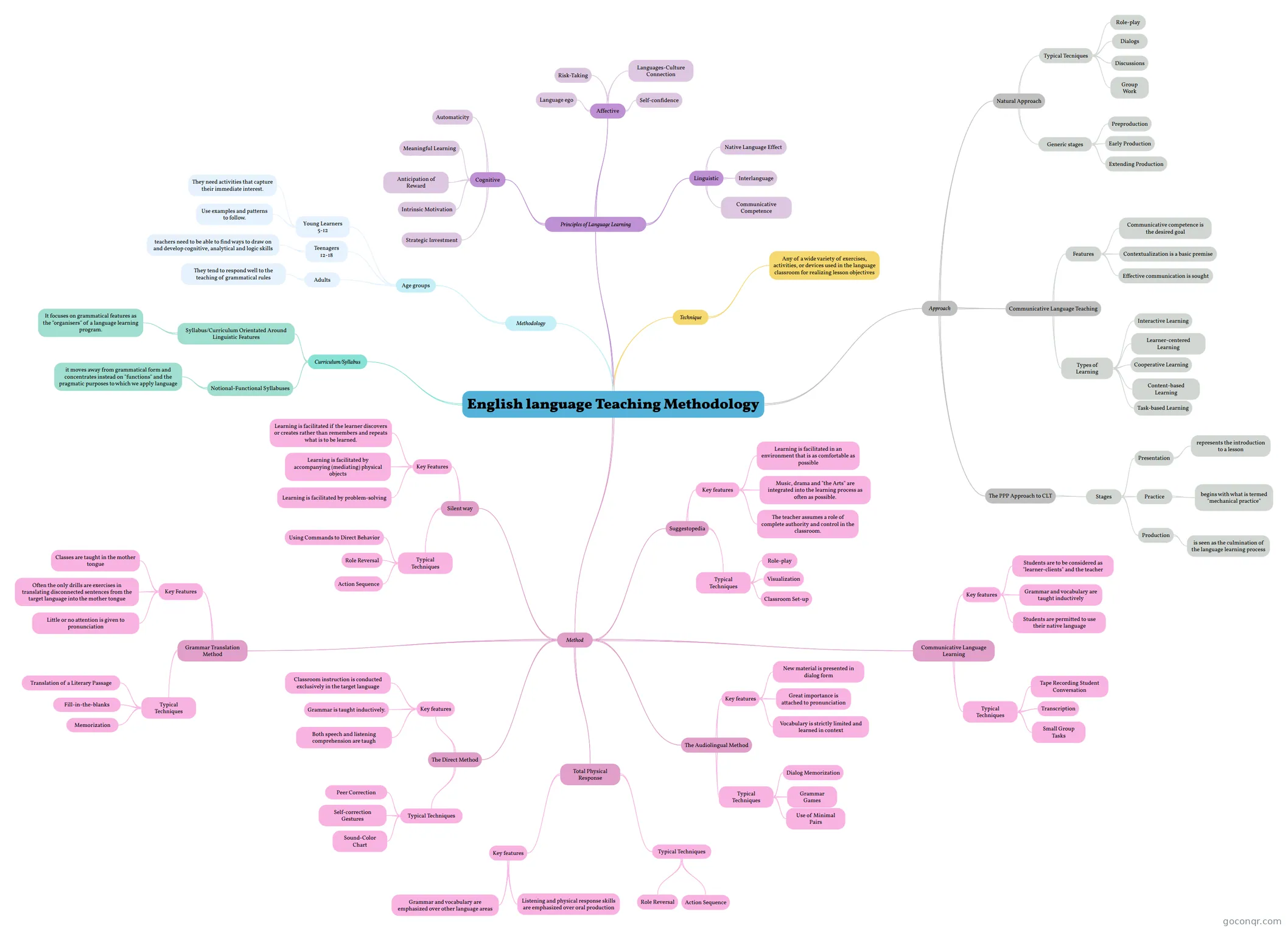
Mind map: English language teaching methodology
Conteúdo do mapa
English language Teaching Methodology
Methodology
- study of pedagogical practices
- Age groups
- Young Learners 5-12
- Use examples and patterns to follow.
- They need activities that capture their immediate interest.
- Teenagers 12-18
- teachers need to be able to find ways to draw on and develop cognitive, analytical and logic skills
- Adults
- They tend to respond well to the teaching of grammatical rules
- Young Learners 5-12
Curriculum/Syllabus
- Designs for carrying out a particular language program
- Syllabus/Curriculum Orientated Around Linguistic Features
- It focuses on grammatical features as the "organisers" of a language learning program.
- Notional-Functional Syllabuses
- it moves away from grammatical form and concentrates instead on "functions" and the pragmatic purposes to which we apply language
Principles of Language Learning
- Principles are seen as theory derived from research, to which teachers need to match classroom practices.
- Cognitive
- Automaticity
- Strategic Investment
- Meaningful Learning
- Intrinsic Motivation
- Anticipation of Reward
- Affective
- Language ego
- Self-confidence
- Risk-Taking
- Languages-Culture Connection
- Linguistic
- Native Language Effect
- Interlanguage
- Communicative Competence
Technique
- Any of a wide variety of exercises, activities, or devices used in the language classroom for realizing lesson objectives
Method
- A generalized set of classroom specifications for accomplishing linguistic objectives
- Grammar Translation Method
- This method focuses on grammatical rules, memorization of vocabulary of various declensions and conjugations, translation of texts, doing written exercises
- Key Features
- Classes are taught in the mother tongue
- Little or no attention is given to pronunciation
- Often the only drills are exercises in translating disconnected sentences from the target language into the mother tongue
- Typical Techniques
- Translation of a Literary Passage
- Fill-in-the-blanks
- Memorization
- The Direct Method
- The Direct Method became very popular when the Grammar-Translation Method was not found effective. The basic premise of the Direct Method is that students will learn to communicate in the target language.
- Key features
- Classroom instruction is conducted exclusively in the target language
- Grammar is taught inductively.
- Both speech and listening comprehension are taugh
- Typical Techniques
- Peer Correction
- Self-correction Gestures
- Sound-Color Chart
- The Audiolingual Method
- It is based on structural linguistics theory, comparative analysis, audio-oral proceedings and the behaviorist psychology.
- Key features
- New material is presented in dialog form
- Vocabulary is strictly limited and learned in context
- Great importance is attached to pronunciation
- Typical Techniques
- Dialog Memorization
- Use of Minimal Pairs
- Grammar Games
- Communicative Language Learning
- it emphasizes the sense of community in the learning group, it encourages interaction as a vehicle of learning, and it considers as a priority the students' feelings and the recognition of struggles in language acquisition.
- Key features
- Students are to be considered as "learner-clients" and the teacher
- Students are permitted to use their native language
- Grammar and vocabulary are taught inductively
- Typical Techniques
- Tape Recording Student Conversation
- Small Group Tasks
- Transcription
- Silent way
- It is based on the premise that the teacher should be silent as much as possible in the classroom but the learner should be encouraged to produce as much language as possible.
- Key Features
- Learning is facilitated if the learner discovers or creates rather than remembers and repeats what is to be learned.
- Learning is facilitated by problem-solving
- Learning is facilitated by accompanying (mediating) physical objects
- Typical Techniques
- Using Commands to Direct Behavior
- Role Reversal
- Action Sequence
- Suggestopedia
- It deal to tap into more of students' mental potential to learn, in order to accelerate the process by which they learn to understand and use the target language for communication.
- Typical Techniques
- Role-play
- Classroom Set-up
- Visualization
- Key features
- Learning is facilitated in an environment that is as comfortable as possible
- The teacher assumes a role of complete authority and control in the classroom.
- Music, drama and "the Arts" are integrated into the learning process as often as possible.
- Total Physical Response
- It attempts to teach language through physical (motor) activity
- Key features
- Listening and physical response skills are emphasized over oral production
- Grammar and vocabulary are emphasized over other language areas
- Typical Techniques
- Role Reversal
- Action Sequence
Approach
- Communicative Language Teaching
- Features
- Communicative competence is the desired goal
- Contextualization is a basic premise
- Effective communication is sought
- Types of Learning
- Interactive Learning
- Content-based Learning
- Learner-centered Learning
- Cooperative Learning
- Task-based Learning
- Features
- Natural Approach
- It was developed and published as a book by Mr. Stephen Krashen and Mrs. Tracy Terrell in 1983. This approach is based on the use of languages in communication situations without resorting to the mother tongue, therefore without any reference or deepening the analysis of grammar, or any particular theory on this.
- Typical Tecniques
- Role-play
- Dialogs
- Group Work
- Discussions
- Generic stages
- Preproduction
- Early Production
- Extending Production
- The PPP Approach to CLT
- a common approach to communicative language teaching that works through the progression of three sequential stages
- Stages
- Presentation
- represents the introduction to a lesson
- Practice
- begins with what is termed "mechanical practice"
- Production
- is seen as the culmination of the language learning process
- Presentation
- Communicative Language Teaching
Informações
- Descrição
- English language teaching methodology--Graphic organizer
- Criado por
- Lorena Forero
- Visualizações
- 80
- Tags
- Avaliação