
Mapa mental
Exam Revision
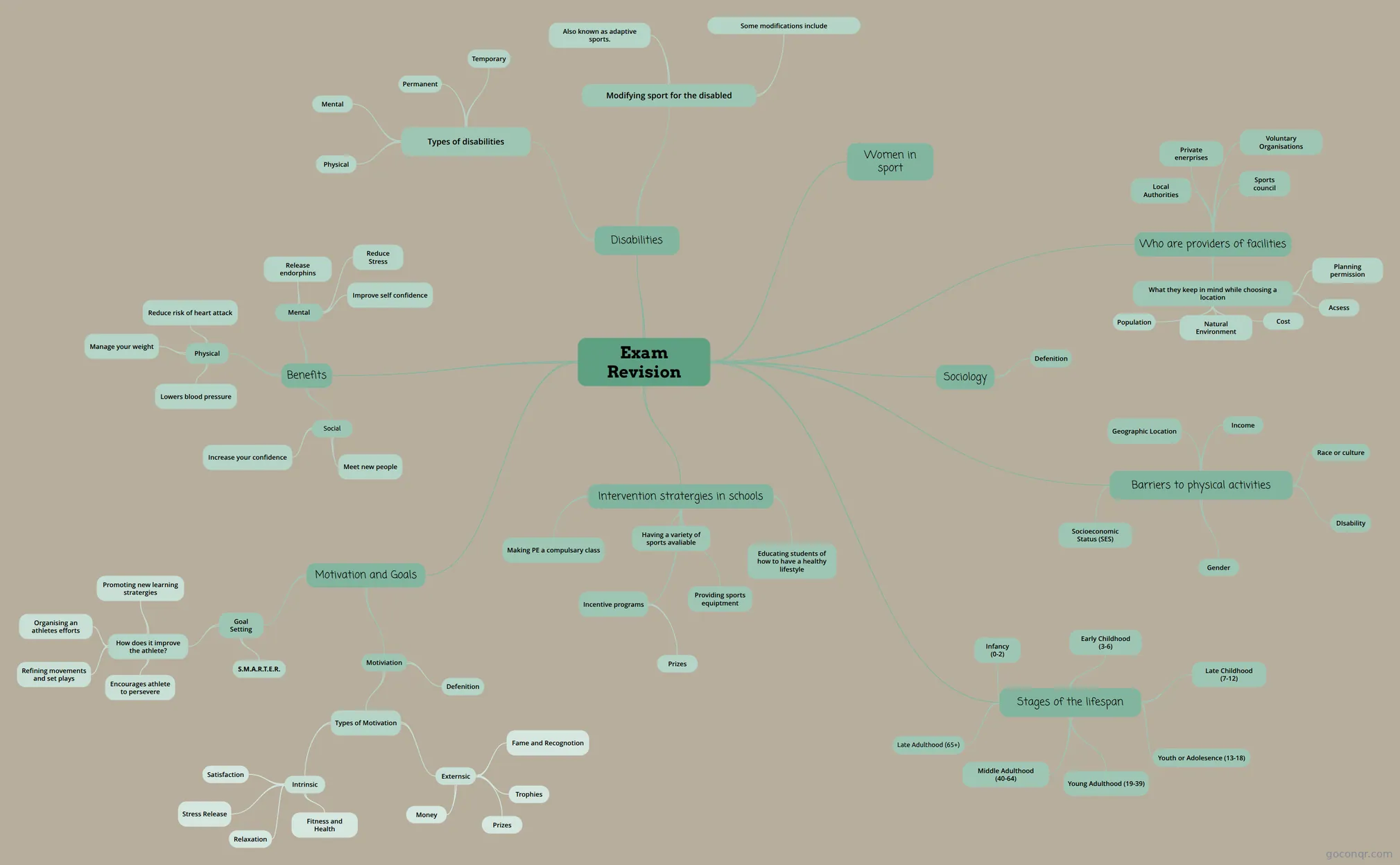
Mind map: exam revision PE
Conteúdo do mapa
Exam Revision
Intervention stratergies in schools
- Making PE a compulsary class
- Having a variety of sports avaliable
- Educating students of how to have a healthy lifestyle
- Incentive programs
- Prizes
- Providing sports equiptment
Barriers to physical activities
- Income
- People with higher incomes can participate in a wider variety of activities and more often. Gym memberships and sporting club memberships are usualy expensive.
- Gender
- Greater proportions of males participate in sport and physical activity than females. Females generally have less opportunity and less access to sporting activities.
- Race or culture
- People born in Australia are more active than those who were not. Race is often used as a form of discrimination, thus reducing participation.
- Socioeconomic Status (SES)
- Well educated white collar workers are the most physically active Australians.
- Geographic Location
- Where you live can limit access to facilities and specific sports. For example if you live in a remote area, there is a lesser chance that you will be able to participate in group sports or make use of leisure centres.
- DIsability
- Income
Benefits
- Physical
- Reduce risk of heart attack
- Manage your weight
- Lowers blood pressure
- Mental
- Reduce Stress
- Release endorphins
- Makes you happy
- Improve self confidence
- Social
- Meet new people
- Increase your confidence
- Physical
Motivation and Goals
- Goal Setting
- S.M.A.R.T.E.R.
- Specific – Clear goals to focus on Measurable – Need to be assessed against previous performances Accepted – Acceptance by the all parties involved Realistic – Goals need to be within the athlete’s capacity Time Phased – Specific date for completion needs to be set Exciting – Challenged, inspired and rewarding goals Recorded – Goals should be written down and kept
- How does it improve the athlete?
- Organising an athletes efforts
- Promoting new learning stratergies
- Refining movements and set plays
- Encourages athlete to persevere
- S.M.A.R.T.E.R.
- Motiviation
- Defenition
- MOTIVATION - is an athlete's reasons for participating. It is the driving force that makes you decide what to do and how much effort to put in.
- Types of Motivation
- Intrinsic
- INTRINSIC MOTIVATORS come from the activity itself.
- Satisfaction
- Stress Release
- Relaxation
- Fitness and Health
- Externsic
- EXTRINSIC MOTIVATORS come from outside the activity.
- Money
- Prizes
- Fame and Recognotion
- Trophies
- Intrinsic
- Defenition
- Goal Setting
Stages of the lifespan
- Infancy (0-2)
- Early Childhood (3-6)
- Late Childhood (7-12)
- Youth or Adolesence (13-18)
- Young Adulthood (19-39)
- Middle Adulthood (40-64)
- Late Adulthood (65+)
Sociology
- Defenition
- the study of the development, structure, and functioning of human society.
- Defenition
Women in sport
Who are providers of facilities
- Private enerprises
- May be run by businesses
- Local Authorities
- Park, Pools, etc.
- Voluntary Organisations
- To a need, not to make a profit.
- Sports council
- 'Centres of Excellence'- Professional use.
- What they keep in mind while choosing a location
- Population
- Natural Environment
- Cost
- Acsess
- Planning permission
- Private enerprises
Disabilities
- Types of disabilities
- Physical
- Mental
- Permanent
- Temporary
- Modifying sport for the disabled
- Also known as adaptive sports.
- Some modifications include
- - Changing the size of the playing field. - Modifying the equipment.
- Types of disabilities
Informações
- Descrição
- 10 Active for Life Mapa Mental sobre Exam Revision, criado por Lauren Thompson em 19-04-2016.
- Criado por
- Lauren Thompson
- Visualizações
- 20
- Tags
- Avaliação