
Mapa mental
Crime & Deviance
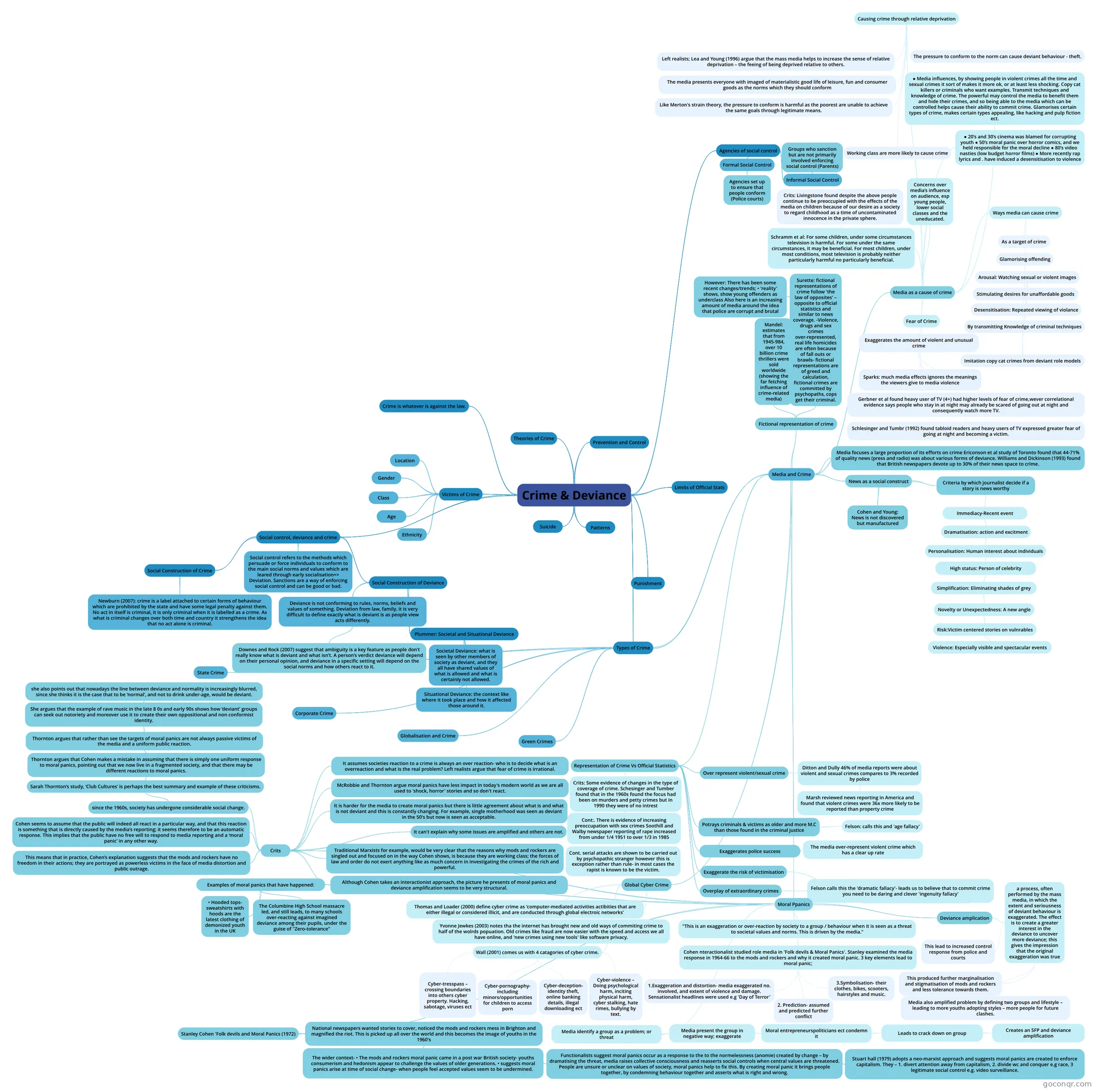
Mind map: Crime and deviance
Conteúdo do mapa
Crime & Deviance
Social control, deviance and crime
- Social control refers to the methods which persuade or force individuals to conform to the main social norms and values which are leared through early socialisation=> Deviation. Sanctions are a way of enforcing social control and can be good or bad.
- Social Construction of Crime
- Newburn (2007): crime is a label attached to certain forms of behaviour which are prohibited by the state and have some legal penalty against them. No act in itself is criminal, it is only criminal when it is labelled as a crime. As what is criminal changes over both time and country it strengthens the idea that no act alone is criminal.
- Social Construction of Deviance
- Deviance is not conforming to rules, norms, beliefs and values of something. Deviation from law, family. It is very difficult to define exactly what is deviant is as people view acts differently.
- Downes and Rock (2007) suggest that ambiguity is a key feature as people don’t really know what is deviant and what isn’t. A person’s verdict deviance will depend on their personal opinion, and deviance in a specific setting will depend on the social norms and how others react to it.
- Plummer: Societal and Situational Deviance
- Situational Deviance: the context like where it took place and how it affected those around it.
- Societal Deviance: what is seen by other members of society as deviant, and they all have shared values of what is allowed and what is certainly not allowed.
- Deviance is not conforming to rules, norms, beliefs and values of something. Deviation from law, family. It is very difficult to define exactly what is deviant is as people view acts differently.
Agencies of social control
- Formal Social Control
- Agencies set up to ensure that people conform (Police courts)
- Informal Social Control
- Groups who sanction but are not primarily involved enforcing social control (Parents)
- Formal Social Control
Theories of Crime
Patterns
Limits of Official Stats
Prevention and Control
Punishment
Victims of Crime
- Gender
- Age
- Location
- Ethnicity
- Class
Types of Crime
- Corporate Crime
- Green Crimes
- Globalisation and Crime
- State Crime
- Media and Crime
- Media focuses a large proportion of its efforts on crime Ericonson et al study of Toronto found that 44-71% of quality news (press and radio) was about various forms of deviance. Williams and Dickinson (1993) found that British newspapers devote up to 30% of their news space to crime.
- Representation of Crime Vs Official Statistics
- Over represent violent/sexual crime
- Ditton and Dully 46% of media reports were about violent and sexual crimes compares to 3% recorded by police
- Marsh reviewed news reporting in America and found that violent crimes were 36x more likely to be reported than property crime
- Ditton and Dully 46% of media reports were about violent and sexual crimes compares to 3% recorded by police
- Potrays criminals & victims as older and more M.C than those found in the criminal justice
- Felson: calls this and 'age fallacy'
- Exaggerates police success
- The media over-represent violent crime which has a clear up rate
- Exaggerate the risk of victimisation
- Esspecially to woman, white people, higher status
- Overplay of extraordinary crimes
- Felson calls this the 'dramatic fallacy'- leads us to believe that to commit crime you need to be daring and clever 'ingenuity fallacy'
- Crits: Some evidence of changes in the type of coverage of crime. Schesinger and Tumber found that in the 1960s found the focus had been on murders and petty crimes but in 1990 they were of no intrest
- Cont:. There is evidence of increasing preoccupation with sex crimes Soothill and Walby newspaper reporting of rape increased from under 1/4 1951 to over 1/3 in 1985
- Cont. serial attacks are shown to be carried out by psychopathic stranger however this is exception rather than rule- in most cases the rapist is known to be the victim.
- Cont:. There is evidence of increasing preoccupation with sex crimes Soothill and Walby newspaper reporting of rape increased from under 1/4 1951 to over 1/3 in 1985
- Over represent violent/sexual crime
- News as a social construct
- Cohen and Young: News is not discovered but manufactured
- Criteria by which journalist decide if a story is news worthy
- Immediacy-Recent event
- Dramatisation: action and excitment
- Personalisation: Human interest about individuals
- High status: Person of celebrity
- Simplification: Eliminating shades of grey
- Novelty or Unexpectedness: A new angle
- Risk:Victim centered stories on vulnrables
- Violence: Especially visible and spectacular events
- Risk:Victim centered stories on vulnrables
- Novelty or Unexpectedness: A new angle
- Simplification: Eliminating shades of grey
- High status: Person of celebrity
- Personalisation: Human interest about individuals
- Dramatisation: action and excitment
- Immediacy-Recent event
- Fictional representation of crime
- Mandel: estimates that from 1945-984, over 10 billion crime thrillers were sold worldwide (showing the far fetching influence of crime-related media)
- Surette: fictional representations of crime follow 'the law of opposites' – opposite to official statistics and similar to news coverage. -Violence, drugs and sex crimes over-represented, real life homicides are often because of fall outs or brawls- fictional representations are of greed and calculation, fictional crimes are committed by psychopaths, cops get their criminal.
- However: There has been some recent changes/trends; • 'reality' shows, show young offenders as underclass Also here is an increasing amount of media around the idea that police are corrupt and brutal
- Media as a cause of crime
- Ways media can cause crime
- Imitation copy cat crimes from deviant role models
- Arousal: Watching sexual or violent images
- Desensitisation: Repeated viewing of violance
- By transmitting Knowledge of criminal techniques
- Stimulating desires for unaffordable goods
- Glamorising offending
- Stimulating desires for unaffordable goods
- By transmitting Knowledge of criminal techniques
- Desensitisation: Repeated viewing of violance
- Arousal: Watching sexual or violent images
- As a target of crime
- Imitation copy cat crimes from deviant role models
- Fear of Crime
- Exaggerates the amount of violent and unusual crime
- Schlesinger and Tumbr (1992) found tabloid readers and heavy users of TV expressed greater fear of going at night and becoming a victim.
- Gerbner et al found heavy user of TV (4+) had higher levels of fear of crime,wever correlational evidence says people who stay in at night may already be scared of going out at night and consequently watch more TV.
- Sparks: much media effects ignores the meanings the viewers give to media violence
- Exaggerates the amount of violent and unusual crime
- Causing crime through relative deprivation
- The media presents everyone with imaged of materialistic good life of leisure, fun and consumer goods as the norms which they should conform
- Left realists; Lea and Young (1996) argue that the mass media helps to increase the sense of relative deprivation – the feeing of being deprived relative to others.
- The pressure to conform to the norm can cause deviant behaviour - theft.
- Working class are more likely to cause crime
- Like Merton's strain theory, the pressure to conform is harmful as the poorest are unable to achieve the same goals through legitimate means.
- ● Media influences, by showing people in violent crimes all the time and sexual crimes it sort of makes it more ok, or at least less shocking. Copy cat killers or criminals who want examples. Transmit techniques and knowledge of crime. The powerful may control the media to benefit them and hide their crimes, and so being able to the media which can be controlled helps cause their ability to commit crime. Glamorises certain types of crime, makes certain types appealing, like hacking and pulp fiction ect.
- Concerns over media’s influence on audience, esp young people, lower social classes and the uneducated.
- ● 20’s and 30’s cinema was blamed for corrupting youth ● 50’s moral panic over horror comics, and we held responsible for the moral decline ● 80’s video nasties (low budget horror films) ● More recently rap lyrics and . have induced a desensitisation to violence
- Schramm et al: For some children, under some circumstances television is harmful. For some under the same circumstances, it may be beneficial. For most children, under most conditions, most television is probably neither particularly harmful no particularly beneficial.
- Crits: Livingstone found despite the above people continue to be preoccupied with the effects of the media on children because of our desire as a society to regard childhood as a time of uncontaminated innocence in the private sphere.
- Ways media can cause crime
- Moral Ppanics
- “This is an exaggeration or over-reaction by society to a group / behaviour when it is seen as a threat to societal values and norms. This is driven by the media.”
- Media identify a group as a problem; or threat
- Media present the group in negative way; exaggerate
- Moral entrepreneurspoliticians ect condemn it
- Leads to crack down on group
- Creates an SFP and deviance amplification
- Leads to crack down on group
- Moral entrepreneurspoliticians ect condemn it
- Media present the group in negative way; exaggerate
- Cohen nteractionalist studied role media in 'Folk devils & Moral Panics'. Stanley examined the media response in 1964-66 to the mods and rockers and why it created moral panic. 3 key elements lead to moral panic;
- 1.Exaggeration and distortion- media exaggerated no. involved, and extent of violence and damage. Sensationalist headlines were used e.g 'Day of Terror'
- 2. Prediction- assumed and predicted further conflict
- 3.Symbolisation- their clothes, bikes, scooters, hairstyles and music.
- Deviance amplication
- a process, often performed by the mass media, in which the extent and seriousness of deviant behaviour is exaggerated. The effect is to create a greater interest in the deviance to uncover more deviance; this gives the impression that the original exaggeration was true
- This lead to increased control response from police and courts
- This produced further marginalisation and stigmatisation of mods and rockers and less tolerance towards them.
- Media also amplified problem by defining two groups and lifestyle – leading to more youths adopting styles – more people for future clashes.
- a process, often performed by the mass media, in which the extent and seriousness of deviant behaviour is exaggerated. The effect is to create a greater interest in the deviance to uncover more deviance; this gives the impression that the original exaggeration was true
- Stanley Cohen 'Folk devils and Moral Panics (1972)
- National newspapers wanted stories to cover, noticed the mods and rockers mess in Brighton and magnified the riot. This is picked up all over the world and this becomes the image of youths in the 1960's
- The wider context- • The mods and rockers moral panic came in a post war British society- youths consumerism and hedonism appear to challenge the values of older generations. • suggests moral panics arise at time of social change- when people feel accepted values seem to be undermined.
- Functionalists suggest moral panics occur as a response to the to the normelessness (anomie) created by change – by dramatising the threat, media raises collective consciousness and reasserts social controls when central values are threatened. People are unsure or unclear on values of society, moral panics help to fix this. By creating moral panic it brings people together, by condemning behaviour together and asserts what is right and wrong.
- Stuart hall (1979) adopts a neo-marxist approach and suggests moral panics are created to enforce capitalism. They – 1. divert attention away from capitalism, 2. divide wc and conquer e.g race, 3 legitimate social control e.g. video surveillance.
- Functionalists suggest moral panics occur as a response to the to the normelessness (anomie) created by change – by dramatising the threat, media raises collective consciousness and reasserts social controls when central values are threatened. People are unsure or unclear on values of society, moral panics help to fix this. By creating moral panic it brings people together, by condemning behaviour together and asserts what is right and wrong.
- The wider context- • The mods and rockers moral panic came in a post war British society- youths consumerism and hedonism appear to challenge the values of older generations. • suggests moral panics arise at time of social change- when people feel accepted values seem to be undermined.
- National newspapers wanted stories to cover, noticed the mods and rockers mess in Brighton and magnified the riot. This is picked up all over the world and this becomes the image of youths in the 1960's
- Crits
- since the 1960s, society has undergone considerable social change.
- Sarah Thornton’s study, ‘Club Cultures’ is perhaps the best summary and example of these criticisms.
- Thornton argues that Cohen makes a mistake in assuming that there is simply one uniform response to moral panics, pointing out that we now live in a fragmented society, and that there may be different reactions to moral panics.
- Thornton argues that rather than see the targets of moral panics are not always passive victims of the media and a uniform public reaction.
- She argues that the example of rave music in the late 8 0s and early 90s shows how ‘deviant’ groups can seek out notoriety and moreover use it to create their own oppositional and non conformist identity.
- she also points out that nowadays the line between deviance and normality is increasingly blurred, since she thinks it is the case that to be ‘normal’, and not to drink under-age, would be deviant.
- She argues that the example of rave music in the late 8 0s and early 90s shows how ‘deviant’ groups can seek out notoriety and moreover use it to create their own oppositional and non conformist identity.
- Thornton argues that rather than see the targets of moral panics are not always passive victims of the media and a uniform public reaction.
- Thornton argues that Cohen makes a mistake in assuming that there is simply one uniform response to moral panics, pointing out that we now live in a fragmented society, and that there may be different reactions to moral panics.
- Sarah Thornton’s study, ‘Club Cultures’ is perhaps the best summary and example of these criticisms.
- Cohen seems to assume that the public will indeed all react in a particular way, and that this reaction is something that is directly caused by the media’s reporting; it seems therefore to be an automatic response. This implies that the public have no free will to respond to media reporting and a ‘moral panic’ in any other way.
- Although Cohen takes an interactionist approach, the picture he presents of moral panics and deviance amplification seems to be very structural.
- Traditional Marxists for example, would be very clear that the reasons why mods and rockers are singled out and focused on in the way Cohen shows, is because they are working class; the forces of law and order do not exert anything like as much concern in investigating the crimes of the rich and powerful.
- McRobbie and Thornton argue moral panics have less impact in today's modern world as we are all used to 'shock, horror' stories and so don't react.
- It can't explain why some issues are amplified and others are not.
- It assumes societies reaction to a crime is always an over reaction- who is to decide what is an overreaction and what is the real problem? Left realists argue that fear of crime is irrational.
- This means that in practice, Cohen’s explanation suggests that the mods and rockers have no freedom in their actions; they are portrayed as powerless victims in the face of media distortion and public outrage.
- It is harder for the media to create moral panics but there is little agreement about what is and what is not deviant and this is constantly changing. For example, single motherhood was seen as deviant in the 50's but now is seen as acceptable.
- since the 1960s, society has undergone considerable social change.
- Examples of moral panics that have happened:
- The Columbine High School massacre led, and still leads, to many schools over-reacting against imagined deviance among their pupils, under the guise of "Zero-tolerance"
- • Hooded tops- sweatshirts with hoods are the latest clothing of demonized youth in the UK
- Global Cyber Crime
- Yvonne Jewkes (2003) notes tha the internet has brought new and old ways of commiting crime to half of the wolrds popuation. Old crimes like fraud are now easier with the speed and access we all have online, and 'new crimes using new tools' like software privacy.
- Thomas and Loader (2000) define cyber crime as 'computer-mediated activities actibities that are either illegal or considered illicit, and are conducted through global electroic networks'
- Wall (2001) comes us with 4 catagories of cyber crime.
- Cyber-deception- identity theft, online banking details, illegal downloading ect
- Cyber-tresspass – crossing boundaries into others cyber property. Hacking, sabotage, viruses ect
- Cyber-pornography- including minors/opportunities for children to access porn
- Cyber-violence – Doing psychological harm, inciting physical harm, cyber stalking, hate rimes, bullying by text.
Suicide
Crime is whatever is against the law.
Informações
- Descrição
- Mapa Mental sobre Crime & Deviance, criado por siham jabri em 01-05-2016.
- Criado por
- siham jabri
- Visualizações
- 2
- Avaliação