
Mapa mental
Lecture 5 - LTM
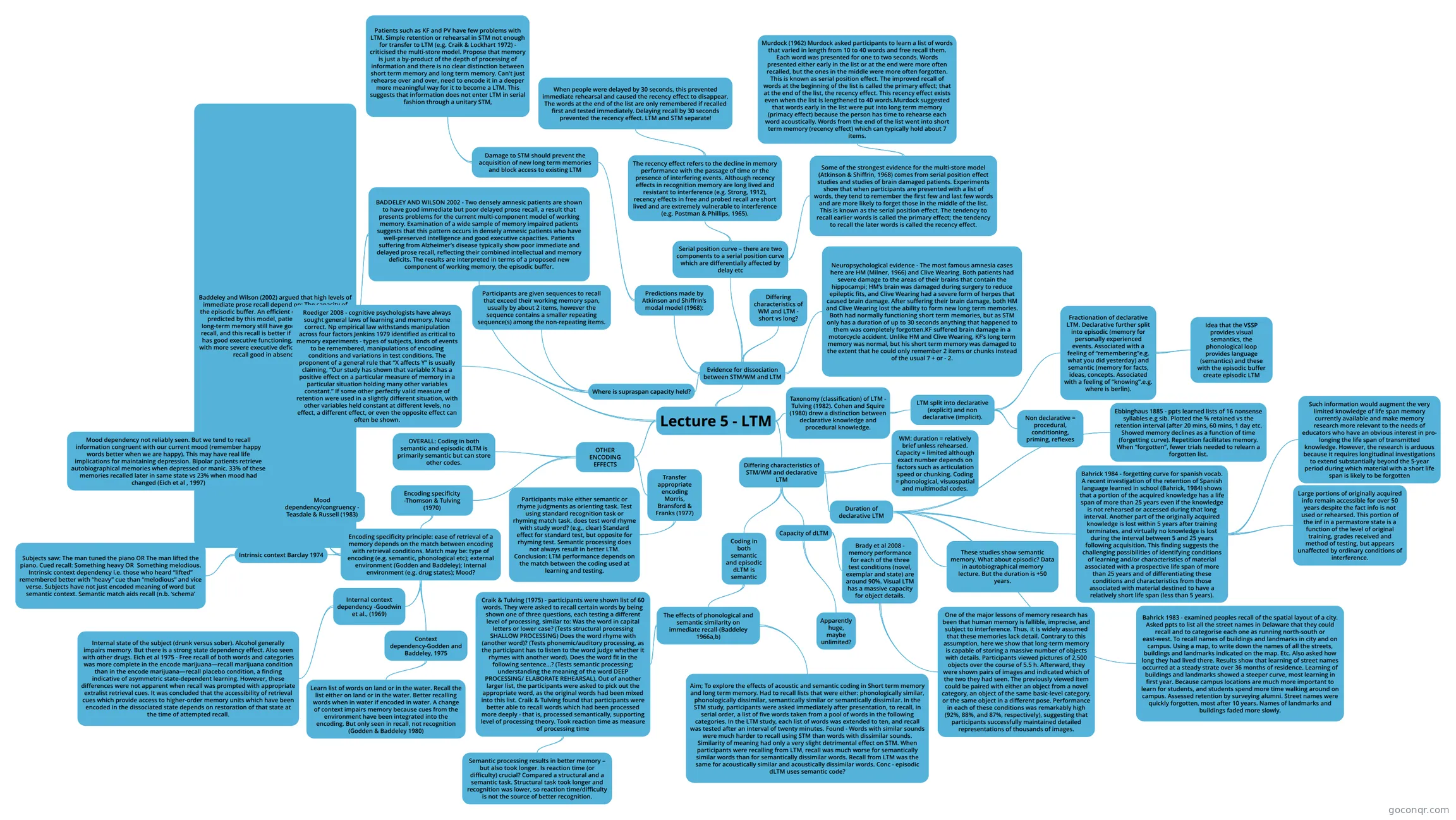
Mind map: Long-term memory (LTM)
Conteúdo do mapa
Lecture 5 - LTM
Evidence for dissociation between STM/WM and LTM
- Serial position curve – there are two components to a serial position curve which are differentially affected by delay etc
- The recency effect refers to the decline in memory performance with the passage of time or the presence of interfering events. Although recency effects in recognition memory are long lived and resistant to interference (e.g. Strong, 1912), recency effects in free and probed recall are short lived and are extremely vulnerable to interference (e.g. Postman & Phillips, 1965).
- When people were delayed by 30 seconds, this prevented immediate rehearsal and caused the recency effect to disappear. The words at the end of the list are only remembered if recalled first and tested immediately. Delaying recall by 30 seconds prevented the recency effect. LTM and STM separate!
- Some of the strongest evidence for the multi-store model (Atkinson & Shiffrin, 1968) comes from serial position effect studies and studies of brain damaged patients. Experiments show that when participants are presented with a list of words, they tend to remember the first few and last few words and are more likely to forget those in the middle of the list. This is known as the serial position effect. The tendency to recall earlier words is called the primary effect; the tendency to recall the later words is called the recency effect.
- Murdock (1962) Murdock asked participants to learn a list of words that varied in length from 10 to 40 words and free recall them. Each word was presented for one to two seconds. Words presented either early in the list or at the end were more often recalled, but the ones in the middle were more often forgotten. This is known as serial position effect. The improved recall of words at the beginning of the list is called the primary effect; that at the end of the list, the recency effect. This recency effect exists even when the list is lengthened to 40 words.Murdock suggested that words early in the list were put into long term memory (primacy effect) because the person has time to rehearse each word acoustically. Words from the end of the list went into short term memory (recency effect) which can typically hold about 7 items.
- The recency effect refers to the decline in memory performance with the passage of time or the presence of interfering events. Although recency effects in recognition memory are long lived and resistant to interference (e.g. Strong, 1912), recency effects in free and probed recall are short lived and are extremely vulnerable to interference (e.g. Postman & Phillips, 1965).
- Neuropsychological evidence - The most famous amnesia cases here are HM (Milner, 1966) and Clive Wearing. Both patients had severe damage to the areas of their brains that contain the hippocampi; HM’s brain was damaged during surgery to reduce epileptic fits, and Clive Wearing had a severe form of herpes that caused brain damage. After suffering their brain damage, both HM and Clive Wearing lost the ability to form new long term memories. Both had normally functioning short term memories, but as STM only has a duration of up to 30 seconds anything that happened to them was completely forgotten.KF suffered brain damage in a motorcycle accident. Unlike HM and Clive Wearing, KF’s long term memory was normal, but his short term memory was damaged to the extent that he could only remember 2 items or chunks instead of the usual 7 + or - 2.
- Predictions made by Atkinson and Shiffrin’s modal model (1968):
- Damage to STM should prevent the acquisition of new long term memories and block access to existing LTM
- Patients such as KF and PV have few problems with LTM. Simple retention or rehearsal in STM not enough for transfer to LTM (e.g. Craik & Lockhart 1972) - criticised the multi-store model. Propose that memory is just a by-product of the depth of processing of information and there is no clear distinction between short term memory and long term memory. Can't just rehearse over and over, need to encode it in a deeper more meaningful way for it to become a LTM. This suggests that information does not enter LTM in serial fashion through a unitary STM,
- Damage to STM should prevent the acquisition of new long term memories and block access to existing LTM
- Where is supraspan capacity held?
- BADDELEY AND WILSON 2002 - Two densely amnesic patients are shown to have good immediate but poor delayed prose recall, a result that presents problems for the current multi-component model of working memory. Examination of a wide sample of memory impaired patients suggests that this pattern occurs in densely amnesic patients who have well-preserved intelligence and good executive capacities. Patients suffering from Alzheimer’s disease typically show poor immediate and delayed prose recall, reflecting their combined intellectual and memory deficits. The results are interpreted in terms of a proposed new component of working memory, the episodic buffer.
- Baddeley and Wilson (2002) argued that high levels of immediate prose recall depend on: The capacity of the episodic buffer. An efficient central executive. As predicted by this model, patients with impaired long-term memory still have good immediate prose recall, and this recall is better if the amnesic patient has good executive functioning, compared to those with more severe executive deficits. Supraspan prose recall good in absence of LTM
- Participants are given sequences to recall that exceed their working memory span, usually by about 2 items, however the sequence contains a smaller repeating sequence(s) among the non-repeating items.
- BADDELEY AND WILSON 2002 - Two densely amnesic patients are shown to have good immediate but poor delayed prose recall, a result that presents problems for the current multi-component model of working memory. Examination of a wide sample of memory impaired patients suggests that this pattern occurs in densely amnesic patients who have well-preserved intelligence and good executive capacities. Patients suffering from Alzheimer’s disease typically show poor immediate and delayed prose recall, reflecting their combined intellectual and memory deficits. The results are interpreted in terms of a proposed new component of working memory, the episodic buffer.
- Differing characteristics of WM and LTM - short vs long?
- Serial position curve – there are two components to a serial position curve which are differentially affected by delay etc
Taxonomy (classification) of LTM - Tulving (1982). Cohen and Squire (1980) drew a distinction between declarative knowledge and procedural knowledge.
- LTM split into declarative (explicit) and non declarative (implicit).
- Fractionation of declarative LTM. Declarative further split into episodic (memory for personally experienced events. Associated with a feeling of “remembering”e.g. what you did yesterday) and semantic (memory for facts, ideas, concepts. Associated with a feeling of “knowing”.e.g. where is berlin).
- Idea that the VSSP provides visual semantics, the phonological loop provides language (semantics) and these with the episodic buffer create episodic LTM
- Non declarative = procedural, conditioning, priming, reflexes
- Fractionation of declarative LTM. Declarative further split into episodic (memory for personally experienced events. Associated with a feeling of “remembering”e.g. what you did yesterday) and semantic (memory for facts, ideas, concepts. Associated with a feeling of “knowing”.e.g. where is berlin).
- LTM split into declarative (explicit) and non declarative (implicit).
Differing characteristics of STM/WM and declarative LTM
- WM: duration = relatively brief unless rehearsed. Capacity = limited although exact number depends on factors such as articulation speed or chunking. Coding = phonological, visuospatial and multimodal codes.
- Duration of declarative LTM
- Ebbinghaus 1885 - ppts learned lists of 16 nonsense syllables e.g sib. Plotted the % retained vs the retention interval (after 20 mins, 60 mins, 1 day etc. Showed memory declines as a function of time (forgetting curve). Repetition facilitates memory. When “forgotten”, fewer trials needed to relearn a forgotten list.
- Bahrick 1984 - forgetting curve for spanish vocab. A recent investigation of the retention of Spanish language learned in school (Bahrick, 1984) shows that a portion of the acquired knowledge has a life span of more than 25 years even if the knowledge is not rehearsed or accessed during that long interval. Another part of the originally acquired knowledge is lost within 5 years after training terminates, and virtually no knowledge is lost during the interval between 5 and 25 years following acquisition. This finding suggests the challenging possibilities of identifying conditions of learning and/or characteristics of material associated with a prospective life span of more than 25 years and of differentiating these conditions and characteristics from those associated with material destined to have a relatively short life span (less than 5 years).
- Such information would augment the very limited knowledge of life span memory currently available and make memory research more relevant to the needs of educators who have an obvious interest in pro- longing the life span of transmitted knowledge. However, the research is arduous because it requires longitudinal investigations to extend substantially beyond the 5-year period during which material with a short life span is likely to be forgotten
- Large portions of originally acquired info remain accessible for over 50 years despite the fact info is not used or rehearsed. This portion of the inf in a permastore state is a function of the level of original training, grades received and method of testing, but appears unaffected by ordinary conditions of interference.
- Bahrick 1983 - examined peoples recall of the spatial layout of a city. Asked ppts to list all the street names in Delaware that they could recall and to categorise each one as running north-south or east-west. To recall names of buildings and landmarks in city and on campus. Using a map, to write down the names of all the streets, buildings and landmarks indicated on the map. Etc. Also asked how long they had lived there. Results show that learning of street names occurred at a steady strate over 36 months of residence. Learning of buildings and landmarks showed a steeper curve, most learning in first year. Because campus locations are much more important to learn for students, and students spend more time walking around on campus. Assessed retention by surveying alumni. Street names were quickly forgotten, most after 10 years. Names of landmarks and buildings faded more slowly.
- These studies show semantic memory. What about episodic? Data in autobiographical memory lecture. But the duration is +50 years.
- Capacity of dLTM
- Brady et al 2008 - memory performance for each of the three test conditions (novel, exemplar and state) are around 90%. Visual LTM has a massive capacity for object details.
- One of the major lessons of memory research has been that human memory is fallible, imprecise, and subject to interference. Thus, it is widely assumed that these memories lack detail. Contrary to this assumption, here we show that long-term memory is capable of storing a massive number of objects with details. Participants viewed pictures of 2,500 objects over the course of 5.5 h. Afterward, they were shown pairs of images and indicated which of the two they had seen. The previously viewed item could be paired with either an object from a novel category, an object of the same basic-level category, or the same object in a different pose. Performance in each of these conditions was remarkably high (92%, 88%, and 87%, respectively), suggesting that participants successfully maintained detailed representations of thousands of images.
- Apparently huge, maybe unlimited?
- Brady et al 2008 - memory performance for each of the three test conditions (novel, exemplar and state) are around 90%. Visual LTM has a massive capacity for object details.
- Coding in both semantic and episodic dLTM is semantic
- The effects of phonological and semantic similarity on immediate recall-(Baddeley 1966a,b)
- Aim; To explore the effects of acoustic and semantic coding in Short term memory and long term memory. Had to recall lists that were either: phonologically similar, phonologically dissimilar, semantically similar or semantically dissimilar. In the STM study, participants were asked immediately after presentation, to recall, in serial order, a list of five words taken from a pool of words in the following categories. In the LTM study, each list of words was extended to ten, and recall was tested after an interval of twenty minutes. Found - Words with similar sounds were much harder to recall using STM than words with dissimilar sounds. Similarity of meaning had only a very slight detrimental effect on STM. When participants were recalling from LTM, recall was much worse for semantically similar words than for semantically dissimilar words. Recall from LTM was the same for acoustically similar and acoustically dissimilar words. Conc - episodic dLTM uses semantic code?
- Craik & Tulving (1975) - participants were shown list of 60 words. They were asked to recall certain words by being shown one of three questions, each testing a different level of processing, similar to: Was the word in capital letters or lower case? (Tests structural processing SHALLOW PROCESSING) Does the word rhyme with (another word)? (Tests phonemic/auditory processing, as the participant has to listen to the word judge whether it rhymes with another word). Does the word fit in the following sentence...? (Tests semantic processing; understanding the meaning of the word DEEP PROCESSING/ ELABORATE REHEARSAL). Out of another larger list, the participants were asked to pick out the appropriate word, as the original words had been mixed into this list. Craik & Tulving found that participants were better able to recall words which had been processed more deeply - that is, processed semantically, supporting level of processing theory. Took reaction time as measure of processing time
- Semantic processing results in better memory – but also took longer. Is reaction time (or difficulty) crucial? Compared a structural and a semantic task. Structural task took longer and recognition was lower, so reaction time/difficulty is not the source of better recognition.
- The effects of phonological and semantic similarity on immediate recall-(Baddeley 1966a,b)
OTHER ENCODING EFFECTS
- Transfer appropriate encoding Morris, Bransford & Franks (1977)
- Participants make either semantic or rhyme judgments as orienting task. Test using standard recognition task or rhyming match task. does test word rhyme with study word? (e.g., clear) Standard effect for standard test, but opposite for rhyming test. Semantic processing does not always result in better LTM. Conclusion: LTM performance depends on the match between the coding used at learning and testing.
- Encoding specificity -Thomson & Tulving (1970)
- Encoding specificity principle: ease of retrieval of a memory depends on the match between encoding with retrieval conditions. Match may be: type of encoding (e.g. semantic, phonological etc); external environment (Godden and Baddeley); Internal environment (e.g. drug states); Mood?
- Context dependency-Godden and Baddeley, 1975
- Learn list of words on land or in the water. Recall the list either on land or in the water. Better recalling words when in water if encoded in water. A change of context impairs memory because cues from the environment have been integrated into the encoding. But only seen in recall, not recognition (Godden & Baddeley 1980)
- Internal context dependency -Goodwin et al., (1969)
- Internal state of the subject (drunk versus sober). Alcohol generally impairs memory. But there is a strong state dependency effect. Also seen with other drugs. Eich et al 1975 - Free recall of both words and categories was more complete in the encode marijuana—recall marijuana condition than in the encode marijuana—recall placebo condition, a finding indicative of asymmetric state-dependent learning. However, these differences were not apparent when recall was prompted with appropriate extralist retrieval cues. It was concluded that the accessibility of retrieval cues which provide access to higher-order memory units which have been encoded in the dissociated state depends on restoration of that state at the time of attempted recall.
- Intrinsic context Barclay 1974
- Subjects saw: The man tuned the piano OR The man lifted the piano. Cued recall: Something heavy OR Something melodious. Intrinsic context dependency i.e. those who heard “lifted” remembered better with “heavy” cue than “melodious” and vice verse. Subjects have not just encoded meaning of word but semantic context. Semantic match aids recall (n.b. ‘schema’
- Mood dependency/congruency - Teasdale & Russell (1983)
- Mood dependency not reliably seen. But we tend to recall information congruent with our current mood (remember happy words better when we are happy). This may have real life implications for maintaining depression. Bipolar patients retrieve autobiographical memories when depressed or manic. 33% of these memories recalled later in same state vs 23% when mood had changed (Eich et al , 1997)
- Context dependency-Godden and Baddeley, 1975
- Encoding specificity principle: ease of retrieval of a memory depends on the match between encoding with retrieval conditions. Match may be: type of encoding (e.g. semantic, phonological etc); external environment (Godden and Baddeley); Internal environment (e.g. drug states); Mood?
- OVERALL: Coding in both semantic and episodic dLTM is primarily semantic but can store other codes.
- Transfer appropriate encoding Morris, Bransford & Franks (1977)
Roediger 2008 - cognitive psychologists have always sought general laws of learning and memory. None correct. Np empirical law withstands manipulation across four factors Jenkins 1979 identified as critical to memory experiments - types of subjects, kinds of events to be remembered, manipulations of encoding conditions and variations in test conditions. The proponent of a general rule that “X affects Y” is usually claiming, “Our study has shown that variable X has a positive effect on a particular measure of memory in a particular situation holding many other variables constant.” If some other perfectly valid measure of retention were used in a slightly different situation, with other variables held constant at different levels, no effect, a different effect, or even the opposite effect can often be shown.
Informações
- Descrição
- yr 2 Cognitive 1 Mapa Mental sobre Lecture 5 - LTM, criado por Issy de Silva em 12-05-2016.
- Criado por
- Issy de Silva
- Visualizações
- 0
- Avaliação