
Mapa mental
Atoms and reactions
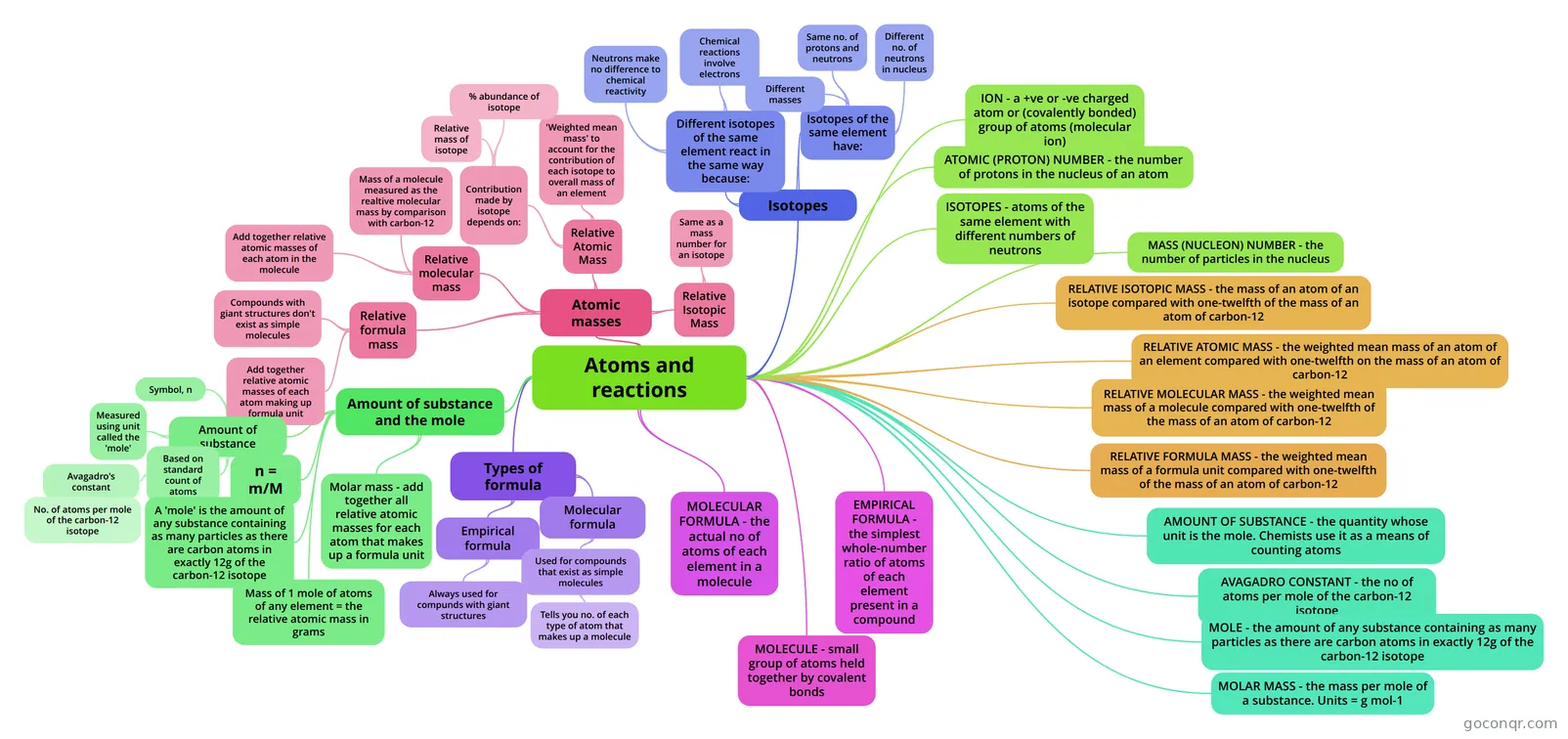
Mind map: Atoms and reactions
Conteúdo do mapa
Atoms and reactions
Isotopes
- Isotopes of the same element have:
- Same no. of protons and neutrons
- Different no. of neutrons in nucleus
- Different masses
- Different isotopes of the same element react in the same way because:
- Chemical reactions involve electrons
- Neutrons make no difference to chemical reactivity
- Isotopes of the same element have:
ATOMIC (PROTON) NUMBER - the number of protons in the nucleus of an atom
ISOTOPES - atoms of the same element with different numbers of neutrons
MASS (NUCLEON) NUMBER - the number of particles in the nucleus
ION - a +ve or -ve charged atom or (covalently bonded) group of atoms (molecular ion)
Atomic masses
- Relative Isotopic Mass
- Same as a mass number for an isotope
- Relative Atomic Mass
- 'Weighted mean mass' to account for the contribution of each isotope to overall mass of an element
- Contribution made by isotope depends on:
- % abundance of isotope
- Relative mass of isotope
- Relative molecular mass
- Mass of a molecule measured as the realtive molecular mass by comparison with carbon-12
- Add together relative atomic masses of each atom in the molecule
- Relative formula mass
- Compounds with giant structures don't exist as simple molecules
- Add together relative atomic masses of each atom making up formula unit
- Relative Isotopic Mass
RELATIVE ISOTOPIC MASS - the mass of an atom of an isotope compared with one-twelfth of the mass of an atom of carbon-12
RELATIVE ATOMIC MASS - the weighted mean mass of an atom of an element compared with one-twelfth on the mass of an atom of carbon-12
RELATIVE MOLECULAR MASS - the weighted mean mass of a molecule compared with one-twelfth of the mass of an atom of carbon-12
RELATIVE FORMULA MASS - the weighted mean mass of a formula unit compared with one-twelfth of the mass of an atom of carbon-12
Amount of substance and the mole
- Amount of substance
- Symbol, n
- Measured using unit called the 'mole'
- Based on standard count of atoms
- Avagadro's constant
- No. of atoms per mole of the carbon-12 isotope
- Avagadro's constant
- Mass of 1 mole of atoms of any element = the relative atomic mass in grams
- A 'mole' is the amount of any substance containing as many particles as there are carbon atoms in exactly 12g of the carbon-12 isotope
- Molar mass - add together all relative atomic masses for each atom that makes up a formula unit
- n = m/M
- Amount of substance
Types of formula
- Empirical formula
- Always used for compunds with giant structures
- Molecular formula
- Used for compounds that exist as simple molecules
- Tells you no. of each type of atom that makes up a molecule
- Used for compounds that exist as simple molecules
- Empirical formula
AMOUNT OF SUBSTANCE - the quantity whose unit is the mole. Chemists use it as a means of counting atoms
AVAGADRO CONSTANT - the no of atoms per mole of the carbon-12 isotope
MOLE - the amount of any substance containing as many particles as there are carbon atoms in exactly 12g of the carbon-12 isotope
MOLAR MASS - the mass per mole of a substance. Units = g mol-1
EMPIRICAL FORMULA - the simplest whole-number ratio of atoms of each element present in a compound
MOLECULE - small group of atoms held together by covalent bonds
MOLECULAR FORMULA - the actual no of atoms of each element in a molecule
Informações
- Descrição
- GCSE Chemistry - UNIT 1 Mapa Mental sobre Atoms and reactions, criado por Jen em 18-03-2014.
- Criado por
- Jen
- Visualizações
- 64
- Tags
- Avaliação