
Mapa mental
Monological Reading
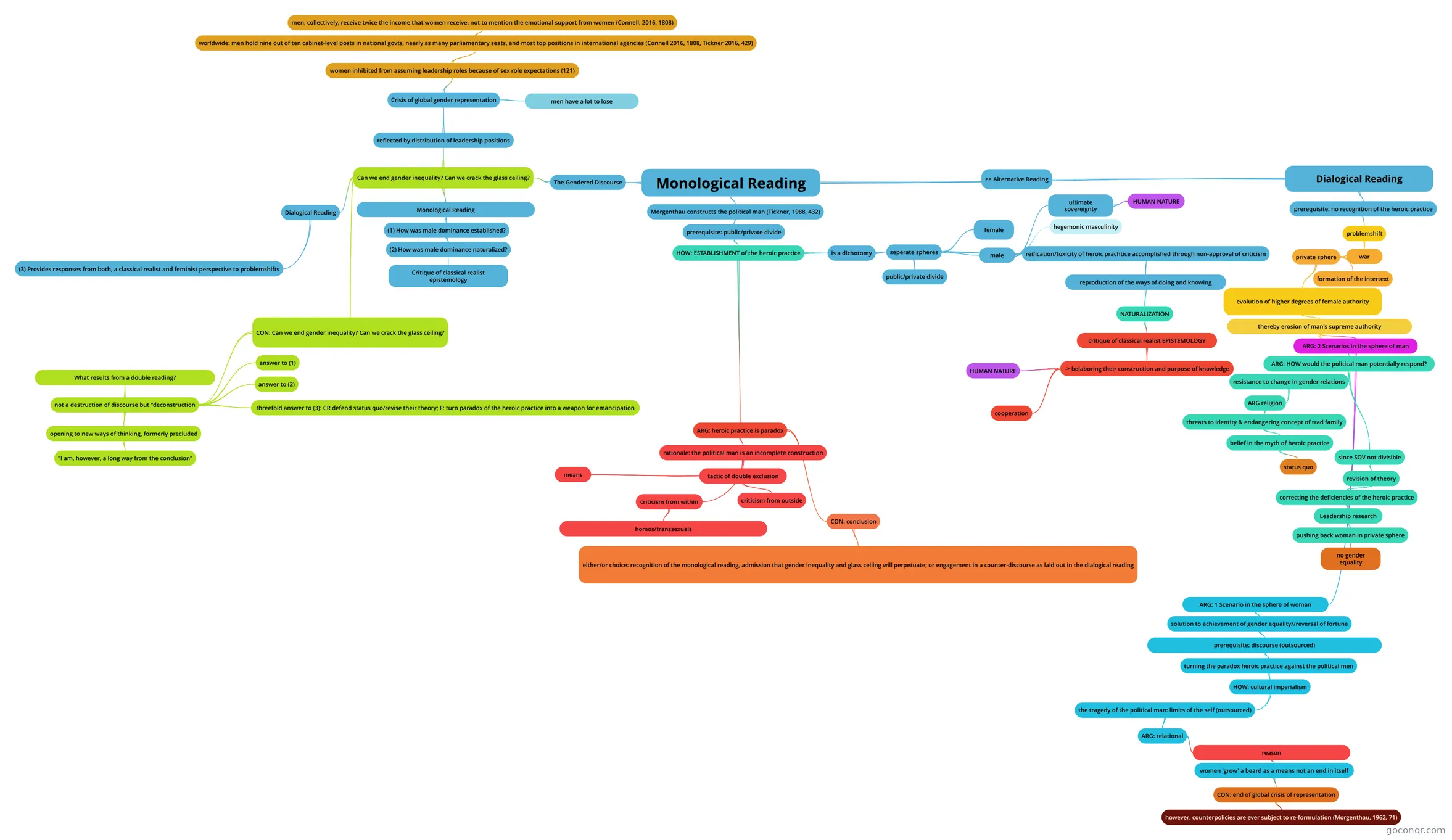
Mind map: Monological reading
Conteúdo do mapa
Monological Reading
Morgenthau constructs the political man (Tickner, 1988, 432)
- prerequisite: public/private divide
- HOW: ESTABLISHMENT of the heroic practice
- that has universal applications (Morgenthau, 1962, 33), "socially constructed configuration of gender practice (Connell 2016, 1805)"
- is a dichotomy
- seperate spheres
- reification/toxicity of heroic prachtice accomplished through non-approval of criticism
- (Jacobi 658) "The [political men] must consolidate its power [reproduce] itself, and legitimize the coercive and extractive powers it monopolizes and not so frequently utilizes against its own [women] in the name of ["gender security"]. "The immediate goal of political action is power, and political power is power over the minds [...]" (Morgenthau, 1962, 88) "[...] it must secure the approval of its own people [...] to mobilize the elements of [men's] power in support of them." (Morgenthau, 1962, 145)
- reproduction of the ways of doing and knowing
- NATURALIZATION
- critique of classical realist EPISTEMOLOGY
- -> belaboring their construction and purpose of knowledge
- HUMAN NATURE
- Morgenthau: "asserts that it is possible to develop a rational theory of IR based on objective laws that have their roots in human nature" (Tickner, 1988, 431) critique -> "world view does not rest on a pluralistic conception of human nature, are partial and masculine" >>>"Human nature arguments are mobilized as shortcuts effectively reducing theoretical complexity" (Jacobi, 661) (Tickner, 1997, 617)
- cooperation
- "Power cannot be infused with meaning that is universally valid. power as domination privileges masculinity and ignores the possibility of collective empowerment, an aspect of power often associated with feminity." (Tickner, 1988, 438)
- HUMAN NATURE
- -> belaboring their construction and purpose of knowledge
- critique of classical realist EPISTEMOLOGY
- NATURALIZATION
- female
- weak, dependent on men, emotional (Tickner, 1997, 614)
- male
- "the political men is rational, objective, and unemotional"(Tickner, 1988, 431) strong
- ultimate sovereignty
- HUMAN NATURE
- to biologize the human condition -> "[...] it would be contrary to nature if the strong did not dominate the weak and if the weak tried to be the equal of the strong. (Morgenthau, 1962, 92)
- HUMAN NATURE
- hegemonic masculinity
- "Ideologies, like all ideas, are weapons that may rise the national morale and, with it, the power of [men] and, in the very act of doing so, may lower the morale of [women]" (Morgenthau, 1962, 89)
- public/private divide
- "the political men maintains the autonomy of the political sphere, [and imprisioned women in the priivate sphere]" (Tickner, 2005, 17) "[...] to proceed as if women were not a relevant part of the analysis, and therefore to analyze masculinities by looking only at men and relations among men." (Connell 837), (Jacobi, 430) "need to "tame" and "domesticate"her - to bring her under control because she can never aspire to having "reason" herself (Tickner, 2005, 17), (Morgenthau, 1962, 29)
- reification/toxicity of heroic prachtice accomplished through non-approval of criticism
- seperate spheres
- ARG: heroic practice is paradox
- rationale: the political man is an incomplete construction
- (Runyan 70)
- criticism from within
- homos/transsexuals
- do not embody an ideal masculinity -> "such an appropriation blurs gender difference" -> evidence "that it is logically possible to define "a thousand and one" variations of masculinity" (Connell 845)
- homos/transsexuals
- tactic of double exclusion
- "[...] the concept of masculinity is flawed because it ESSENTIALIZES the character of men or imposes a false unity on a fluid and contradictory reality" -> or reversely: concept criticized for "leading to inconsistent applications, sometimes referring to a fixed type of masculinity" -> present it as transhistorical model double exclusionary practice >> the concept is criticized for ESSENTIALIZING male-female difference and IGNORES difference and exclusion within the gender categories. (Connell 836)"censure directed at subordinated groups "[men] is lost within, or, [...] subjected to, an ideological apparatus and an innate drive for power" (Connell 842) "from a feminist perspective, neither can realism escape criticism for its own attempts to contain and repress difference" (Runyan 69) "[...] the human intellect is unable to calculate and to control completely the results of human action. [...] "Our thoughts are ours; their ends none of our own."" (Morgenthau, 1965, 189)
- criticism from outside
- means
- # men has established devices for "controlling individual power drives. These [devices] either divert individual power drives into channels where they cannot endanger society, or else they weaken them or suppress them altogether." (Morgenthau, 1962, 102) # "mechanisms ranges from the discrediting of "soft" options in the "hard" world of international relations, security threats, and war, to homophobic assaults and murders, all the way to the teasing of boys in school for "sissiness" (Connell 844 ll Connell 2016, 1803 ll Morgenthau, 1962, 9)"# however, self-restraint of men -> "[...] hegemonic masculinity do include "positive actions" as bringing home a wage, sustaining a sexual relationship, and being a father" (Connell 840)
- CON: conclusion
- either/or choice: recognition of the monological reading, admission that gender inequality and glass ceiling will perpetuate; or engagement in a counter-discourse as laid out in the dialogical reading
- rationale: the political man is an incomplete construction
- HOW: ESTABLISHMENT of the heroic practice
- prerequisite: public/private divide
Dialogical Reading
- >> Alternative Reading
- prerequisite: no recognition of the heroic practice
- problemshift
- "changed the conditions of existence for gender orders"
- war
- private sphere
- evolution of higher degrees of female authority
- thereby erosion of man's supreme authority
- "The morale of others will only slowly decline and, as it were, corrode at the edges - not break at all in one sudden collapse [...]" (Morgenthau, 1962, 134)
- ARG: HOW would the political man potentially respond?
- resistance to change in gender relations
- ARG religion
- threats to identity & endangering concept of trad family
- "hegemonic masculinity include being the breadwinner and being "strong," then men seem less worthy of respect." (Connell 2016, 1811) -> ideological defense of male supremacy
- belief in the myth of heroic practice
- status quo
- threats to identity & endangering concept of trad family
- ARG religion
- since SOV not divisible
- revision of theory
- (Runyan 80) "The dominance of a philosophy over its age and its fecundity (Fruchtbarkeit) for the future are [...] determined by its relation to the life experiences of the common man" "He will not forever listen to "appeals to reason" when he experiences the power of irrational forces over his own life [...]" (Morgenthau, 1965, 8)
- correcting the deficiencies of the heroic practice
- Leadership research
- pushing back woman in private sphere
- "bringing men in" - given the larger context in which men still control most of the wealth and institutional authority - may undermine, not help, the drive for gender equality." (Connell, 2016, 1807)
- no gender equality
- pushing back woman in private sphere
- Leadership research
- revision of theory
- resistance to change in gender relations
- ARG: 2 Scenarios in the sphere of man
- ARG: 1 Scenario in the sphere of woman
- solution to achievement of gender equality//reversal of fortune
- prerequisite: discourse (outsourced)
- turning the paradox heroic practice against the political men
- HOW: cultural imperialism
- The method = Cultural imperialism= effective political weapon -> "[...] the conquest and control of the minds of men as an instrument for changing the power relations between [the sexes]" "And everyday changes, however small and imperceptible at first,[...] add an ounce of strength to this side and take a grain of might away from the other. (Morgenthau, 1962, 151) "the problem of recognizing imperialistic tendencies" is to the advantage of woman (Morgenthau 1962, 96) -> deutlicher werden hier
- the tragedy of the political man: limits of the self (outsourced)
- ARG: relational
- reason
- "Reason is carried by the irrational forces of interest and emotion to where those forces want it to move, regardless of what the inner logic of abstract reason would require" (Morgenthau, 1965, 155) when "passion shakes off the control of reason and man becomes a predominantly irrational being [...] he may fail and in his failure destroy himself"." (Morgenthau, 1965, 156)
- women 'grow' a beard as a means not an end in itself
- >>therefore Thatcher can act like an iron man<< (Tickner, 1997, 614) "women have been more apt to rely on power as persuasion" -> "condition of survival in the nuclear age", "and building international community"(Tickner, 1988, 434)(Runyan 81)
- CON: end of global crisis of representation
- however, counterpolicies are ever subject to re-formulation (Morgenthau, 1962, 71)
- reason
- ARG: relational
- HOW: cultural imperialism
- turning the paradox heroic practice against the political men
- prerequisite: discourse (outsourced)
- solution to achievement of gender equality//reversal of fortune
- ARG: 1 Scenario in the sphere of woman
- thereby erosion of man's supreme authority
- formation of the intertext
- evolution of higher degrees of female authority
- private sphere
- problemshift
The Gendered Discourse
- Can we end gender inequality? Can we crack the glass ceiling?
- reflected by distribution of leadership positions
- Crisis of global gender representation
- women inhibited from assuming leadership roles because of sex role expectations (121)
- worldwide: men hold nine out of ten cabinet-level posts in national govts, nearly as many parliamentary seats, and most top positions in international agencies (Connell 2016, 1808, Tickner 2016, 429)
- men, collectively, receive twice the income that women receive, not to mention the emotional support from women (Connell, 2016, 1808)
- worldwide: men hold nine out of ten cabinet-level posts in national govts, nearly as many parliamentary seats, and most top positions in international agencies (Connell 2016, 1808, Tickner 2016, 429)
- men have a lot to lose
- from pursuing gender equality because men, collectively, continue to receive a PATRIARCHAL dividend
- women inhibited from assuming leadership roles because of sex role expectations (121)
- Crisis of global gender representation
- Monological Reading
- (1) How was male dominance established?
- (2) How was male dominance naturalized?
- Critique of classical realist epistemology
- (1) How was male dominance established?
- Dialogical Reading
- (3) Provides responses from both, a classical realist and feminist perspective to problemshifts
- CON: Can we end gender inequality? Can we crack the glass ceiling?
- not a destruction of discourse but "deconstruction
- opening to new ways of thinking, formerly precluded
- "I am, however, a long way from the conclusion"
- answer to (1)
- answer to (2)
- threefold answer to (3): CR defend status quo/revise their theory; F: turn paradox of the heroic practice into a weapon for emancipation
- What results from a double reading?
- opening to new ways of thinking, formerly precluded
- not a destruction of discourse but "deconstruction
- reflected by distribution of leadership positions
- Can we end gender inequality? Can we crack the glass ceiling?
Informações
- Descrição
- international relations Mapa Mental sobre Monological Reading, criado por Tere S. em 24-10-2016.
- Criado por
- Tere S.
- Visualizações
- 0
- Avaliação
Mais sobre Realism in International Relations