
Mapa mental
River form
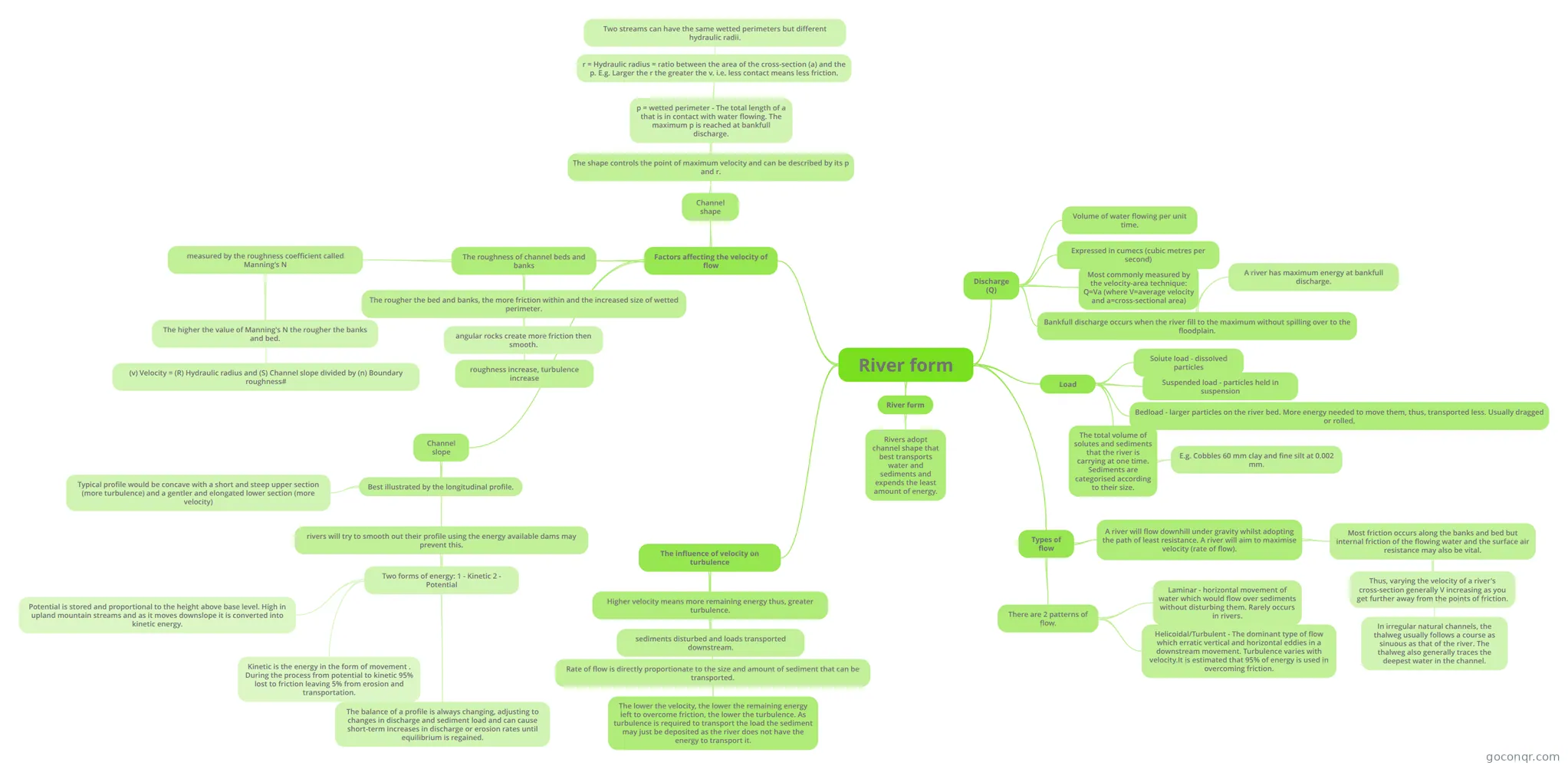
Mind map: River form
Conteúdo do mapa
River form
Discharge (Q)
- Volume of water flowing per unit time.
- Expressed in cumecs (cubic metres per second)
- Most commonly measured by the velocity-area technique: Q=Va (where V=average velocity and a=cross-sectional area)
- Bankfull discharge occurs when the river fill to the maximum without spilling over to the floodplain.
- A river has maximum energy at bankfull discharge.
Load
- The total volume of solutes and sediments that the river is carrying at one time. Sediments are categorised according to their size.
- E.g. Cobbles 60 mm clay and fine silt at 0.002 mm.
- Solute load - dissolved particles
- Suspended load - particles held in suspension
- Bedload - larger particles on the river bed. More energy needed to move them, thus, transported less. Usually dragged or rolled.
- The total volume of solutes and sediments that the river is carrying at one time. Sediments are categorised according to their size.
River form
- Rivers adopt channel shape that best transports water and sediments and expends the least amount of energy.
Types of flow
- A river will flow downhill under gravity whilst adopting the path of least resistance. A river will aim to maximise velocity (rate of flow).
- Most friction occurs along the banks and bed but internal friction of the flowing water and the surface air resistance may also be vital.
- Thus, varying the velocity of a river's cross-section generally V increasing as you get further away from the points of friction.
- In irregular natural channels, the thalweg usually follows a course as sinuous as that of the river. The thalweg also generally traces the deepest water in the channel.
- Most friction occurs along the banks and bed but internal friction of the flowing water and the surface air resistance may also be vital.
- There are 2 patterns of flow.
- Laminar - horizontal movement of water which would flow over sediments without disturbing them. Rarely occurs in rivers.
- Helicoidal/Turbulent - The dominant type of flow which erratic vertical and horizontal eddies in a downstream movement. Turbulence varies with velocity.It is estimated that 95% of energy is used in overcoming friction.
- A river will flow downhill under gravity whilst adopting the path of least resistance. A river will aim to maximise velocity (rate of flow).
The influence of velocity on turbulence
- Higher velocity means more remaining energy thus, greater turbulence.
- sediments disturbed and loads transported downstream.
- Rate of flow is directly proportionate to the size and amount of sediment that can be transported.
- The lower the velocity, the lower the remaining energy left to overcome friction, the lower the turbulence. As turbulence is required to transport the load the sediment may just be deposited as the river does not have the energy to transport it.
- Higher velocity means more remaining energy thus, greater turbulence.
Factors affecting the velocity of flow
- Channel shape
- The shape controls the point of maximum velocity and can be described by its p and r.
- p = wetted perimeter - The total length of a that is in contact with water flowing. The maximum p is reached at bankfull discharge.
- r = Hydraulic radius = ratio between the area of the cross-section (a) and the p. E.g. Larger the r the greater the v. i.e. less contact means less friction.
- Two streams can have the same wetted perimeters but different hydraulic radii.
- The shape controls the point of maximum velocity and can be described by its p and r.
- The roughness of channel beds and banks
- The rougher the bed and banks, the more friction within and the increased size of wetted perimeter.
- angular rocks create more friction then smooth.
- roughness increase, turbulence increase
- measured by the roughness coefficient called Manning's N
- The higher the value of Manning's N the rougher the banks and bed.
- (v) Velocity = (R) Hydraulic radius and (S) Channel slope divided by (n) Boundary roughness#
- The rougher the bed and banks, the more friction within and the increased size of wetted perimeter.
- Channel slope
- Best illustrated by the longitudinal profile.
- Typical profile would be concave with a short and steep upper section (more turbulence) and a gentler and elongated lower section (more velocity)
- rivers will try to smooth out their profile using the energy available dams may prevent this.
- Two forms of energy: 1 - Kinetic 2 - Potential
- Potential is stored and proportional to the height above base level. High in upland mountain streams and as it moves downslope it is converted into kinetic energy.
- Kinetic is the energy in the form of movement . During the process from potential to kinetic 95% lost to friction leaving 5% from erosion and transportation.
- The balance of a profile is always changing, adjusting to changes in discharge and sediment load and can cause short-term increases in discharge or erosion rates until equilibrium is regained.
- Two forms of energy: 1 - Kinetic 2 - Potential
- Best illustrated by the longitudinal profile.
- Channel shape
Informações
- Descrição
- Undergraduate Physical Geography (Hydrosphere) Mapa Mental sobre River form, criado por Sharondeep em 26-03-2014.
- Criado por
- Sharondeep
- Visualizações
- 37
- Tags
- Avaliação
Mais sobre River Erosion, Transportation and Deposition