
Mapa mental
Migration and Nationalism
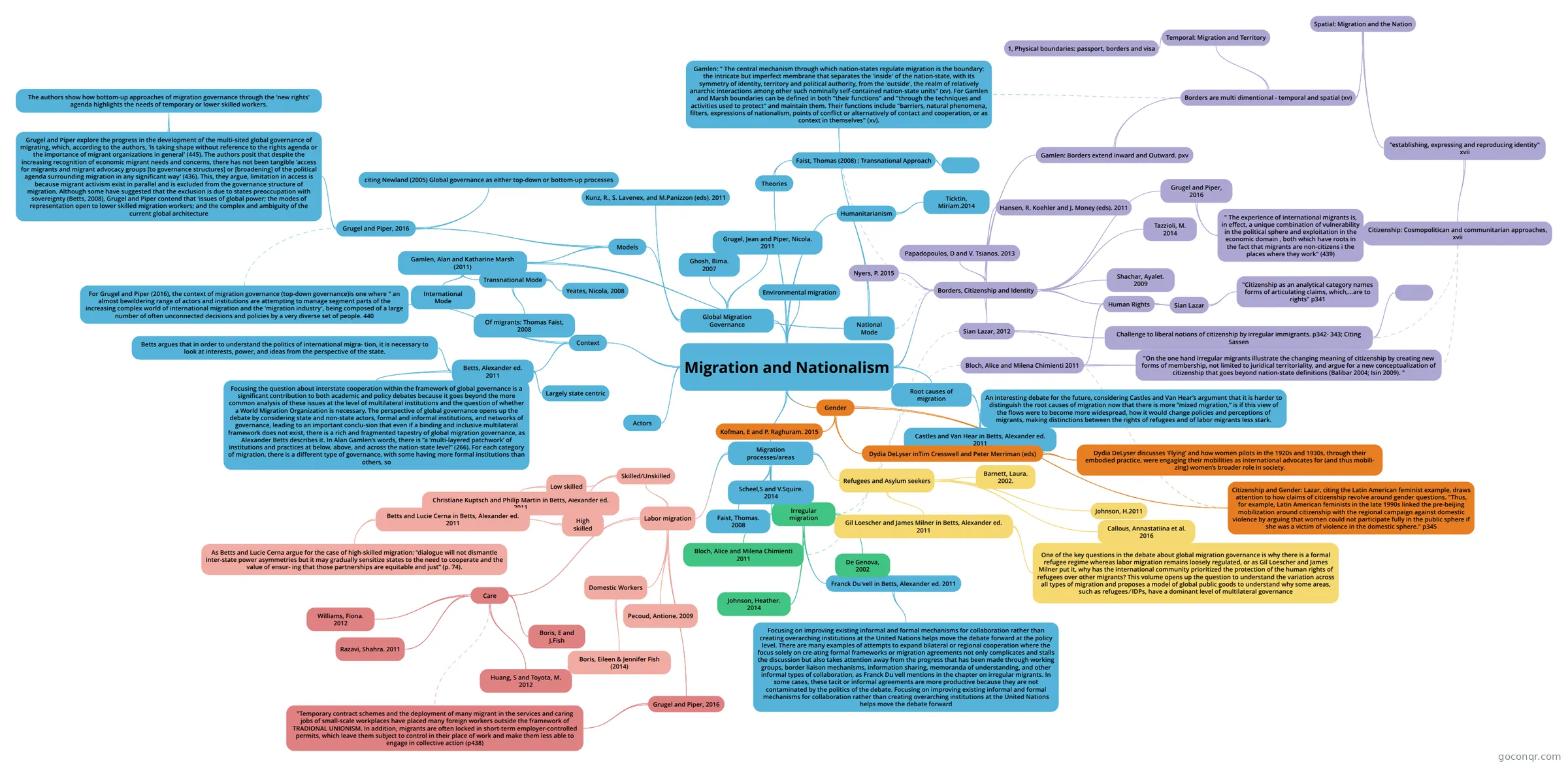
Mind map: Migration and Nationalism
Conteúdo do mapa
Migration and Nationalism
Environmental migration
Global Migration Governance
- Ghosh, Bima. 2007
- Grugel, Jean and Piper, Nicola. 2011
- Kunz, R., S. Lavenex, and M.Panizzon (eds). 2011
- Models
- Gamlen, Alan and Katharine Marsh (2011)
- National Mode
- Gamlen: " The central mechanism through which nation-states regulate migration is the boundary: the intricate but imperfect membrane that separates the 'inside' of the nation-state, with its symmetry of identity, territory and political authority, from the 'outside', the realm of relatively anarchic interactions among other such nominally self-contained nation-state units" (xv). For Gamlen and Marsh boundaries can be defined in both "their functions" and "through the techniques and activities used to protect" and maintain them. Their functions include "barriers, natural phenomena, filters, expressions of nationalism, points of conflict or alternatively of contact and cooperation, or as context in themselves" (xv).
- International Mode
- Transnational Mode
- Yeates, Nicola, 2008
- Of migrants: Thomas Faist, 2008
- National Mode
- Grugel and Piper, 2016
- citing Newland (2005) Global governance as either top-down or bottom-up processes
- Grugel and Piper explore the progress in the development of the multi-sited global governance of migrating, which, according to the authors, 'is taking shape without reference to the rights agenda or the importance of migrant organizations in general' (445). The authors posit that despite the increasing recognition of economic migrant needs and concerns, there has not been tangible 'access for migrants and migrant advocacy groups [to governance structures] or [broadening] of the political agenda surrounding migration in any significant way' (436). This, they argue, limitation in access is because migrant activism exist in parallel and is excluded from the governance structure of migration. Although some have suggested that the exclusion is due to states preoccupation with sovereignty (Betts, 2008), Grugel and Piper contend that 'issues of global power; the modes of representation open to lower skilled migration workers; and the complex and ambiguity of the current global architecture
- The authors show how bottom-up approaches of migration governance through the 'new rights' agenda highlights the needs of temporary or lower skilled workers.
- Gamlen, Alan and Katharine Marsh (2011)
Migration processes/areas
- Labor migration
- Skilled/Unskilled
- Low skilled
- Christiane Kuptsch and Philip Martin in Betts, Alexander ed. 2011
- High skilled
- Betts and Lucie Cerna in Betts, Alexander ed. 2011
- As Betts and Lucie Cerna argue for the case of high-skilled migration: ‘‘dialogue will not dismantle inter-state power asymmetries but it may gradually sensitize states to the need to cooperate and the value of ensur- ing that those partnerships are equitable and just’’ (p. 74).
- Betts and Lucie Cerna in Betts, Alexander ed. 2011
- Low skilled
- Care
- Razavi, Shahra. 2011
- Huang, S and Toyota, M. 2012
- Williams, Fiona. 2012
- Boris, E and J.Fish
- Domestic Workers
- Boris, Eileen & Jennifer Fish (2014)
- Pecoud, Antione. 2009
- Grugel and Piper, 2016
- "Temporary contract schemes and the deployment of many migrant in the services and caring jobs of small-scale workplaces have placed many foreign workers outside the framework of TRADIONAL UNIONISM. In addition, migrants are often locked in short-term employer-controlled permits, which leave them subject to control in their place of work and make them less able to engage in collective action (p438)
- Skilled/Unskilled
- Refugees and Asylum seekers
- Barnett, Laura. 2002.
- Gil Loescher and James Milner in Betts, Alexander ed. 2011
- One of the key questions in the debate about global migration governance is why there is a formal refugee regime whereas labor migration remains loosely regulated, or as Gil Loescher and James Milner put it, why has the international community prioritized the protection of the human rights of refugees over other migrants? This volume opens up the question to understand the variation across all types of migration and proposes a model of global public goods to understand why some areas, such as refugees ⁄ IDPs, have a dominant level of multilateral governance
- Johnson, H.2011
- Callous, Annastatiina et al. 2016
- Irregular migration
- Franck Du ̈vell in Betts, Alexander ed. 2011
- Focusing on improving existing informal and formal mechanisms for collaboration rather than creating overarching institutions at the United Nations helps move the debate forward at the policy level. There are many examples of attempts to expand bilateral or regional cooperation where the focus solely on cre-ating formal frameworks or migration agreements not only complicates and stalls the discussion but also takes attention away from the progress that has been made through working groups, border liaison mechanisms, information sharing, memoranda of understanding, and other informal types of collaboration, as Franck Du ̈vell mentions in the chapter on irregular migrants. In some cases, these tacit or informal agreements are more productive because they are not contaminated by the politics of the debate. Focusing on improving existing informal and formal mechanisms for collaboration rather than creating overarching institutions at the United Nations helps move the debate forward
- Bloch, Alice and Milena Chimienti 2011
- De Genova, 2002
- Johnson, Heather. 2014
- Franck Du ̈vell in Betts, Alexander ed. 2011
- Scheel,S and V.Squire. 2014
- Faist, Thomas. 2008
- Labor migration
Theories
- Faist, Thomas (2008) : Transnational Approach
- Faist, Thomas (2008) : Transnational Approach
Root causes of migration
- Castles and Van Hear in Betts, Alexander ed. 2011
- An interesting debate for the future, considering Castles and Van Hear’s argument that it is harder to distinguish the root causes of migration now that there is more ‘‘mixed migration,’’ is if this view of the flows were to become more widespread, how it would change policies and perceptions of migrants, making distinctions between the rights of refugees and of labor migrants less stark.
- Castles and Van Hear in Betts, Alexander ed. 2011
Borders, Citizenship and Identity
- Sian Lazar, 2012
- Challenge to liberal notions of citizenship by irregular immigrants. p342- 343; Citing Sassen
- Challenge to liberal notions of citizenship by irregular immigrants. p342- 343; Citing Sassen
- Papadopoulos, D and V. Tsianos. 2013
- Nyers, P. 2015
- Tazzioli, M. 2014
- Shachar, Ayalet. 2009
- Hansen, R. Koehler and J. Money (eds). 2011
- Human Rights
- Bloch, Alice and Milena Chimienti 2011
- "On the one hand irregular migrants illustrate the changing meaning of citizenship by creating new forms of membership, not limited to juridical territoriality, and argue for a new conceptualization of citizenship that goes beyond nation-state definitions (Balibar 2004; Isin 2009). "
- Sian Lazar
- "Citizenship as an analytical category names forms of articulating claims, which,...are to rights" p341
- Bloch, Alice and Milena Chimienti 2011
- Grugel and Piper, 2016
- " The experience of international migrants is, in effect, a unique combination of vulnerability in the political sphere and exploitation in the economic domain , both which have roots in the fact that migrants are non-citizens i the places where they work" (439)
- Gamlen: Borders extend inward and Outward. pxv
- Borders are multi dimentional - temporal and spatial (xv)
- Temporal: Migration and Territory
- 1, Physical boundaries: passport, borders and visa
- Spatial: Migration and the Nation
- "establishing, expressing and reproducing identity" xvii
- Citizenship: Cosmopolitican and communitarian approaches, xvii
- "establishing, expressing and reproducing identity" xvii
- Temporal: Migration and Territory
- Borders are multi dimentional - temporal and spatial (xv)
- Sian Lazar, 2012
Actors
Gender
- Dydia DeLyser inTim Cresswell and Peter Merriman (eds)
- Dydia DeLyser discusses ‘Flying’ and how women pilots in the 1920s and 1930s, through their embodied practice, were engaging their mobilities as international advocates for (and thus mobili- zing) women’s broader role in society.
- Kofman, E and P. Raghuram. 2015
- Citizenship and Gender: Lazar, citing the Latin American feminist example, draws attention to how claims of citizenship revolve around gender questions. "Thus, for example, Latin American feminists in the late 1990s linked the pre-beijing mobilization around citizenship with the regional campaign against domestic violence by arguing that women could not participate fully in the public sphere if she was a victim of violence in the domestic sphere." p345
- Dydia DeLyser inTim Cresswell and Peter Merriman (eds)
Humanitarianism
- Ticktin, Miriam.2014
Context
- Betts, Alexander ed. 2011
- Focusing the question about interstate cooperation within the framework of global governance is a significant contribution to both academic and policy debates because it goes beyond the more common analysis of these issues at the level of multilateral institutions and the question of whether a World Migration Organization is necessary. The perspective of global governance opens up the debate by considering state and non-state actors, formal and informal institutions, and networks of governance, leading to an important conclu-sion that even if a binding and inclusive multilateral framework does not exist, there is a rich and fragmented tapestry of global migration governance, as Alexander Betts describes it. In Alan Gamlen’s words, there is ‘‘a ‘multi-layered patchwork’ of institutions and practices at below, above, and across the nation-state level’’ (266). For each category of migration, there is a different type of governance, with some having more formal institutions than others, so
- Betts argues that in order to understand the politics of international migra- tion, it is necessary to look at interests, power, and ideas from the perspective of the state.
- Largely state centric
- For Grugel and Piper (2016), the context of migration governance (top-down governance)is one where " an almost bewildering range of actors and institutions are attempting to manage segment parts of the increasing complex world of international migration and the 'migration industry', being composed of a large number of often unconnected decisions and policies by a very diverse set of people. 440
- Betts, Alexander ed. 2011
Informações
- Descrição
- Mapa Mental sobre Migration and Nationalism, criado por Jennifer Kandjii em 17-12-2016.
- Criado por
- Jennifer Kandjii
- Visualizações
- 1
- Avaliação
Mais sobre Migration Policy and Human Rights