
Mapa mental
Intelligence & Psychological Testing
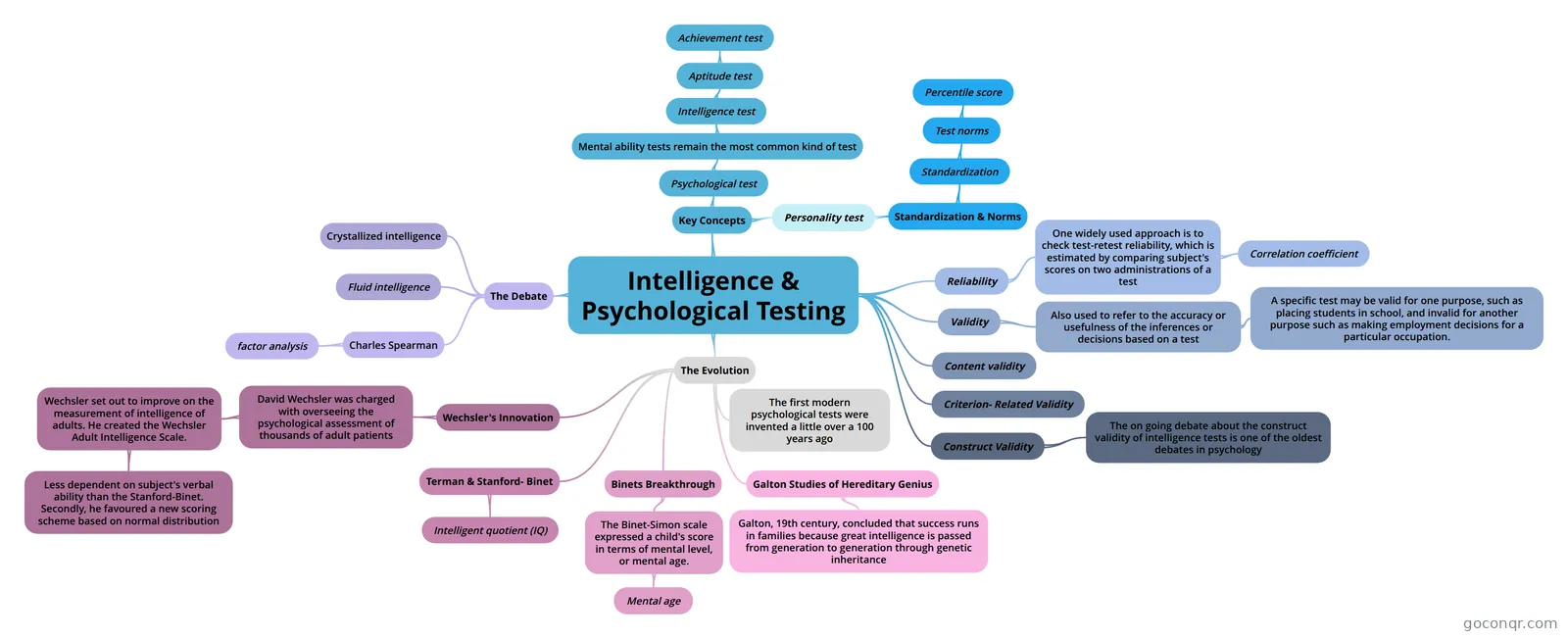
Mind map: Intelligence & psychological testing
Conteúdo do mapa
Intelligence & Psychological Testing
Key Concepts
- Psychological test
- A standardized measure of a sample o a person's behaviour
- Mental ability tests remain the most common kind of test
- Intelligence test
- Measures general metal ability.
- Aptitude test
- Asses specific types of mental abilities such as verbal reasoning, numerical, and abstract reasoning
- Achievement test
- Test gauge a person's mastery and knowledge of various subjects such as reading, English, or history.
- Intelligence test
- Personality test
- Measures various aspects of personality including motives, interests, calues and attitudes.
- Standardization & Norms
- Standardization
- Refers to the uniform proccedures used in the administration & scoring of a test.
- Test norms
- Provide information about where a score on a psychological test ranks in relation to other scores on that test.
- Percentile score
- Indicates the percentage of people who score at or below the score one has obtained.
- Standardization
- Psychological test
Reliability
- Refers to the measurement consistency of a test (or of other kinds of measurement techniques)
- One widely used approach is to check test-retest reliability, which is estimated by comparing subject's scores on two administrations of a test
- Correlation coefficient
- A numerical index of the degree of relationship between two variables
- Correlation coefficient
Validity
- Refers to the ability of a test to easure what it was designed to measure
- Also used to refer to the accuracy or usefulness of the inferences or decisions based on a test
- A specific test may be valid for one purpose, such as placing students in school, and invalid for another purpose such as making employment decisions for a particular occupation.
Content validity
- Refers to the degree to which the content of a test is representative of the domain it's suppose to cover.
Criterion- Related Validity
- Is estimated by correlating subject's scores ona test with their scores on an independent criterion (another measure) of the trait assessed by the test.
Construct Validity
- The extent to which there is evidence that a test measures a particular hypothetical construct.
- The on going debate about the construct validity of intelligence tests is one of the oldest debates in psychology
The Evolution
- The first modern psychological tests were invented a little over a 100 years ago
- Galton Studies of Hereditary Genius
- Galton, 19th century, concluded that success runs in families because great intelligence is passed from generation to generation through genetic inheritance
- Binets Breakthrough
- The Binet-Simon scale expressed a child's score in terms of mental level, or mental age.
- Mental age
- Indicated that he/she displayed the mental ability typical of a child of that chronological age
- Mental age
- The Binet-Simon scale expressed a child's score in terms of mental level, or mental age.
- Terman & Stanford- Binet
- Intelligent quotient (IQ)
- Is a child's mental age divided by chronological age, multiplied by 100.
- Intelligent quotient (IQ)
- Wechsler's Innovation
- David Wechsler was charged with overseeing the psychological assessment of thousands of adult patients
- Wechsler set out to improve on the measurement of intelligence of adults. He created the Wechsler Adult Intelligence Scale.
- Less dependent on subject's verbal ability than the Stanford-Binet. Secondly, he favoured a new scoring scheme based on normal distribution
- Wechsler set out to improve on the measurement of intelligence of adults. He created the Wechsler Adult Intelligence Scale.
- David Wechsler was charged with overseeing the psychological assessment of thousands of adult patients
The Debate
- Charles Spearman
- factor analysis
- Correlations among many variables are analyzed to identify closely related clusters of variables
- factor analysis
- Fluid intelligence
- Involves reasoning ability, memory capacity, and speed of information processing
- Crystallized intelligence
- Involves the ability to apply acquired knowledge and skills in problem solving
- Charles Spearman
Informações
- Descrição
- Mapa Mental sobre Intelligence & Psychological Testing, criado por Kimmy Hudy em 11-01-2017.
- Criado por
- Kimmy Hudy
- Visualizações
- 0
- Avaliação