
Mapa mental
Landforms
Conteúdo do mapa
Landforms
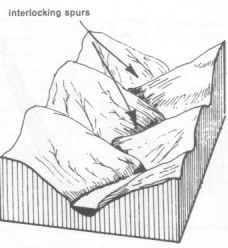
Interlocking Spurs
- As the river flows downstream it erodes the softer rock. As the river erodes the landscape in the upper course, it winds and bends to avoid areas of hard rock. This creates interlocking spurs, which look a bit like the interlocking parts of a zip.
Waterfalls
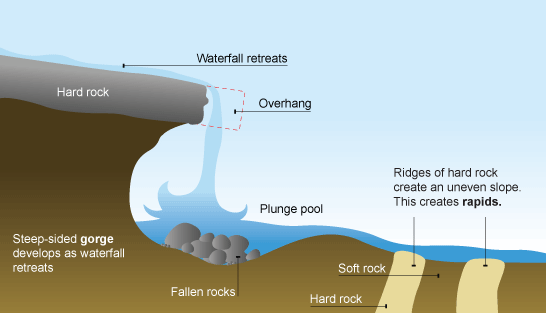
- A waterfall is formed when water flows over a ridge of hard and soft rock on the river bed. The water starts to erode the soft rock underneath which causes the distance between the rocks to increase. The water then starts to erode a plunge pool underneath. This is where the water falls with increasing impact and makes it deeper. The water erodes the soft rock by the processes of Hydrauliaction and abrasion. Hydraulic action is where the water gets into cracks in the rock, expands and pushes the air resulting in the rock becoming weaker and more cracked.
Meanders
River Cliffs
Oxbow Lakes
- Oxbow lakes are formed by the continual erosion and deposition of a meander bend. Deposition occurs on the inside of the bend. this is because the water flows slowly here which means that the river has little energy to hold onto materials. Erosion occurs on the outside bend. This erosion results in the outside bends of the river becoming closer together. This is called the river neck. With either continual erosion or a flood the land separating the two bends will disappear, meaining the meander has been cut through completely. Deposition blocks off the old meander as the water takes the fastest route. The old meander will eventually dry up.
Flood Plains
Levees
Imagens e arquivos do mapa
Informações
- Descrição
- GCSE Geography Mapa Mental sobre Landforms, criado por sian.phillips em 13-04-2014.
- Criado por
- sian.phillips
- Visualizações
- 17
- Avaliação