
Mapa mental
Emma Themes: self-knowledge
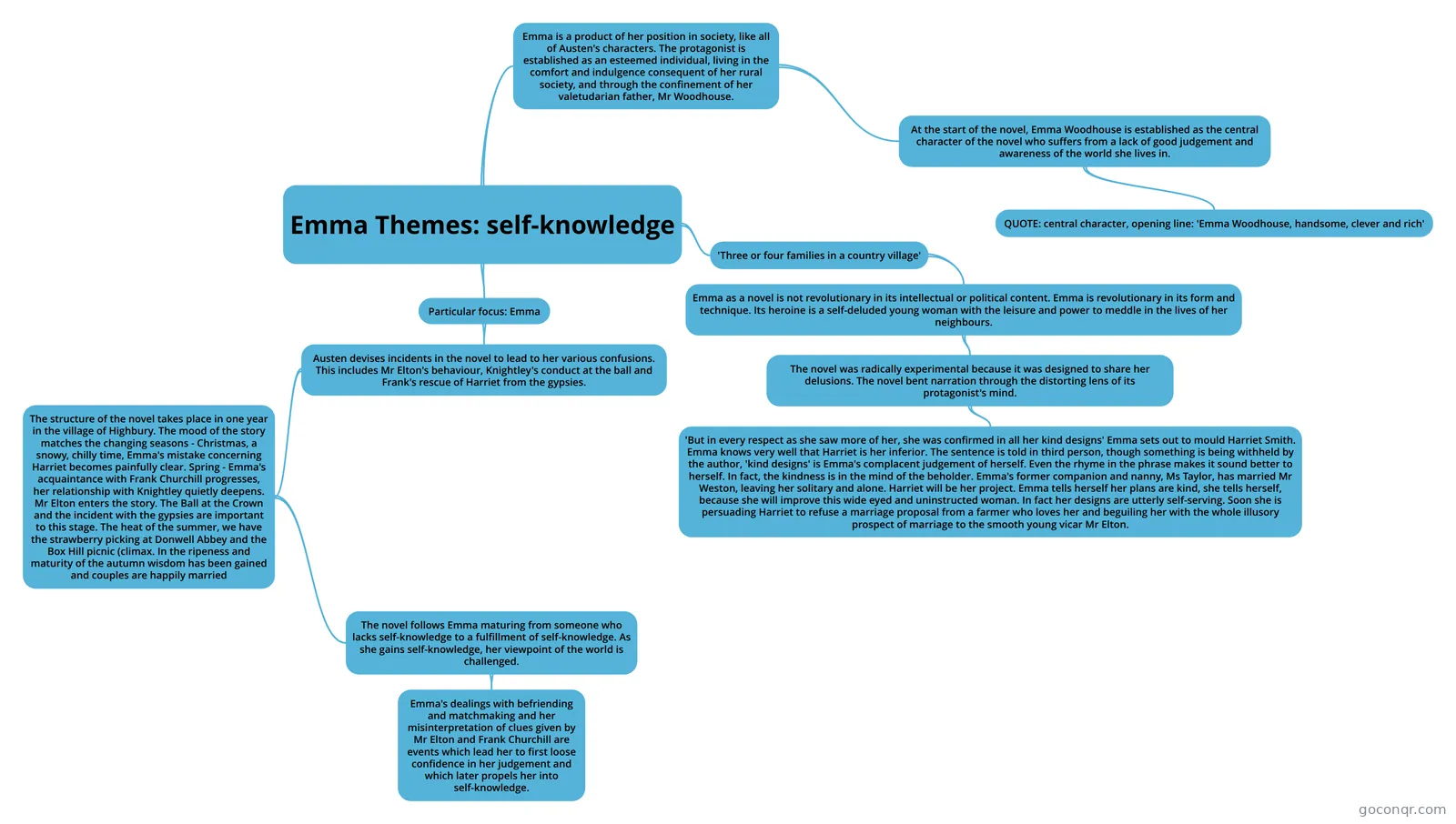
Mind map: Emma themes: self-knowledge
Conteúdo do mapa
Emma Themes: self-knowledge
Particular focus: Emma
- Austen devises incidents in the novel to lead to her various confusions. This includes Mr Elton's behaviour, Knightley's conduct at the ball and Frank's rescue of Harriet from the gypsies.
- The structure of the novel takes place in one year in the village of Highbury. The mood of the story matches the changing seasons - Christmas, a snowy, chilly time, Emma's mistake concerning Harriet becomes painfully clear. Spring - Emma's acquaintance with Frank Churchill progresses, her relationship with Knightley quietly deepens. Mr Elton enters the story. The Ball at the Crown and the incident with the gypsies are important to this stage. The heat of the summer, we have the strawberry picking at Donwell Abbey and the Box Hill picnic (climax. In the ripeness and maturity of the autumn wisdom has been gained and couples are happily married
- The novel follows Emma maturing from someone who lacks self-knowledge to a fulfillment of self-knowledge. As she gains self-knowledge, her viewpoint of the world is challenged.
- Emma's dealings with befriending and matchmaking and her misinterpretation of clues given by Mr Elton and Frank Churchill are events which lead her to first loose confidence in her judgement and which later propels her into self-knowledge.
- The novel follows Emma maturing from someone who lacks self-knowledge to a fulfillment of self-knowledge. As she gains self-knowledge, her viewpoint of the world is challenged.
- The structure of the novel takes place in one year in the village of Highbury. The mood of the story matches the changing seasons - Christmas, a snowy, chilly time, Emma's mistake concerning Harriet becomes painfully clear. Spring - Emma's acquaintance with Frank Churchill progresses, her relationship with Knightley quietly deepens. Mr Elton enters the story. The Ball at the Crown and the incident with the gypsies are important to this stage. The heat of the summer, we have the strawberry picking at Donwell Abbey and the Box Hill picnic (climax. In the ripeness and maturity of the autumn wisdom has been gained and couples are happily married
- Austen devises incidents in the novel to lead to her various confusions. This includes Mr Elton's behaviour, Knightley's conduct at the ball and Frank's rescue of Harriet from the gypsies.
Emma is a product of her position in society, like all of Austen's characters. The protagonist is established as an esteemed individual, living in the comfort and indulgence consequent of her rural society, and through the confinement of her valetudarian father, Mr Woodhouse.
- At the start of the novel, Emma Woodhouse is established as the central character of the novel who suffers from a lack of good judgement and awareness of the world she lives in.
- QUOTE: central character, opening line: 'Emma Woodhouse, handsome, clever and rich'
- At the start of the novel, Emma Woodhouse is established as the central character of the novel who suffers from a lack of good judgement and awareness of the world she lives in.
'Three or four families in a country village'
- Emma as a novel is not revolutionary in its intellectual or political content. Emma is revolutionary in its form and technique. Its heroine is a self-deluded young woman with the leisure and power to meddle in the lives of her neighbours.
- The novel was radically experimental because it was designed to share her delusions. The novel bent narration through the distorting lens of its protagonist's mind.
- 'But in every respect as she saw more of her, she was confirmed in all her kind designs' Emma sets out to mould Harriet Smith. Emma knows very well that Harriet is her inferior. The sentence is told in third person, though something is being withheld by the author, 'kind designs' is Emma's complacent judgement of herself. Even the rhyme in the phrase makes it sound better to herself. In fact, the kindness is in the mind of the beholder. Emma's former companion and nanny, Ms Taylor, has married Mr Weston, leaving her solitary and alone. Harriet will be her project. Emma tells herself her plans are kind, she tells herself, because she will improve this wide eyed and uninstructed woman. In fact her designs are utterly self-serving. Soon she is persuading Harriet to refuse a marriage proposal from a farmer who loves her and beguiling her with the whole illusory prospect of marriage to the smooth young vicar Mr Elton.
- The novel was radically experimental because it was designed to share her delusions. The novel bent narration through the distorting lens of its protagonist's mind.
- Emma as a novel is not revolutionary in its intellectual or political content. Emma is revolutionary in its form and technique. Its heroine is a self-deluded young woman with the leisure and power to meddle in the lives of her neighbours.
Informações
- Descrição
- Mapa Mental sobre Emma Themes: self-knowledge, criado por Biba Stern em 13-02-2017.
- Criado por
- Biba Stern
- Visualizações
- 2
- Tags
- Avaliação