
Mapa mental
The Vietnam War
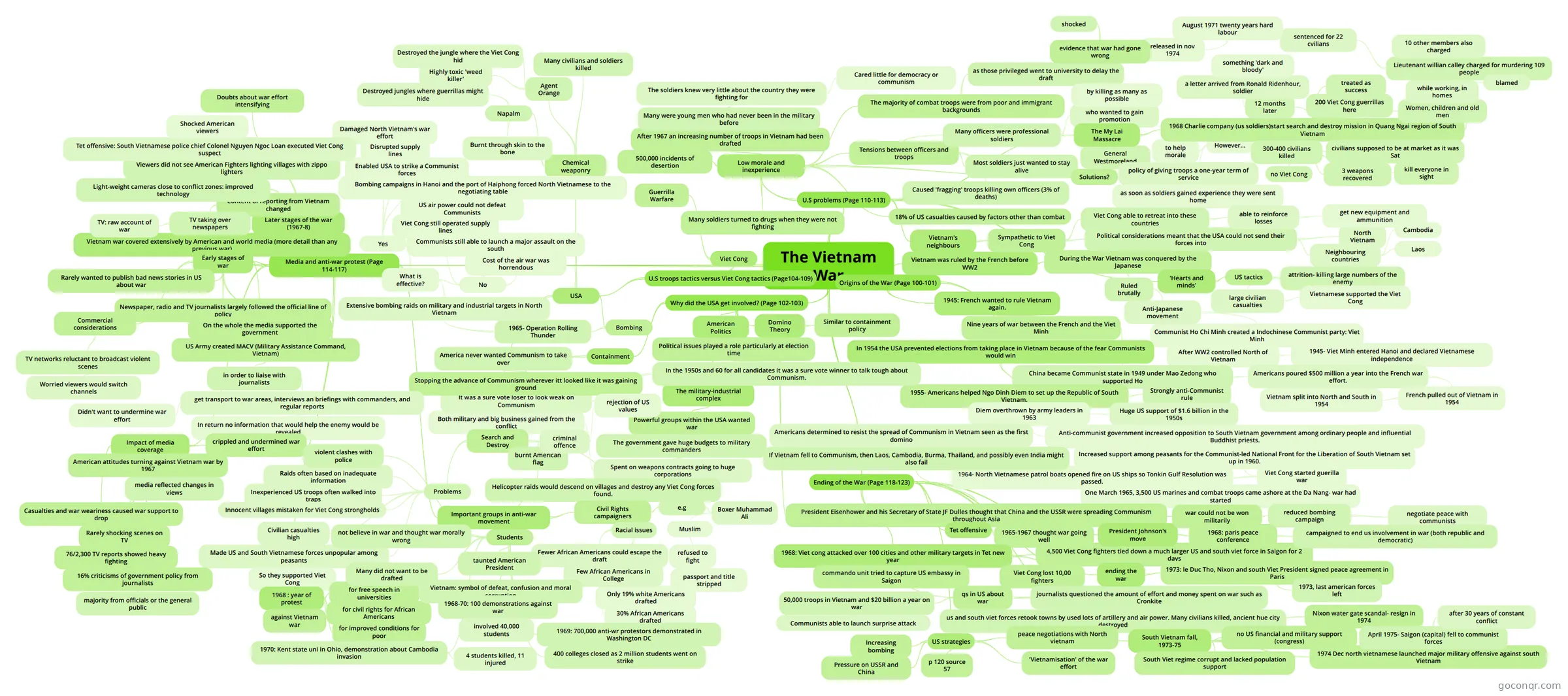
Mind map: The Vietnam War
Conteúdo do mapa
The Vietnam War
Origins of the War (Page 100-101)
- Vietnam was ruled by the French before WW2
- During the War Vietnam was conquered by the Japanese
- Ruled brutally
- Anti-Japanese movement
- Communist Ho Chi Minh created a Indochinese Communist party: Viet Minh
- After WW2 controlled North of Vietnam
- 1945- Viet Minh entered Hanoi and declared Vietnamese independence
- After WW2 controlled North of Vietnam
- Communist Ho Chi Minh created a Indochinese Communist party: Viet Minh
- Anti-Japanese movement
- Ruled brutally
- During the War Vietnam was conquered by the Japanese
- 1945: French wanted to rule Vietnam again.
- Nine years of war between the French and the Viet Minh
- China became Communist state in 1949 under Mao Zedong who supported Ho
- Americans poured $500 million a year into the French war effort.
- French pulled out of Vietnam in 1954
- Vietnam split into North and South in 1954
- French pulled out of Vietnam in 1954
- Americans poured $500 million a year into the French war effort.
- China became Communist state in 1949 under Mao Zedong who supported Ho
- Nine years of war between the French and the Viet Minh
- In 1954 the USA prevented elections from taking place in Vietnam because of the fear Communists would win
- 1955- Americans helped Ngo Dinh Diem to set up the Republic of South Vietnam.
- Strongly anti-Communist rule
- Huge US support of $1.6 billion in the 1950s
- Diem overthrown by army leaders in 1963
- Anti-communist government increased opposition to South Vietnam government among ordinary people and influential Buddhist priests.
- Increased support among peasants for the Communist-led National Front for the Liberation of South Vietnam set up in 1960.
- Viet Cong started guerilla war
- One March 1965, 3,500 US marines and combat troops came ashore at the Da Nang- war had started
- 1964- North Vietnamese patrol boats opened fire on US ships so Tonkin Gulf Resolution was passed.
- Viet Cong started guerilla war
- Increased support among peasants for the Communist-led National Front for the Liberation of South Vietnam set up in 1960.
- Anti-communist government increased opposition to South Vietnam government among ordinary people and influential Buddhist priests.
- Diem overthrown by army leaders in 1963
- Huge US support of $1.6 billion in the 1950s
- Strongly anti-Communist rule
- 1955- Americans helped Ngo Dinh Diem to set up the Republic of South Vietnam.
- Vietnam was ruled by the French before WW2
Why did the USA get involved? (Page 102-103)
- The military-industrial complex
- Powerful groups within the USA wanted war
- The government gave huge budgets to military commanders
- Spent on weapons contracts going to huge corporations
- Both military and big business gained from the conflict
- Spent on weapons contracts going to huge corporations
- The government gave huge budgets to military commanders
- Powerful groups within the USA wanted war
- Containment
- Stopping the advance of Communism wherever itt looked like it was gaining ground
- America never wanted Communism to take over
- Stopping the advance of Communism wherever itt looked like it was gaining ground
- American Politics
- Political issues played a role particularly at election time
- In the 1950s and 60 for all candidates it was a sure vote winner to talk tough about Communism.
- It was a sure vote loser to look weak on Communism
- In the 1950s and 60 for all candidates it was a sure vote winner to talk tough about Communism.
- Political issues played a role particularly at election time
- Domino Theory
- President Eisenhower and his Secretary of State JF Dulles thought that China and the USSR were spreading Communism throughout Asia
- If Vietnam fell to Communism, then Laos, Cambodia, Burma, Thailand, and possibly even India might also fail
- Americans determined to resist the spread of Communism in Vietnam seen as the first domino
- If Vietnam fell to Communism, then Laos, Cambodia, Burma, Thailand, and possibly even India might also fail
- Similar to containment policy
- President Eisenhower and his Secretary of State JF Dulles thought that China and the USSR were spreading Communism throughout Asia
- The military-industrial complex
U.S troops tactics versus Viet Cong tactics (Page104-109)
- Viet Cong
- Guerrilla Warfare
- USA
- Bombing
- 1965- Operation Rolling Thunder
- Extensive bombing raids on military and industrial targets in North Vietnam
- What is effective?
- Yes
- Damaged North Vietnam's war effort
- Disrupted supply lines
- Enabled USA to strike a Communist forces
- Bombing campaigns in Hanoi and the port of Haiphong forced North Vietnamese to the negotiating table
- No
- US air power could not defeat Communists
- Viet Cong still operated supply lines
- Communists still able to launch a major assault on the south
- Cost of the air war was horrendous
- Yes
- What is effective?
- Extensive bombing raids on military and industrial targets in North Vietnam
- 1965- Operation Rolling Thunder
- Chemical weaponry
- Napalm
- Destroyed jungles where guerrillas might hide
- Burnt through skin to the bone
- Agent Orange
- Highly toxic 'weed killer'
- Destroyed the jungle where the Viet Cong hid
- Many civilians and soldiers killed
- Napalm
- Search and Destroy
- Helicopter raids would descend on villages and destroy any Viet Cong forces found.
- Problems
- Raids often based on inadequate information
- Inexperienced US troops often walked into traps
- Innocent villages mistaken for Viet Cong strongholds
- Civilian casualties high
- Made US and South Vietnamese forces unpopular among peasants
- So they supported Viet Cong
- Bombing
- Viet Cong
U.S problems (Page 110-113)
- Low morale and inexperience
- After 1967 an increasing number of troops in Vietnam had been drafted
- Many were young men who had never been in the military before
- The soldiers knew very little about the country they were fighting for
- Cared little for democracy or communism
- The soldiers knew very little about the country they were fighting for
- Many were young men who had never been in the military before
- The majority of combat troops were from poor and immigrant backgrounds
- as those privileged went to university to delay the draft
- Tensions between officers and troops
- Many officers were professional soldiers
- who wanted to gain promotion
- by killing as many as possible
- who wanted to gain promotion
- Most soldiers just wanted to stay alive
- Caused 'fragging' troops killing own officers (3% of deaths)
- Many officers were professional soldiers
- Many soldiers turned to drugs when they were not fighting
- 500,000 incidents of desertion
- 18% of US casualties caused by factors other than combat
- Solutions?
- General Westmoreland
- policy of giving troops a one-year term of service
- to help morale
- However...
- as soon as soldiers gained experience they were sent home
- However...
- to help morale
- policy of giving troops a one-year term of service
- General Westmoreland
- After 1967 an increasing number of troops in Vietnam had been drafted
- Vietnam's neighbours
- Sympathetic to Viet Cong
- Political considerations meant that the USA could not send their forces into
- North Vietnam
- Neighbouring countries
- Cambodia
- Laos
- Viet Cong able to retreat into these countries
- able to reinforce losses
- get new equipment and ammunition
- able to reinforce losses
- Political considerations meant that the USA could not send their forces into
- Sympathetic to Viet Cong
- 'Hearts and minds'
- US tactics
- attrition- killing large numbers of the enemy
- large civilian casualties
- Vietnamese supported the Viet Cong
- large civilian casualties
- attrition- killing large numbers of the enemy
- US tactics
- The My Lai Massacre
- 1968 Charlie company (us soldiers)start search and destroy mission in Quang Ngai region of South Vietnam
- 200 Viet Cong guerrillas here
- 300-400 civilians killed
- no Viet Cong
- Women, children and old men
- while working, in homes
- 3 weapons recovered
- kill everyone in sight
- civilians supposed to be at market as it was Sat
- treated as success
- 12 months later
- a letter arrived from Ronald Ridenhour, soldier
- something 'dark and bloody'
- a letter arrived from Ronald Ridenhour, soldier
- Lieutenant willian calley charged for murdering 109 people
- 10 other members also charged
- sentenced for 22 cvilians
- August 1971 twenty years hard labour
- released in nov 1974
- August 1971 twenty years hard labour
- blamed
- evidence that war had gone wrong
- shocked
- 1968 Charlie company (us soldiers)start search and destroy mission in Quang Ngai region of South Vietnam
- Low morale and inexperience
Ending of the War (Page 118-123)
- Tet offensive
- 1965-1967 thought war going well
- 1968: Viet cong attacked over 100 cities and other military targets in Tet new year
- commando unit tried to capture US embassy in Saigon
- 4,500 Viet Cong fighters tied down a much larger US and south viet force in Saigon for 2 days
- Viet Cong lost 10,00 fighters
- qs in US about war
- 50,000 troops in Vietnam and $20 billion a year on war
- Communists able to launch surprise attack
- us and south viet forces retook towns by used lots of artillery and air power. Many civilians killed, ancient hue city destroyed
- journalists questioned the amount of effort and money spent on war such as Cronkite
- 50,000 troops in Vietnam and $20 billion a year on war
- President Johnson's move
- war could not be won militarily
- reduced bombing campaign
- negotiate peace with communists
- reduced bombing campaign
- 1968: paris peace conference
- campaigned to end us involvement in war (both republic and democratic)
- war could not be won militarily
- ending the war
- 1973: le Duc Tho, Nixon and south Viet President signed peace agreement in Paris
- 1973, last american forces left
- 1973: le Duc Tho, Nixon and south Viet President signed peace agreement in Paris
- US strategies
- peace negotiations with North vietnam
- 'Vietnamisation' of the war effort
- Increasing bombing
- Pressure on USSR and China
- p 120 source 57
- South Vietnam fall, 1973-75
- no US financial and military support (congress)
- South Viet regime corrupt and lacked population support
- Nixon water gate scandal- resign in 1974
- 1974 Dec north vietnamese launched major military offensive against south Vietnam
- April 1975- Saigon (capital) fell to communist forces
- after 30 years of constant conflict
- April 1975- Saigon (capital) fell to communist forces
- Tet offensive
Media and anti-war protest (Page 114-117)
- Vietnam war covered extensively by American and world media (more detail than any previous war)
- Early stages of war
- Newspaper, radio and TV journalists largely followed the official line of policy
- On the whole the media supported the government
- US Army created MACV (Military Assistance Command, Vietnam)
- in order to liaise with journalists
- get transport to war areas, interviews an briefings with commanders, and regular reports
- In return no information that would help the enemy would be revealed
- Didn't want to undermine war effort
- get transport to war areas, interviews an briefings with commanders, and regular reports
- in order to liaise with journalists
- Rarely wanted to publish bad news stories in US about war
- Commercial considerations
- TV networks reluctant to broadcast violent scenes
- Worried viewers would switch channels
- TV networks reluctant to broadcast violent scenes
- Later stages of the war (1967-8)
- Content of reporting from Vietnam changed
- TV taking over newspapers
- TV: raw account of war
- Light-weight cameras close to conflict zones: improved technology
- Viewers did not see American Fighters lighting villages with zippo lighters
- Tet offensive: South Vietnamese police chief Colonel Nguyen Ngoc Loan executed Viet Cong suspect
- Shocked American viewers
- Tet offensive: South Vietnamese police chief Colonel Nguyen Ngoc Loan executed Viet Cong suspect
- TV taking over newspapers
- Doubts about war effort intensifying
- Content of reporting from Vietnam changed
- Impact of media coverage
- crippled and undermined war effort
- American attitudes turning against Vietnam war by 1967
- media reflected changes in views
- Casualties and war weariness caused war support to drop
- Rarely shocking scenes on TV
- 76/2,300 TV reports showed heavy fighting
- 16% criticisms of government policy from journalists
- majority from officials or the general public
- 1968 : year of protest
- for free speech in universities
- for civil rights for African Americans
- for improved conditions for poor
- against Vietnam war
- Important groups in anti-war movement
- Students
- Many did not want to be drafted
- not believe in war and thought war morally wrong
- Vietnam: symbol of defeat, confusion and moral corruption
- taunted American President
- 1968-70: 100 demonstrations against war
- involved 40,000 students
- 1969: 700,000 anti-wr protestors demonstrated in Washington DC
- burnt American flag
- criminal offence
- rejection of US values
- criminal offence
- violent clashes with police
- 1970: Kent state uni in Ohio, demonstration about Cambodia invasion
- 4 students killed, 11 injured
- 400 colleges closed as 2 million students went on strike
- Civil Rights campaigners
- e.g
- Boxer Muhammad Ali
- Muslim
- refused to fight
- passport and title stripped
- refused to fight
- Muslim
- Boxer Muhammad Ali
- Racial issues
- Fewer African Americans could escape the draft
- 30% African Americans drafted
- Only 19% white Americans drafted
- Few African Americans in College
- Fewer African Americans could escape the draft
- e.g
- Students
Informações
- Descrição
- Mapa Mental sobre The Vietnam War, criado por juliet.tremble em 18-04-2014.
- Criado por
- juliet.tremble
- Visualizações
- 37
- Avaliação