
Mapa mental
DEMOGRAPHY
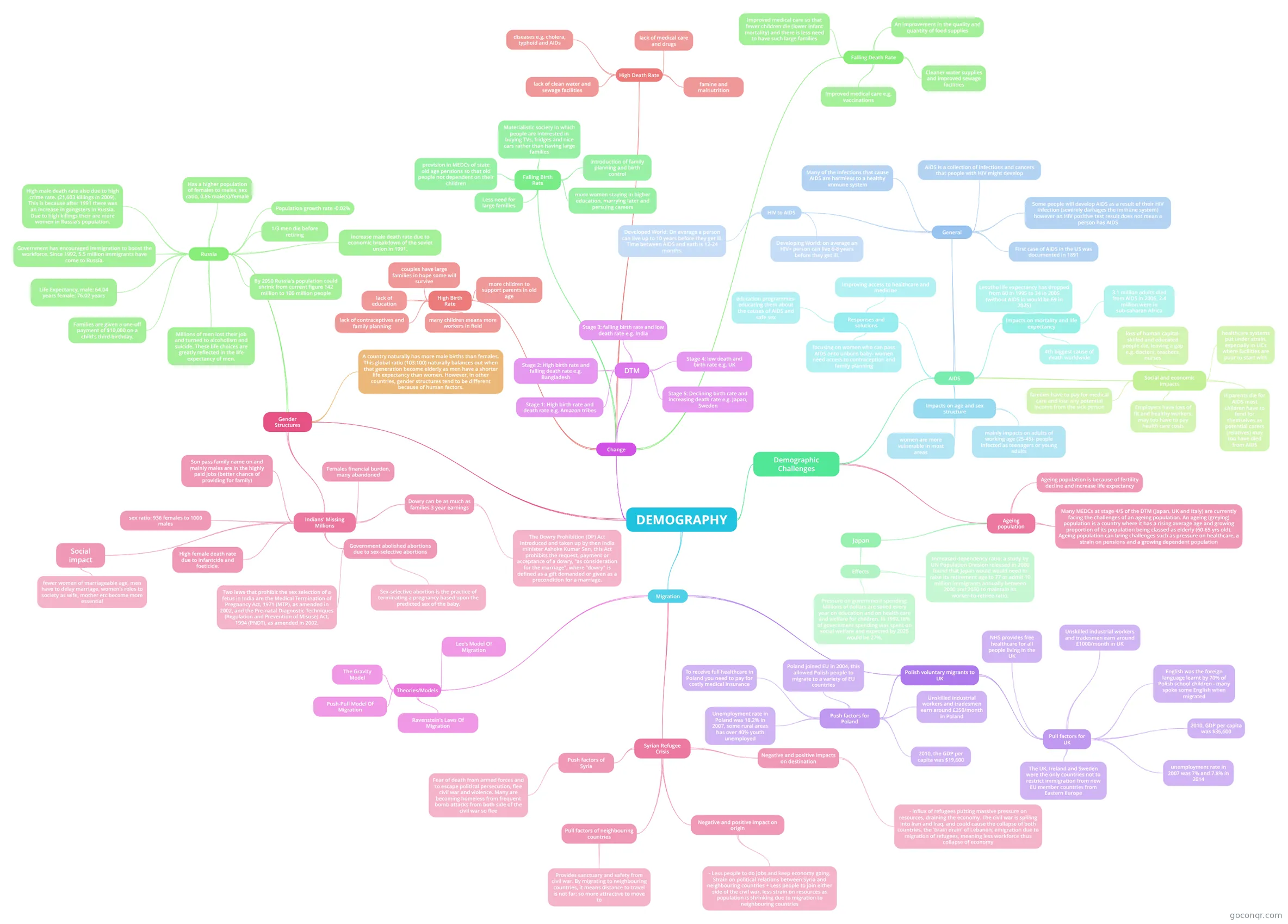
Mind map: Demography
Conteúdo do mapa
DEMOGRAPHY
Migration
- Syrian Refugee Crisis
- Push factors of Syria
- Fear of death from armed forces and to escape political persecution, flee civil war and violence. Many are becoming homeless from frequent bomb attacks from both side of the civil war so flee
- Pull factors of neighbouring countries
- Provides sanctuary and safety from civil war. By migrating to neighbouring countries, it means distance to travel is not far; so more attractive to move to
- Negative and positive impact on origin
- - Less people to do jobs and keep economy going. Strain on political relations between Syria and neighbouring countries + Less people to join either side of the civil war, less strain on resources as population is shrinking due to migration to neighbouring countries
- Negative and positive impacts on destination
- - Influx of refugees putting massive pressure on resources, draining the economy. The civil war is spilling into Iran and Iraq, and could cause the collapse of both countries, the 'brain drain' of Lebanon; emigration due to migration of refugees, meaning less workforce thus collapse of economy
- Push factors of Syria
- Polish voluntary migrants to UK
- Push factors for Poland
- Poland joined EU in 2004, this allowed Polish people to migrate to a variety of EU countries
- Unskilled industrial workers and tradesmen earn around £250/month in Poland
- 2010, the GDP per capita was $19,600
- To receive full healthcare in Poland you need to pay for costly medical insurance
- Unemployment rate in Poland was 18.2% in 2007, some rural areas has over 40% youth unemployed
- Pull factors for UK
- Unskilled industrial workers and tradesmen earn around £1000/month in UK
- 2010, GDP per capita was $36,600
- unemployment rate in 2007 was 7% and 7.8% in 2014
- NHS provides free healthcare for all people living in the UK
- The UK, Ireland and Sweden were the only countries not to restrict immigration from new EU member countries from Eastern Europe
- English was the foreign language learnt by 70% of Polish school children - many spoke some English when migrated
- Push factors for Poland
- Theories/Models
- The Gravity Model
- Push-Pull Model Of Migration
- Ravenstein's Laws Of Migration
- Lee's Model Of Migration
- Syrian Refugee Crisis
Change
- DTM
- Stage 1: High birth rate and death rate e.g. Amazon tribes
- Stage 2: High birth rate and falling death rate e.g. Bangladesh
- Stage 3: falling birth rate and low death rate e.g. India
- Stage 4: low death and birth rate e.g. UK
- Stage 5: Declining birth rate and increasing death rate e.g. Japan, Sweden
- High Birth Rate
- couples have large families in hope some will survive
- lack of education
- lack of contraceptives and family planning
- many children means more workers in field
- more children to support parents in old age
- Falling Birth Rate
- introduction of family planning and birth control
- more women staying in higher education, marrying later and persuing careers
- Less need for large families
- provision in MEDCs of state old age pensions so that old people not dependent on their children
- Materialistic society in which people are interested in buying TVs, fridges and nice cars rather than having large families
- High Death Rate
- diseases e.g. cholera, typhoid and AIDs
- lack of medical care and drugs
- lack of clean water and sewage facilities
- famine and malnutrition
- Falling Death Rate
- An improvement in the quality and quantity of food supplies
- Cleaner water supplies and improved sewage facilities
- Improved medical care e.g. vaccinations
- Improved medical care so that fewer children die (lower infant mortality) and there is less need to have such large families
- DTM
Gender Structures
- Indians' Missing Millions
- Females financial burden, many abandoned
- Dowry can be as much as families 3 year earnings
- The Dowry Prohibition (DP) Act Introduced and taken up by then Indla minister Ashoke Kumar Sen, this Act prohibits the request, payment or acceptance of a dowry, "as consideration for the marriage", where "dowry" is defined as a gift demanded or given as a precondition for a marriage.
- Government abolished abortions due to sex-selective abortions
- Sex-selective abortion is the practice of terminating a pregnancy based upon the predicted sex of the baby.
- Two laws that prohibit the sex selection of a fetus in India are the Medical Termination of Pregnancy Act, 1971 (MTP), as amended in 2002, and the Pre-natal Diagnostic Techniques (Regulation and Prevention of Misuse) Act, 1994 (PNDT), as amended in 2002.
- High female death rate due to infantcide and foeticide.
- Female foeticide is the act of aborting a foetus because it is female. Female infantcide is the intentionally killing of female infants because they are female.
- sex ratio: 936 females to 1000 males
- Son pass family name on and mainly males are in the highly paid jobs (better chance of providing for family)
- Social impact
- fewer women of marriageable age, men have to delay marriage, women's roles to society as wife, mother etc become more essential
- A country naturally has more male births than females. This global ratio (103:100) naturally balances out when that generation become elderly as men have a shorter life expectancy than women. However, in other countries, gender structures tend to be different because of human factors.
- Russia
- Has a higher population of females to males, sex ratio, 0.86 male(s)/female
- Increase male death rate due to economic breakdown of the soviet union in 1991.
- Millions of men lost their job and turned to alcoholism and suicide. These life choices are greatly reflected in the life expectancy of men.
- Life Expectancy, male: 64.04 years female: 76.02 years
- High male death rate also due to high crime rate. (21,603 killings in 2009). This is because after 1991 there was an increase in gangsters in Russia. Due to high killings their are more women in Russia's population.
- By 2050 Russia's population could shrink from current figure 142 million to 100 million people
- 1/3 men die before retiring
- Government has encouraged immigration to boost the workforce. Since 1992, 5.5 million immigrants have come to Russia.
- Families are given a one-off payment of $10,000 on a child's third birthday.
- Population growth rate -0.02%
- Indians' Missing Millions
Demographic Challenges
- AIDS
- Impacts on mortality and life expectancy
- 4th biggest cause of death worldwide
- 3.1 million adults died from AIDS in 2005, 2.4 million were in sub-saharan Africa
- Lesotho life expectancy has dropped from 60 in 1995 to 34 in 2005 (without AIDS in would be 69 in 2025)
- Impacts on age and sex structure
- women are more vulnerable in most areas
- mainly impacts on adults of working age (25-45)- people infected as teenagers or young adults
- Social and economic impacts
- families have to pay for medical care and lose any potential income from the sick person
- loss of human capital- skilled and educated people die, leaving a gap e.g. doctors, teachers, nurses
- healthcare systems put under strain, especially in LICs where facilities are poor to start with
- Employers have loss of fit and healthy workers, may too have to pay health care costs
- If parents die for AIDS most children have to fend for themselves as potential carers (relatives) may too have died from AIDS
- Responses and solutions
- focusing on women who can pass AIDS onto unborn baby- women need access to contraception and family planning
- education programmes- educating them about the causes of AIDS and safe sex
- Improving access to healthcare and medicine
- General
- First case of AIDS in the US was documented in 1891
- Some people will develop AIDS as a result of their HIV infection (severely damages the immune system) however an HIV positive test result does not mean a person has AIDS
- AIDS is a collection of infections and cancers that people with HIV might develop
- Many of the infections that cause AIDS are harmless to a healthy immune system
- HIV to AIDS
- Developed World: On average a person can live up to 10 years before they get ill. Time between AIDS and eath is 12-24 months.
- Developing World: on average an HIV+ person can live 6-8 years before they get ill.
- Impacts on mortality and life expectancy
- Ageing population
- Many MEDCs at stage 4/5 of the DTM (Japan, UK and Italy) are currently facing the challenges of an ageing population. An ageing (greying) population is a country where it has a rising average age and growing proportion of its population being classed as elderly (60-65 yrs old). Ageing population can bring challenges such as pressure on healthcare, a strain on pensions and a growing dependent population
- Ageing population is because of fertility decline and increase life expectancy
- Japan
- Effects
- Increased dependency ratio: a study by UN Population Division released in 2000 found that Japan would would need to raise its retirement age to 77 or admit 10 million immigrants annually between 2000 and 2050 to maintain its worker-to-retiree ratio.
- Pressure on government spending: Millions of dollars are saved every year on education and on health care and welfare for children. In 1992,18% of government spending was spent on social welfare and expected by 2025 would be 27%.
- Effects
- AIDS
Informações
- Descrição
- A Levels geography Mapa Mental sobre DEMOGRAPHY, criado por kat kd em 22-04-2014.
- Criado por
- kat kd
- Visualizações
- 19
- Avaliação