
Mapa mental
Acids and Bases
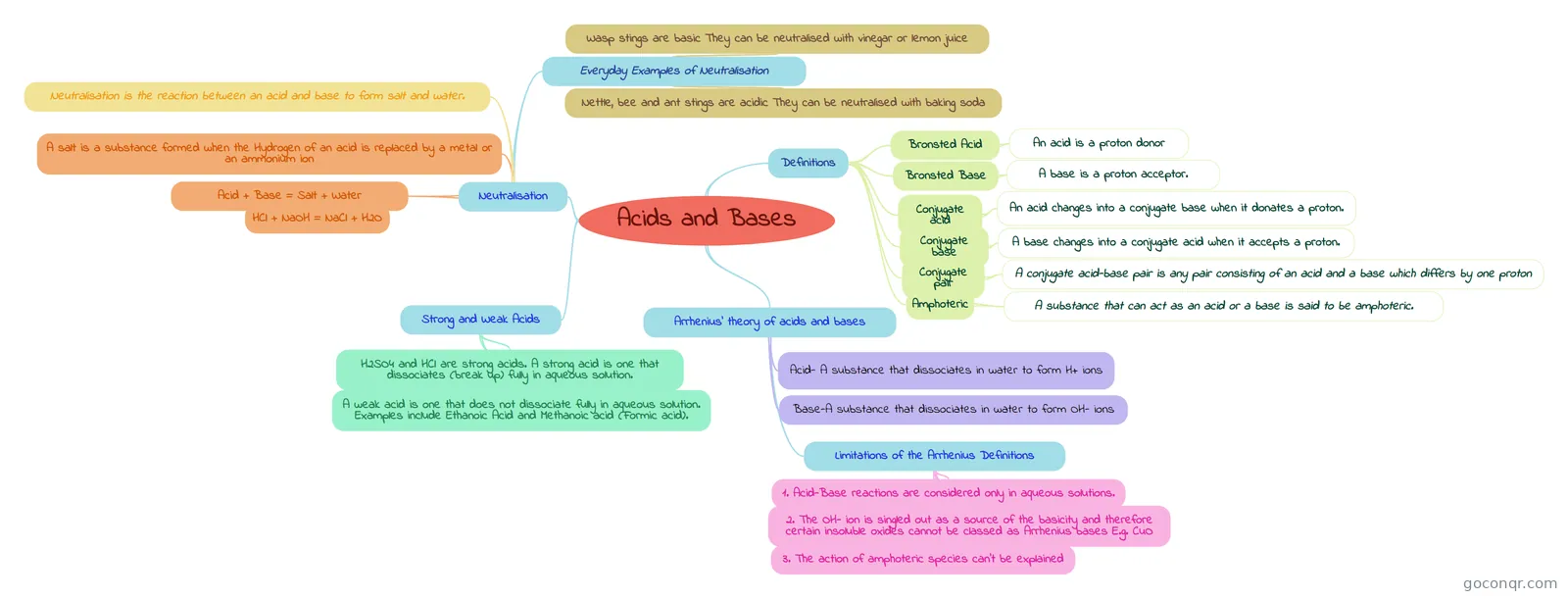
Mind map: acids and bases
Conteúdo do mapa
Acids and Bases
Arrhenius' theory of acids and bases
- Acid- A substance that dissociates in water to form H+ ions
- Base-A substance that dissociates in water to form OH- ions
- Limitations of the Arrhenius Definitions
- 1. Acid-Base reactions are considered only in aqueous solutions.
- 2. The OH- ion is singled out as a source of the basicity and therefore certain insoluble oxides cannot be classed as Arrhenius bases E.g. CuO
- 3. The action of amphoteric species can't be explained
Strong and Weak Acids
- H2SO4 and HCl are strong acids. A strong acid is one that dissociates (break up) fully in aqueous solution.
- A weak acid is one that does not dissociate fully in aqueous solution. Examples include Ethanoic Acid and Methanoic acid (Formic acid).
Neutralisation
- Neutralisation is the reaction between an acid and base to form salt and water.
- Acid + Base = Salt + Water
- HCl + NaOH = NaCl + H2O
- A salt is a substance formed when the Hydrogen of an acid is replaced by a metal or an ammonium ion
- Everyday Examples of Neutralisation
- Wasp stings are basic They can be neutralised with vinegar or lemon juice
- Nettle, bee and ant stings are acidic They can be neutralised with baking soda
Definitions
- Conjugate acid
- An acid changes into a conjugate base when it donates a proton.
- Conjugate base
- A base changes into a conjugate acid when it accepts a proton.
- Conjugate pair
- A conjugate acid-base pair is any pair consisting of an acid and a base which differs by one proton
- Bronsted Acid
- An acid is a proton donor
- Bronsted Base
- A base is a proton acceptor.
- Amphoteric
- A substance that can act as an acid or a base is said to be amphoteric.
- Conjugate acid
Informações
- Descrição
- Chemistry Mapa Mental sobre Acids and Bases, criado por emmajarvis96 em 30-04-2014.
- Criado por
- emmajarvis96
- Visualizações
- 28
- Avaliação