
Mapa mental
Electoral Systems UK
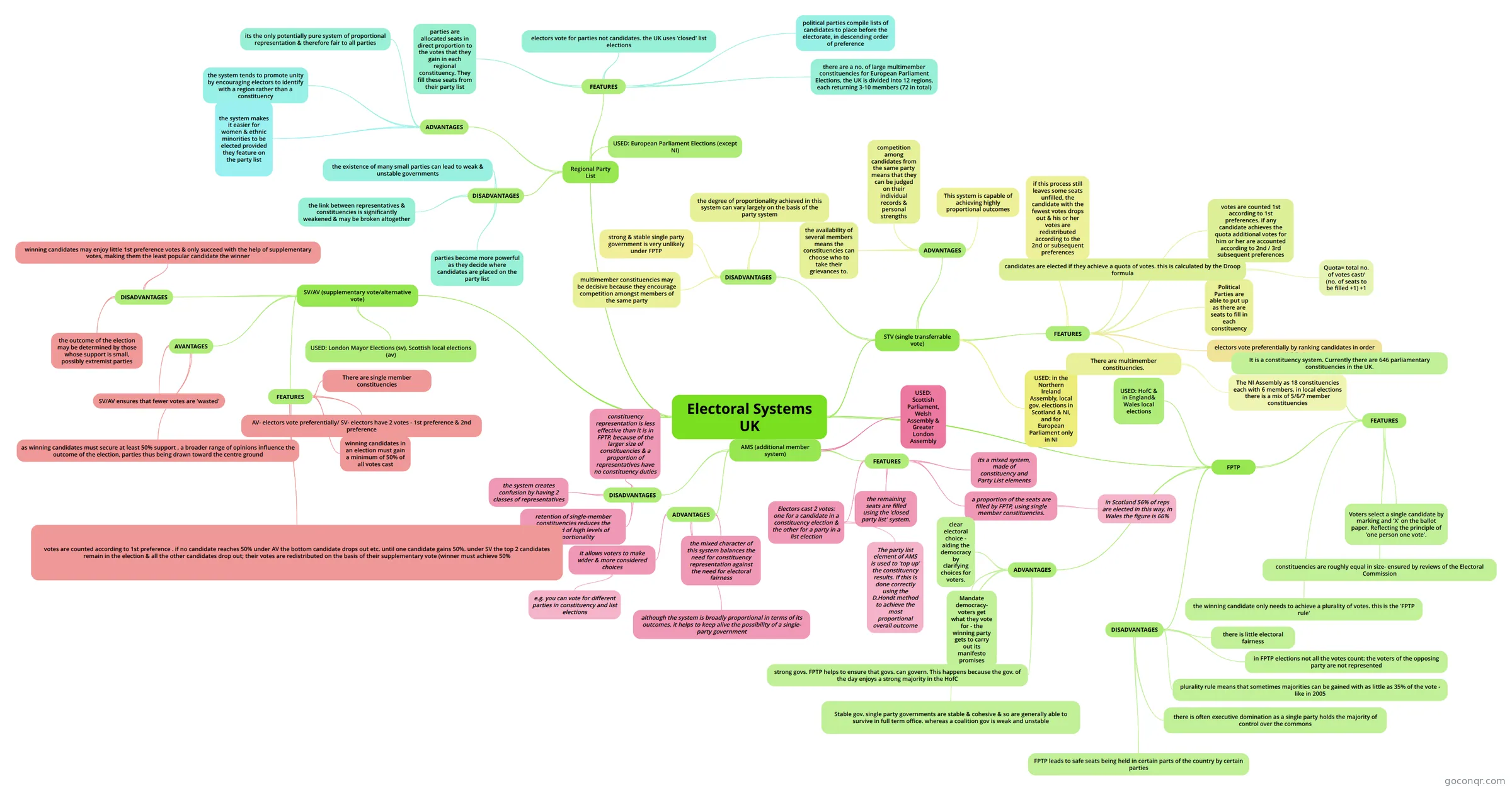
Mind map: Electoral systems UK
Conteúdo do mapa
Electoral Systems UK
AMS (additional member system)
- USED: Scottish Parliament, Welsh Assembly & Greater London Assembly
- FEATURES
- its a mixed system, made of constituency and Party List elements
- a proportion of the seats are filled by FPTP, using single member constituencies.
- in Scotland 56% of reps are elected in this way, in Wales the figure is 66%
- the remaining seats are filled using the 'closed party list' system.
- Electors cast 2 votes: one for a candidate in a constituency election & the other for a party in a list election
- The party list element of AMS is used to 'top up' the constituency results. If this is done correctly using the D.Hondt method to achieve the most proportional overall outcome
- ADVANTAGES
- the mixed character of this system balances the need for constituency representation against the need for electoral fairness
- although the system is broadly proportional in terms of its outcomes, it helps to keep alive the possibility of a single- party government
- it allows voters to make wider & more considered choices
- e.g. you can vote for different parties in constituency and list elections
- DISADVANTAGES
- retention of single-member constituencies reduces the likelihood of high levels of proportionality
- the system creates confusion by having 2 classes of representatives
- constituency representation is less effective than it is in FPTP, because of the larger size of constituencies & a proportion of representatives have no constituency duties
STV (single transferrable vote)
- USED: in the Northern Ireland Assembly, local gov. elections in Scotland & NI, and for European Parliament only in NI
- FEATURES
- There are multimember constituencies.
- The NI Assembly as 18 constituencies each with 6 members. in local elections there is a mix of 5/6/7 member constituencies
- Political Parties are able to put up as there are seats to fill in each constituency
- electors vote preferentially by ranking candidates in order (1,2,3...)
- candidates are elected if they achieve a quota of votes. this is calculated by the Droop formula
- Quota= total no. of votes cast/ (no. of seats to be filled +1) +1
- votes are counted 1st according to 1st preferences. if any candidate achieves the quota additional votes for him or her are accounted according to 2nd / 3rd subsequent preferences
- if this process still leaves some seats unfilled, the candidate with the fewest votes drops out & his or her votes are redistributed according to the 2nd or subsequent preferences
- There are multimember constituencies.
- ADVANTAGES
- This system is capable of achieving highly proportional outcomes
- competition among candidates from the same party means that they can be judged on their individual records & personal strengths
- the availability of several members means the constituencies can choose who to take their grievances to.
- DISADVANTAGES
- the degree of proportionality achieved in this system can vary largely on the basis of the party system
- strong & stable single party government is very unlikely under FPTP
- multimember constituencies may be decisive because they encourage competition amongst members of the same party
Regional Party List
- USED: European Parliament Elections (except NI)
- FEATURES
- there are a no. of large multimember constituencies for European Parliament Elections, the UK is divided into 12 regions, each returning 3-10 members (72 in total)
- political parties compile lists of candidates to place before the electorate, in descending order of preference
- electors vote for parties not candidates. the UK uses 'closed' list elections
- parties are allocated seats in direct proportion to the votes that they gain in each regional constituency. They fill these seats from their party list
- ADVANTAGES
- its the only potentially pure system of proportional representation & therefore fair to all parties
- the system tends to promote unity by encouraging electors to identify with a region rather than a constituency
- the system makes it easier for women & ethnic minorities to be elected provided they feature on the party list
- DISADVANTAGES
- the existence of many small parties can lead to weak & unstable governments
- the link between representatives & constituencies is significantly weakened & may be broken altogether
- parties become more powerful as they decide where candidates are placed on the party list
SV/AV (supplementary vote/alternative vote)
- USED: London Mayor Elections (sv), Scottish local elections (av)
- FEATURES
- There are single member constituencies
- AV- electors vote preferentially/ SV- electors have 2 votes - 1st preference & 2nd preference
- winning candidates in an election must gain a minimum of 50% of all votes cast
- votes are counted according to 1st preference . if no candidate reaches 50% under AV the bottom candidate drops out etc. until one candidate gains 50%. under SV the top 2 candidates remain in the election & all the other candidates drop out; their votes are redistributed on the basis of their supplementary vote (winner must achieve 50%
- AVANTAGES
- SV/AV ensures that fewer votes are 'wasted'
- as winning candidates must secure at least 50% support , a broader range of opinions influence the outcome of the election, parties thus being drawn toward the centre ground
- DISADVANTAGES
- the outcome of the election may be determined by those whose support is small, possibly extremist parties
- winning candidates may enjoy little 1st preference votes & only succeed with the help of supplementary votes, making them the least popular candidate the winner
FPTP
- USED: HofC & in England& Wales local elections
- FEATURES
- It is a constituency system. Currently there are 646 parliamentary constituencies in the UK.
- Voters select a single candidate by marking and 'X' on the ballot paper. Reflecting the principle of 'one person one vote'.
- constituencies are roughly equal in size- ensured by reviews of the Electoral Commission
- the winning candidate only needs to achieve a plurality of votes. this is the 'FPTP rule'
- ADVANTAGES
- clear electoral choice - aiding the democracy by clarifying choices for voters.
- Mandate democracy- voters get what they vote for - the winning party gets to carry out its manifesto promises
- strong govs. FPTP helps to ensure that govs. can govern. This happens because the gov. of the day enjoys a strong majority in the HofC
- Stable gov. single party governments are stable & cohesive & so are generally able to survive in full term office. whereas a coalition gov is weak and unstable
- DISADVANTAGES
- there is little electoral fairness
- in FPTP elections not all the votes count: the voters of the opposing party are not represented
- plurality rule means that sometimes majorities can be gained with as little as 35% of the vote - like in 2005
- there is often executive domination as a single party holds the majority of control over the commons
- FPTP leads to safe seats being held in certain parts of the country by certain parties
Informações
- Descrição
- AS level Politics Mapa Mental sobre Electoral Systems UK, criado por abigailmc96 em 07-05-2014.
- Criado por
- abigailmc96
- Visualizações
- 19
- Avaliação
Mais sobre Electoral Systems and Redistricting