
Mapa mental
Social learning
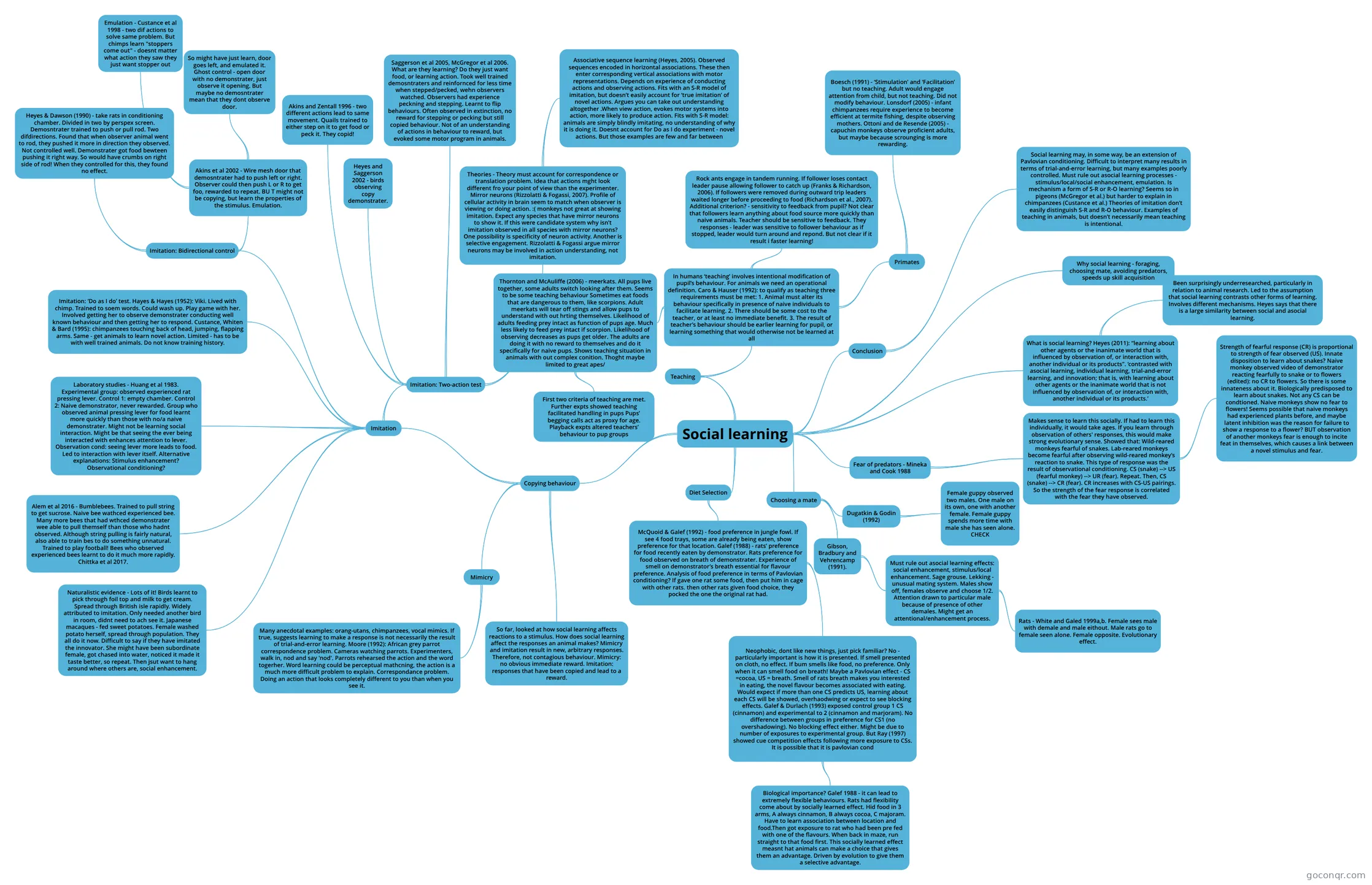
Mind map: Social learning
Conteúdo do mapa
Social learning
Why social learning - foraging, choosing mate, avoiding predators, speeds up skill acquisition
What is social learning? Heyes (2011): “learning about other agents or the inanimate world that is influenced by observation of, or interaction with, another individual or its products”. ‘contrasted with asocial learning, individual learning, trial-and-error learning, and innovation; that is, with learning about other agents or the inanimate world that is not influenced by observation of, or interaction with, another individual or its products.’
- Been surprisingly underresearched, particularly in relation to animal research. Led to the assumption that social learning contrasts other forms of learning. Involves different mechanisms. Heyes says that there is a large similarity between social and asocial learning.
Fear of predators - Mineka and Cook 1988
- Makes sense to learn this socially. If had to learn this individually, it would take ages. If you learn through observation of others' responses, this would make strong evolutionary sense. Showed that: Wild-reared monkeys fearful of snakes. Lab-reared monkeys become fearful after observing wild-reared monkey’s reaction to snake. This type of response was the result of observational conditioning. CS (snake) --> US (fearful monkey) --> UR (fear). Repeat. Then, CS (snake) --> CR (fear). CR increases with CS-US pairings. So the strength of the fear response is correlated with the fear they have observed.
- Strength of fearful response (CR) is proportional to strength of fear observed (US). Innate disposition to learn about snakes? Naive monkey observed video of demonstrator reacting fearfully to snake or to flowers (edited): no CR to flowers. So there is some innateness about it. Biologically predisposed to learn about snakes. Not any CS can be condtioned. Naive monkeys show no fear to flowers! Seems possible that naive monkeys had experienced plants before, and maybe latent inhibition was the reason for failure to show a response to a flower? BUT observation of another monkeys fear is enough to incite feat in themselves, which causes a link between a novel stimulus and fear.
- Makes sense to learn this socially. If had to learn this individually, it would take ages. If you learn through observation of others' responses, this would make strong evolutionary sense. Showed that: Wild-reared monkeys fearful of snakes. Lab-reared monkeys become fearful after observing wild-reared monkey’s reaction to snake. This type of response was the result of observational conditioning. CS (snake) --> US (fearful monkey) --> UR (fear). Repeat. Then, CS (snake) --> CR (fear). CR increases with CS-US pairings. So the strength of the fear response is correlated with the fear they have observed.
Choosing a mate
- Dugatkin & Godin (1992)
- Female guppy observed two males. One male on its own, one with another female. Female guppy spends more time with male she has seen alone. CHECK
- Gibson, Bradbury and Vehrencamp (1991).
- Must rule out asocial learning effects: social enhancement, stimulus/local enhancement. Sage grouse. Lekking - unusual mating system. Males show off, females observe and choose 1/2. Attention drawn to particular male because of presence of other demales. Might get an attentional/enhancement process.
- Rats - White and Galed 1999a,b. Female sees male with demale and male eithout. Male rats go to female seen alone. Female opposite. Evolutionary effect.
- Must rule out asocial learning effects: social enhancement, stimulus/local enhancement. Sage grouse. Lekking - unusual mating system. Males show off, females observe and choose 1/2. Attention drawn to particular male because of presence of other demales. Might get an attentional/enhancement process.
- Dugatkin & Godin (1992)
Diet Selection
- McQuoid & Galef (1992) - food preference in jungle fowl. If see 4 food trays, some are already being eaten, show preference for that location. Galef (1988) - rats’ preference for food recently eaten by demonstrator. Rats preference for food observed on breath of demonstrater. Experience of smell on demonstrator’s breath essential for flavour preference. Analysis of food preference in terms of Pavlovian conditioning? If gave one rat some food, then put him in cage with other rats. then other rats given food choice, they pocked the one the original rat had.
- Neophobic, dont like new things, just pick familiar? No - particularly important is how it is presented. If smell presented on cloth, no effect. If bum smells like food, no preference. Only when it can smell food on breath! Maybe a Pavlovian effect - CS =cocoa, US = breath. Smell of rats breath makes you interested in eating, the novel flavour becomes associated with eating. Would expect if more than one CS predicts US, learning about each CS will be showed, overhaodwing or expect to see blocking effects. Galef & Durlach (1993) exposed control group 1 CS (cinnamon) and experimental to 2 (cinnamon and marjoram). No difference between groups in preference for CS1 (no overshadowing). No blocking effect either. Might be due to number of exposures to experimental group. But Ray (1997) showed cue competition effects following more exposure to CSs. It is possible that it is pavlovian cond
- Biological importance? Galef 1988 - it can lead to extremely flexible behaviours. Rats had flexibility come about by socially learned effect. Hid food in 3 arms, A always cinnamon, B always cocoa, C majoram. Have to learn association between location and food.Then got exposure to rat who had been pre fed with one of the flavours. When back in maze, run straight to that food first. This socially learned effect measnt hat animals can make a choice that gives them an advantage. Driven by evolution to give them a selective advantage.
- Neophobic, dont like new things, just pick familiar? No - particularly important is how it is presented. If smell presented on cloth, no effect. If bum smells like food, no preference. Only when it can smell food on breath! Maybe a Pavlovian effect - CS =cocoa, US = breath. Smell of rats breath makes you interested in eating, the novel flavour becomes associated with eating. Would expect if more than one CS predicts US, learning about each CS will be showed, overhaodwing or expect to see blocking effects. Galef & Durlach (1993) exposed control group 1 CS (cinnamon) and experimental to 2 (cinnamon and marjoram). No difference between groups in preference for CS1 (no overshadowing). No blocking effect either. Might be due to number of exposures to experimental group. But Ray (1997) showed cue competition effects following more exposure to CSs. It is possible that it is pavlovian cond
- McQuoid & Galef (1992) - food preference in jungle fowl. If see 4 food trays, some are already being eaten, show preference for that location. Galef (1988) - rats’ preference for food recently eaten by demonstrator. Rats preference for food observed on breath of demonstrater. Experience of smell on demonstrator’s breath essential for flavour preference. Analysis of food preference in terms of Pavlovian conditioning? If gave one rat some food, then put him in cage with other rats. then other rats given food choice, they pocked the one the original rat had.
Copying behaviour
- So far, looked at how social learning affects reactions to a stimulus. How does social learning affect the responses an animal makes? Mimicry and imitation result in new, arbitrary responses. Therefore, not contagious behaviour. Mimicry: no obvious immediate reward. Imitation: responses that have been copied and lead to a reward.
- Mimicry
- Many anecdotal examples: orang-utans, chimpanzees, vocal mimics. If true, suggests learning to make a response is not necessarily the result of trial-and-error learning. Moore (1992): African grey parrot correspondence problem. Cameras watching parrots. Experimenters, walk in, nod and say 'nod'. Parrots rehearsed the action and the word togerher. Word learning could be perceptual mathcning, the action is a much more difficult problem to explain. Correspondance problem. Doing an action that looks completely different to you than when you see it.
- Imitation
- Naturalistic evidence - Lots of it! Birds learnt to pick through foil top and milk to get cream. Spread through British isle rapidly. Widely attributed to imitation. Only needed another bird in room, didnt need to ach see it. Japanese macaques - fed sweet potatoes. Female washed potato herself, spread through population. They all do it now. Difficult to say if they have imitated the innovator. She might have been subordinate female, got chased into water, noticed it made it taste better, so repeat. Then jsut want to hang around where others are, social enhancement.
- Alem et al 2016 - Bumblebees. Trained to pull string to get sucrose. Naive bee wathced experienced bee. Many more bees that had wthced demonstrater wee able to pull themself than those who hadnt observed. Although string pulling is fairly natural, also able to train bes to do something unnatural. Trained to play football! Bees who observed experienced bees learnt to do it much more rapidly. Chittka et al 2017.
- Laboratory studies - Huang et al 1983. Experimental group: observed experienced rat pressing lever. Control 1: empty chamber. Control 2: Naive demonstrator, never rewarded. Group who observed animal pressing lever for food learnt more quickly than those with no/a naive demonstrater. Might not be learning social interaction. Might be that seeing the ever being interacted with enhances attention to lever. Observation cond: seeing lever more leads to food. Led to interaction with lever itself. Alternative explanations: Stimulus enhancement? Observational conditioning?
- Imitation: ‘Do as I do’ test. Hayes & Hayes (1952): Viki. Lived with chimp. Trained to soem words. Could wash up. Play game with her. Involved getting her to observe demonstrater conducting well known behaviour and then getting her to respond. Custance, Whiten & Bard (1995): chimpanzees touching back of head, jumping, flapping arms. Same - get animals to learn novel action. Limited - has to be with well trained animals. Do not know training history.
- Imitation: Bidirectional control
- Heyes & Dawson (1990) - take rats in conditioning chamber. Divided in two by perspex screen. Demosntrater trained to push or pull rod. Two difdirections. Found that when observer animal went to rod, they pushed it more in direction they observed. Not controlled well. Demonstrater got food bewteen pushing it right way. So would have crumbs on right side of rod! When they controlled for this, they found no effect.
- Akins et al 2002 - Wire mesh door that demosntrater had to push left or right. Observer could then push L or R to get foo, rewarded to repeat. BU T might not be copying, but learn the properties of the stimulus. Emulation.
- Emulation - Custance et al 1998 - two dif actions to solve same problem. But chimps learn "stoppers come out" - doesnt matter what action they saw they just want stopper out
- So might have just learn, door goes left, and emulated it. Ghost control - open door with no demonstrater, just observe it opening. But maybe no demosntrater mean that they dont observe door.
- Imitation: Two-action test
- Akins and Zentall 1996 - two different actions lead to same movement. Quails trained to either step on it to get food or peck it. They copid!
- Heyes and Saggerson 2002 - birds observing copy demonstrater.
- Saggerson et al 2005, McGregor et al 2006. What are they learning? Do they just want food, or learning action. Took well trained demosntraters and reinfornced for less time when stepped/pecked, wehn observers watched. Observers had experience peckning and stepping. Learnt to flip behaviours. Often observed in extinction, no reward for stepping or pecking but still copied behaviour. Not of an understanding of actions in behaviour to reward, but evoked some motor program in animals.
- Theories - Theory must account for correspondence or translation problem. Idea that actions mght look different fro your point of view than the experimenter. Mirror neurons (Rizzolatti & Fogassi, 2007). Profile of cellular activity in brain seem to match when observer is viewing or doing action. :( monkeys not great at showing imitation. Expect any species that have mirror neurons to show it. If this were candidate system why isn’t imitation observed in all species with mirror neurons? One possibility is specificity of neuron activity. Another is selective engagement. Rizzolatti & Fogassi argue mirror neurons may be involved in action understanding, not imitation.
- Associative sequence learning (Heyes, 2005). Observed sequences encoded in horizontal associations. These then enter corresponding vertical associations with motor representations. Depends on experience of conducting actions and observing actions. Fits with an S-R model of imitation, but doesn’t easily account for ‘true imitation’ of novel actions. Argues you can take out understanding altogether .When view action, evokes motor systems into action, more likely to produce action. Fits with S-R model: animals are simply blindly imitating, no understanding of why it is doing it. Doesnt account for Do as I do experiment - novel actions. But those examples are few and far between
Teaching
- In humans ‘teaching’ involves intentional modification of pupil’s behaviour. For animals we need an operational definition. Caro & Hauser (1992): to qualify as teaching three requirements must be met: 1. Animal must alter its behaviour specifically in presence of naive individuals to facilitate learning. 2. There should be some cost to the teacher, or at least no immediate benefit. 3. The result of teacher’s behaviour should be earlier learning for pupil, or learning something that would otherwise not be learned at all
- Thornton and McAuliffe (2006) - meerkats. All pups live together, some adults switch looking after them. Seems to be some teaching behaviour Sometimes eat foods that are dangerous to them, like scorpions. Adult meerkats will tear off stings and allow pups to understand with out hrting themselves. Likelihood of adults feeding prey intact as function of pups age. Much less likely to feed prey intact if scorpion. Likelihood of observing decreases as pups get older. The adults are doing it with no reward to themselves and do it specifically for naive pups. Shows teaching situation in animals with out complex conition. Thoght maybe limited to great apes/
- First two criteria of teaching are met. Further expts showed teaching facilitated handling in pups Pups’ begging calls act as proxy for age. Playback expts altered teachers’ behaviour to pup groups
- Rock ants engage in tandem running. If follower loses contact leader pause allowing follower to catch up (Franks & Richardson, 2006). If followers were removed during outward trip leaders waited longer before proceeding to food (Richardson et al., 2007). Additional criterion? - sensitivity to feedback from pupil? Not clear that followers learn anything about food source more quickly than naive animals. Teacher should be sensitive to feedback. They responses - leader was sensitive to follower behaviour as if stopped, leader would turn around and repond. But not clear if it result i faster learning!
- Primates
- Boesch (1991) - ‘Stimulation’ and ‘Facilitation’ but no teaching. Adult would engage attention from child, but not teaching. Did not modify behaviour. Lonsdorf (2005) - infant chimpanzees require experience to become efficient at termite fishing, despite observing mothers. Ottoni and de Resende (2005) - capuchin monkeys observe proficient adults, but maybe because scrounging is more rewarding.
- Thornton and McAuliffe (2006) - meerkats. All pups live together, some adults switch looking after them. Seems to be some teaching behaviour Sometimes eat foods that are dangerous to them, like scorpions. Adult meerkats will tear off stings and allow pups to understand with out hrting themselves. Likelihood of adults feeding prey intact as function of pups age. Much less likely to feed prey intact if scorpion. Likelihood of observing decreases as pups get older. The adults are doing it with no reward to themselves and do it specifically for naive pups. Shows teaching situation in animals with out complex conition. Thoght maybe limited to great apes/
- In humans ‘teaching’ involves intentional modification of pupil’s behaviour. For animals we need an operational definition. Caro & Hauser (1992): to qualify as teaching three requirements must be met: 1. Animal must alter its behaviour specifically in presence of naive individuals to facilitate learning. 2. There should be some cost to the teacher, or at least no immediate benefit. 3. The result of teacher’s behaviour should be earlier learning for pupil, or learning something that would otherwise not be learned at all
Conclusion
- Social learning may, in some way, be an extension of Pavlovian conditioning. Difficult to interpret many results in terms of trial-and-error learning, but many examples poorly controlled. Must rule out asocial learning processes - stimulus/local/social enhancement, emulation. Is mechanism a form of S-R or R-O learning? Seems so in pigeons (McGregor et al.) but harder to explain in chimpanzees (Custance et al.) Theories of imitation don’t easily distinguish S-R and R-O behaviour. Examples of teaching in animals, but doesn’t necessarily mean teaching is intentional.
Informações
- Descrição
- Y3 Uni Learning and Animal Cognition - Anthony McGregor Mapa Mental sobre Social learning, criado por Issy de Silva em 06-04-2017.
- Criado por
- Issy de Silva
- Visualizações
- 0
- Avaliação