
Mapa mental
C6
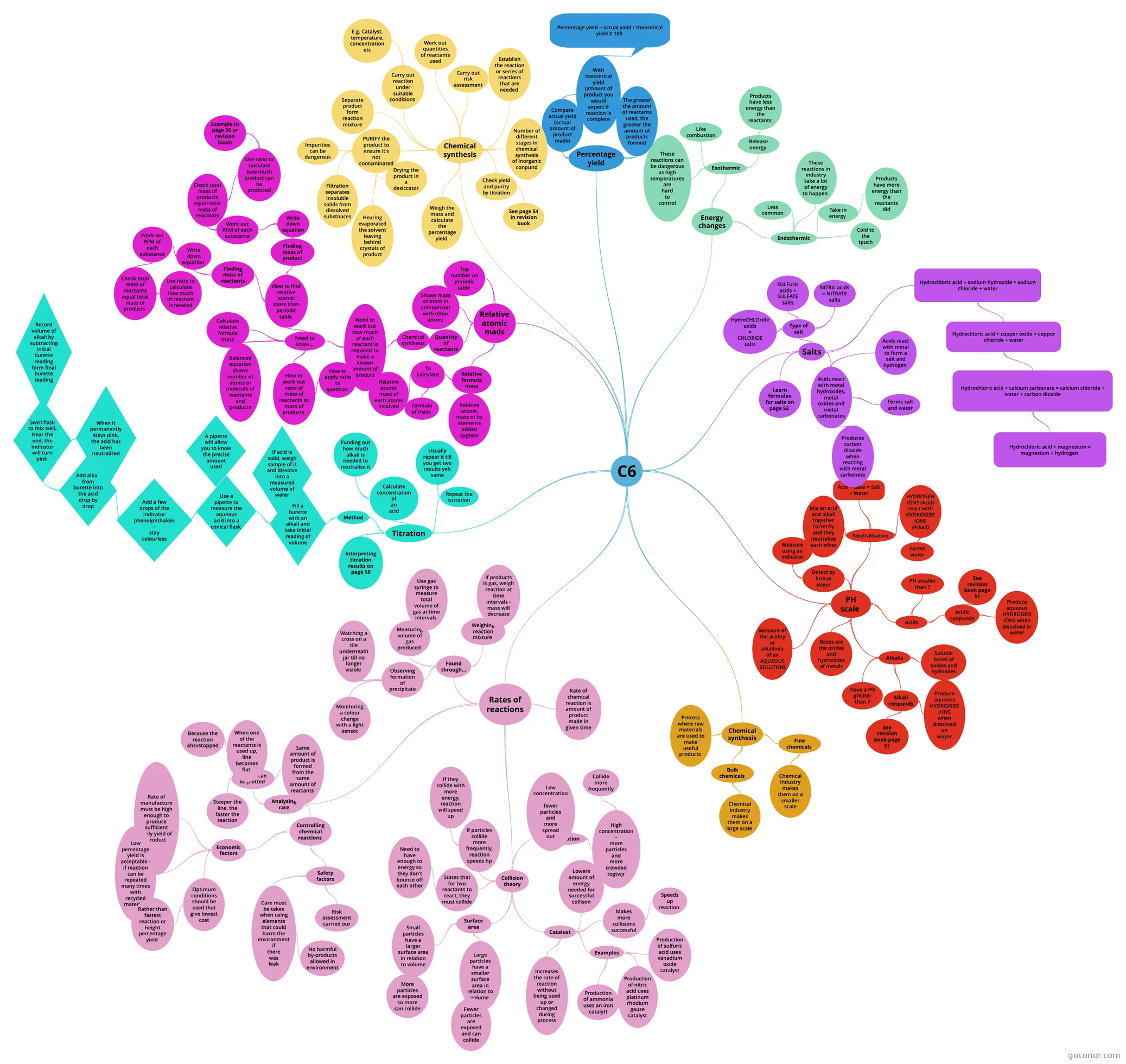
Mind map: Chemical synthesis
Conteúdo do mapa
C6
Chemical synthesis
- Process where raw materials are used to make useful products
- Bulk chemicals
- Chemical industry makes them on a large scale
- Fine chemicals
- Chemical industry makes them on a smaller scale
PH scale
- Measure of the acidity or alkalinity of an AQUEOUS SOLUTION
- Acids
- PH smaller than 7
- Acidic conpunds
- Produce aqueous HYDROGEN IONS when dissolved in water
- See revision book page 51
- Alkalis
- Have a PH greater than 7
- Soluble bases of oxides and hydroides
- Alkali conpunds
- Produce aqueous HYDROXIDE IONS when dissolved on wayer
- See revision book page 51
- Bases are the oxides and hydroxides of metals
- Detect by litmus paper
- Measure using an indicator
- Neutralisation
- Mix an acid and alkali together correctly and they neutralise each ofher
- Acid + Base = Salt + Water
- HYDROGEN IONS (Acid) react with HYDROXIDE IONS (Alkali)
- Forms water
Salts
- Acids react with metal hydroxides, metal oxides and metal carbonates
- Forms salt and water
- Produces carbon dioxide when reacting with metal carbonete
- Acids react with metal to form a salt and hydrogen
- Type of salt
- HydroCHLOride acids = CHLORIDE salts
- SULFuric acids = SULFATE salts
- NITRic acids = NITRATE salts
- Learn formulae for salts on page 53
- Hydrochloric acid + sodium hydroxide = sodium chloride + water
- Hydrochloric acid + copper oxide = copper chloride + water
- Hydrochloric acid + calcium carbonate = calcium chloride + water + carbon dioxide
- Hydrochloric acid + magnesium = magnesium + hydrogen
- Hydrochloric acid + calcium carbonate = calcium chloride + water + carbon dioxide
- Hydrochloric acid + copper oxide = copper chloride + water
- Acids react with metal hydroxides, metal oxides and metal carbonates
Energy changes
- Exothermic
- Like combustion
- Release energy
- Products have less energy than the reactants
- These reactions can be dangerous as high temperatures are hard to control
- Endothermic
- Less common
- Take in energy
- Products have more energy than the reactants did
- Cold to the tpuch
- These reactions in industry take a lot of energy to happen
- Exothermic
Percentage yield
- The greater the amount of reactants used, the greater the amount of products formed
- Compare actual yield (actual amount of product made)
- With theoretical yield (amount of product you would expect if reaction is complete
- Percentage yield = actual yield / theoretical yield X 100
- With theoretical yield (amount of product you would expect if reaction is complete
Chemical synthesis
- Number of different stages in chemical synthesis of inorganic conpund
- Establish the reaction or series of reactions that are needed
- Think this means exothermic and endothermic
- Carry out risk assessment
- Work out quantities of reactants used
- Carry out reaction under suitable conditions
- E.g. Catalyst, temperature, concentration etc
- Separate product form reaction mixture
- PURIFY the product to ensure it's not contaminated
- Impurities can be dangerous
- Filtration separates insoluble solids from dissolved substnaces
- Hearing evaporated the solvent leaving behind crystals of product
- Drying the product in a desiccator
- Weigh the mass and calculate the percentage yield
- Check yield and purity by titration
- See page 54 in revision book
Relative atomic mads
- Shows mass of atom in comparison with other atoms
- Top number on periodic table
- Relative formula mass
- Relative atomic mass of its elements added tpgtehr
- To calculate -
- Formula of mass
- Relative atomic mass of each atoms incolved
- Quantity of reactants
- Chemical synthesis
- Need to work out how much of each reactant is required to make a known amount of product
- Need to know...
- How to find relative atomic mass from periodic table
- Finding mass of product
- Write down equation
- Work out RFM of each substance
- Check total mass of products equal total mass of reactnats
- Use ratio to calculate how much product can be produced
- Example in page 56 or revision boom
- Use ratio to calculate how much product can be produced
- Check total mass of products equal total mass of reactnats
- Work out RFM of each substance
- Write down equation
- Finding mass of reactants
- Write down equation
- Work out RFM of each substance
- Check total mass of reactants equal total mass of products
- Use ratio to calculate how much of reactant is needed
- Check total mass of reactants equal total mass of products
- Work out RFM of each substance
- Write down equation
- Finding mass of product
- Calculate relative formula mass
- Balanced equation shows number of atoms or molecule of reactants and products
- How to work out ratio of mass of reactants to mass of products
- How to apply ratio to question
- How to find relative atomic mass from periodic table
- Need to know...
- Need to work out how much of each reactant is required to make a known amount of product
- Chemical synthesis
Titration
- Calculate concentration of an acid
- Funding out how much alkali is needed to neutralise it
- Method
- Fill a burette with an alkali and take initial reading of volume
- Use a pipette to measure the aqueous acid into a conical flask
- A pipette will allow you to know the precise amount used
- Add a few drops of the indicator phenolphthalein - stay colourless
- Add alkali from burette into the acid drop by drop
- Swirl flask to mix well. Near the end, the indicator will turn pink
- When it permanently stays pink, the acid has been neutralised
- Record volume of alkali by subtracting initial burette reading form final burette teading
- Swirl flask to mix well. Near the end, the indicator will turn pink
- Add alkali from burette into the acid drop by drop
- If acid is solid, weigh sample of it and dissolve into a measured volume of water
- Use a pipette to measure the aqueous acid into a conical flask
- Fill a burette with an alkali and take initial reading of volume
- Repeat the tutration
- Usually repeat it till you get two results yeh same
- Interpreting titration results on page 58
- Calculate concentration of an acid
Rates of reactions
- Rate of chemical reaction is amount of product made in given time
- Found through...
- Weighing reaction mixture
- If products is gas, weigh reaction at time intervals - mass will decrease
- Measuring volume of gas produced
- Use gas syringe to measure total volume of gas at time intervals
- Observing formation of precipitate
- Watching a cross on a tile underneath jar till no longer visible
- Monitoring a colour change with a light sensot
- Weighing reaction mixture
- Collision theory
- States that for two reactants to react, they must collide
- Need to have enough to energy so they don't bounce off each other
- If particles collide more frequently, reaction speeds hp
- If they collide with more energy, reaction will speed up
- Concentration
- Low concentration - fewer particles and more spread out
- High concentration - more particles and more crowded togtwjr
- Collide more frequently
- Surface area
- Large particles have a smaller surface area in relation to volume
- Fewer particles are exposed and can collide
- Small particles have a larger surface area in relation to volume
- More particles are exposed so more can collide
- Large particles have a smaller surface area in relation to volume
- Catalust
- Increases the rate of reaction without being used up or changed during process
- Lowers amount of energy needed for successful collison
- Makes more collisions successful
- Speeds up reaction
- Examples
- Production of ammonia uses an iron catalytt
- Production of sulfuric acid uses vanadium oxide catalyst
- Production of nitric acid uses platinum rhodium gauze catalyst
- States that for two reactants to react, they must collide
- Analysing rate
- Graphs can be plotted
- Steeper the line, the faster the teaction
- When one of the reactants is used up, line becomes flat
- Because the reaction ahsvstopped
- Same amount of product is formed from the same amount of reactants
- Controlling chemical reactions
- Economic factors
- Rate of manufacture must be high enough to produce sufficient daily yield of product
- Low percentage yield is acceptable - if reaction can be repeated many times with recycled materials
- Optimum conditions should be used that give lowest cost
- Rather than fastest reaction or height percentage yield
- Safety factors
- Care must be takes when using elements that could harm the environment if there was leak
- No harmful by-products allowed in environment
- Risk assessment carried our
- Care must be takes when using elements that could harm the environment if there was leak
- Economic factors
- Graphs can be plotted
Informações
- Descrição
- Mapa Mental sobre C6, criado por Olivia Evenson em 13-04-2017.
- Criado por
- Olivia Evenson
- Visualizações
- 2
- Avaliação