
Mapa mental
physics-motion
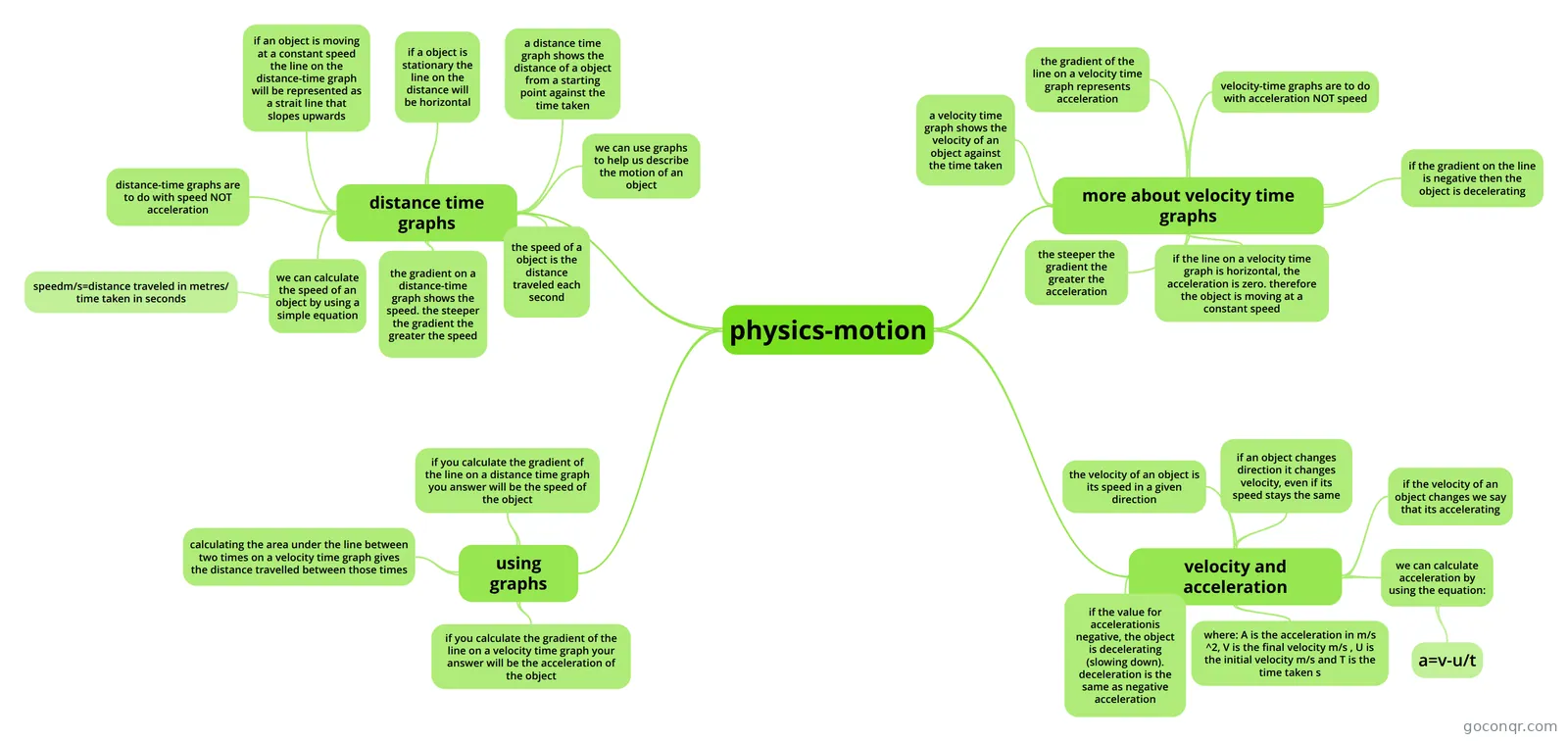
Mind map: physics motion graphs
Conteúdo do mapa
physics-motion
distance time graphs
- we can use graphs to help us describe the motion of an object
- a distance time graph shows the distance of a object from a starting point against the time taken
- the speed of a object is the distance traveled each second
- the gradient on a distance-time graph shows the speed. the steeper the gradient the greater the speed
- if a object is stationary the line on the distance will be horizontal
- if an object is moving at a constant speed the line on the distance-time graph will be represented as a strait line that slopes upwards
- we can calculate the speed of an object by using a simple equation
- speedm/s=distance traveled in metres/ time taken in seconds
- distance-time graphs are to do with speed NOT acceleration
more about velocity time graphs
- a velocity time graph shows the velocity of an object against the time taken
- the gradient of the line on a velocity time graph represents acceleration
- the steeper the gradient the greater the acceleration
- if the line on a velocity time graph is horizontal, the acceleration is zero. therefore the object is moving at a constant speed
- if the gradient on the line is negative then the object is decelerating
- velocity-time graphs are to do with acceleration NOT speed
velocity and acceleration
- the velocity of an object is its speed in a given direction
- if an object changes direction it changes velocity, even if its speed stays the same
- if the velocity of an object changes we say that its accelerating
- we can calculate acceleration by using the equation:
- a=v-u/t
- if the value for accelerationis negative, the object is decelerating (slowing down). deceleration is the same as negative acceleration
- where: A is the acceleration in m/s ^2, V is the final velocity m/s , U is the initial velocity m/s and T is the time taken s
using graphs
- if you calculate the gradient of the line on a distance time graph you answer will be the speed of the object
- if you calculate the gradient of the line on a velocity time graph your answer will be the acceleration of the object
- calculating the area under the line between two times on a velocity time graph gives the distance travelled between those times
Informações
- Descrição
- Mapa Mental sobre physics-motion, criado por shaunie.sle em 13-05-2014.
- Criado por
- shaunie.sle
- Visualizações
- 27
- Avaliação