
Mapa mental
Eating disorders
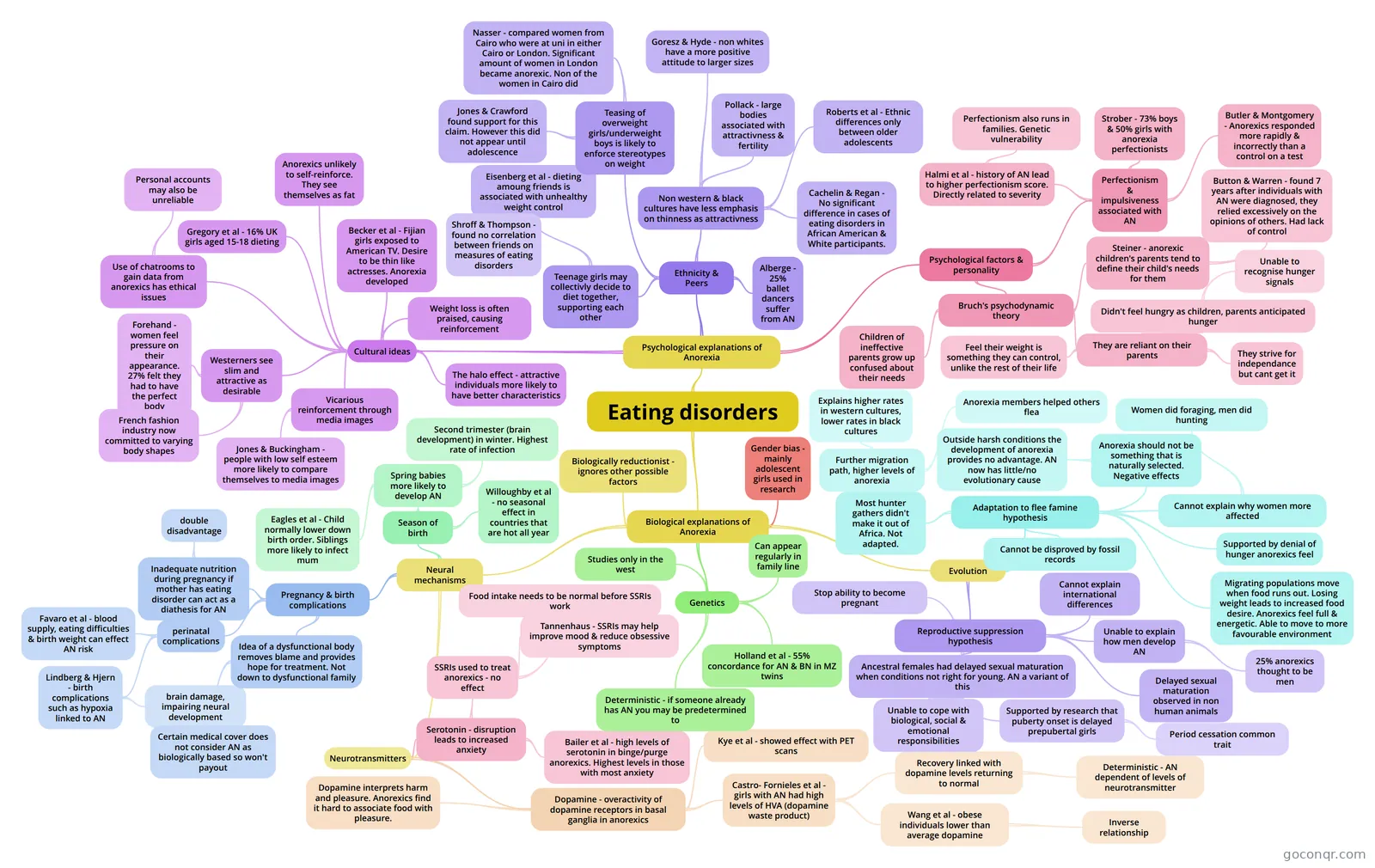
Mind map: Eating disorders
Conteúdo do mapa
Eating disorders
Psychological explanations of Anorexia
- Cultural ideas
- Westerners see slim and attractive as desirable
- Forehand - women feel pressure on their appearance. 27% felt they had to have the perfect body
- French fashion industry now committed to varying body shapes
- Weight loss is often praised, causing reinforcement
- Anorexics unlikely to self-reinforce. They see themselves as fat
- Vicarious reinforcement through media images
- Jones & Buckingham - people with low self esteem more likely to compare themselves to media images
- Gregory et al - 16% UK girls aged 15-18 dieting
- Use of chatrooms to gain data from anorexics has ethical issues
- Personal accounts may also be unreliable
- Becker et al - Fijian girls exposed to American TV. Desire to be thin like actresses. Anorexia developed
- The halo effect - attractive individuals more likely to have better characteristics
- Westerners see slim and attractive as desirable
- Ethnicity & Peers
- Non western & black cultures have less emphasis on thinness as attractivness
- Pollack - large bodies associated with attractivness & fertility
- Goresz & Hyde - non whites have a more positive attitude to larger sizes
- Cachelin & Regan - No significant difference in cases of eating disorders in African American & White participants.
- Roberts et al - Ethnic differences only between older adolescents
- Teenage girls may collectivly decide to diet together, supporting each other
- Eisenberg et al - dieting amoung friends is associated with unhealthy weight control
- Shroff & Thompson - found no correlation between friends on measures of eating disorders
- Eisenberg et al - dieting amoung friends is associated with unhealthy weight control
- Teasing of overweight girls/underweight boys is likely to enforce stereotypes on weight
- Nasser - compared women from Cairo who were at uni in either Cairo or London. Significant amount of women in London became anorexic. Non of the women in Cairo did
- Jones & Crawford found support for this claim. However this did not appear until adolescence
- Alberge - 25% ballet dancers suffer from AN
- Non western & black cultures have less emphasis on thinness as attractivness
- Psychological factors & personality
- Bruch's psychodynamic theory
- Children of ineffective parents grow up confused about their needs
- They are reliant on their parents
- They strive for independance but cant get it
- Feel their weight is something they can control, unlike the rest of their life
- Didn't feel hungry as children, parents anticipated hunger
- Unable to recognise hunger signals
- Steiner - anorexic children's parents tend to define their child's needs for them
- Button & Warren - found 7 years after individuals with AN were diagnosed, they relied excessively on the opinions of others. Had lack of control
- Perfectionism & impulsiveness associated with AN
- Strober - 73% boys & 50% girls with anorexia perfectionists
- Butler & Montgomery - Anorexics responded more rapidly & incorrectly than a control on a test
- Halmi et al - history of AN lead to higher perfectionism score. Directly related to severity
- Perfectionism also runs in families. Genetic vulnerability
- Bruch's psychodynamic theory
- Cultural ideas
Biological explanations of Anorexia
- Neural mechanisms
- Neurotransmitters
- Serotonin - disruption leads to increased anxiety
- Bailer et al - high levels of serotonin in binge/purge anorexics. Highest levels in those with most anxiety
- SSRIs used to treat anorexics - no effect
- Food intake needs to be normal before SSRIs work
- Tannenhaus - SSRIs may help improve mood & reduce obsessive symptoms
- Dopamine - overactivity of dopamine receptors in basal ganglia in anorexics
- Kye et al - showed effect with PET scans
- Dopamine interprets harm and pleasure. Anorexics find it hard to associate food with pleasure.
- Castro- Fornieles et al - girls with AN had high levels of HVA (dopamine waste product)
- Wang et al - obese individuals lower than average dopamine
- Inverse relationship
- Recovery linked with dopamine levels returning to normal
- Deterministic - AN dependent of levels of neurotransmitter
- Wang et al - obese individuals lower than average dopamine
- Serotonin - disruption leads to increased anxiety
- Season of birth
- Spring babies more likely to develop AN
- Second trimester (brain development) in winter. Highest rate of infection
- Eagles et al - Child normally lower down birth order. Siblings more likely to infect mum
- Willoughby et al - no seasonal effect in countries that are hot all year
- Spring babies more likely to develop AN
- Pregnancy & birth complications
- Inadequate nutrition during pregnancy if mother has eating disorder can act as a diathesis for AN
- double disadvantage
- perinatal complications
- Lindberg & Hjern - birth complications such as hypoxia linked to AN
- brain damage, impairing neural development
- Favaro et al - blood supply, eating difficulties & birth weight can effect AN risk
- Lindberg & Hjern - birth complications such as hypoxia linked to AN
- Idea of a dysfunctional body removes blame and provides hope for treatment. Not down to dysfunctional family
- Certain medical cover does not consider AN as biologically based so won't payout
- Inadequate nutrition during pregnancy if mother has eating disorder can act as a diathesis for AN
- Neurotransmitters
- Genetics
- Can appear regularly in family line
- Holland et al - 55% concordance for AN & BN in MZ twins
- Studies only in the west
- Deterministic - if someone already has AN you may be predetermined to
- Evolution
- Adaptation to flee famine hypothesis
- Migrating populations move when food runs out. Losing weight leads to increased food desire. Anorexics feel full & energetic. Able to move to more favourable environment
- Supported by denial of hunger anorexics feel
- Cannot be disproved by fossil records
- Anorexia should not be something that is naturally selected. Negative effects
- Outside harsh conditions the development of anorexia provides no advantage. AN now has little/no evolutionary cause
- Cannot explain why women more affected
- Women did foraging, men did hunting
- Most hunter gathers didn't make it out of Africa. Not adapted.
- Further migration path, higher levels of anorexia
- Anorexia members helped others flea
- Explains higher rates in western cultures, lower rates in black cultures
- Further migration path, higher levels of anorexia
- Reproductive suppression hypothesis
- Ancestral females had delayed sexual maturation when conditions not right for young. AN a variant of this
- Stop ability to become pregnant
- Unable to cope with biological, social & emotional responsibilities
- Supported by research that puberty onset is delayed prepubertal girls
- Period cessation common trait
- Unable to explain how men develop AN
- 25% anorexics thought to be men
- Delayed sexual maturation observed in non human animals
- Cannot explain international differences
- Ancestral females had delayed sexual maturation when conditions not right for young. AN a variant of this
- Adaptation to flee famine hypothesis
- Biologically reductionist - ignores other possible factors
- Gender bias - mainly adolescent girls used in research
- Neural mechanisms
Informações
- Descrição
- Mindmap for AQA-A psychology unit 3 eating disorders
- Criado por
- Brendan Williams
- Visualizações
- 101
- Tags
- Histórico
-
- Criado por Brendan Williams · 14 mai 2014
- Copiado por Brendan Williams · 14 mai 2014
- Copiado por Brendan Williams · 14 mai 2014
- Avaliação