
Eating Behaviour and Eating Disorders
489 resources created by 245 users
This Eating Behaviour and Eating Disorders page on GoConqr gathers community-made mind maps, flashcards, quizzes, notes, slide sets and flowcharts, from attitudes to food and the success and failure of dieting to neural mechanisms and anorexia nervosa. It's built for school students revising for A-level Psychology, university students filling gaps, and teachers after ready-made material. There are over 480 resources here, including more than 340 mind maps and over 70 flashcard decks. Pick a topic, try a quiz to find your gaps, then make your own set.
Top Eating Behaviour and Eating Disorders resources
-
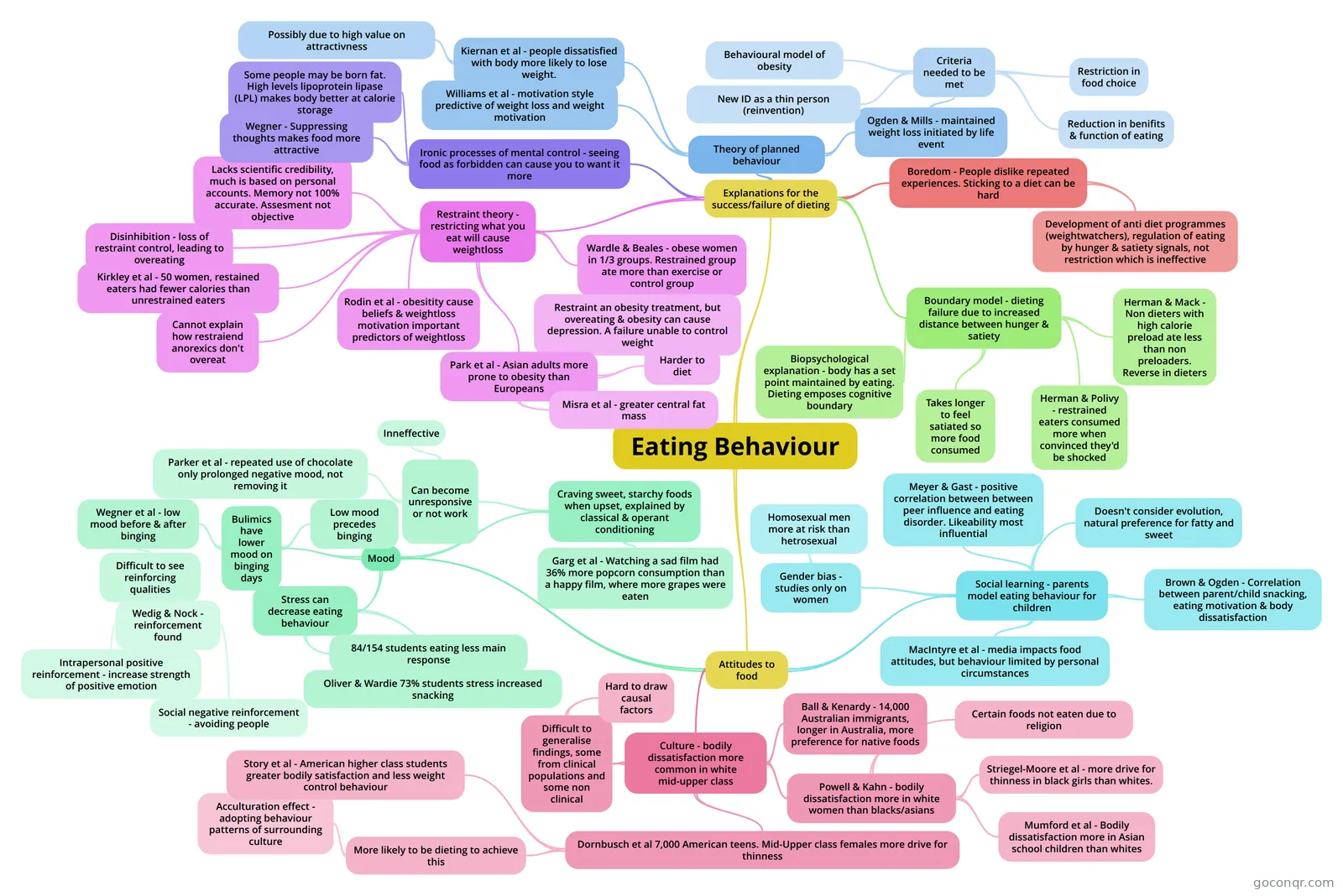 Mind map Eating Behaviour Mindmap for AQA-A psychology unit 3 eating behaviour
-
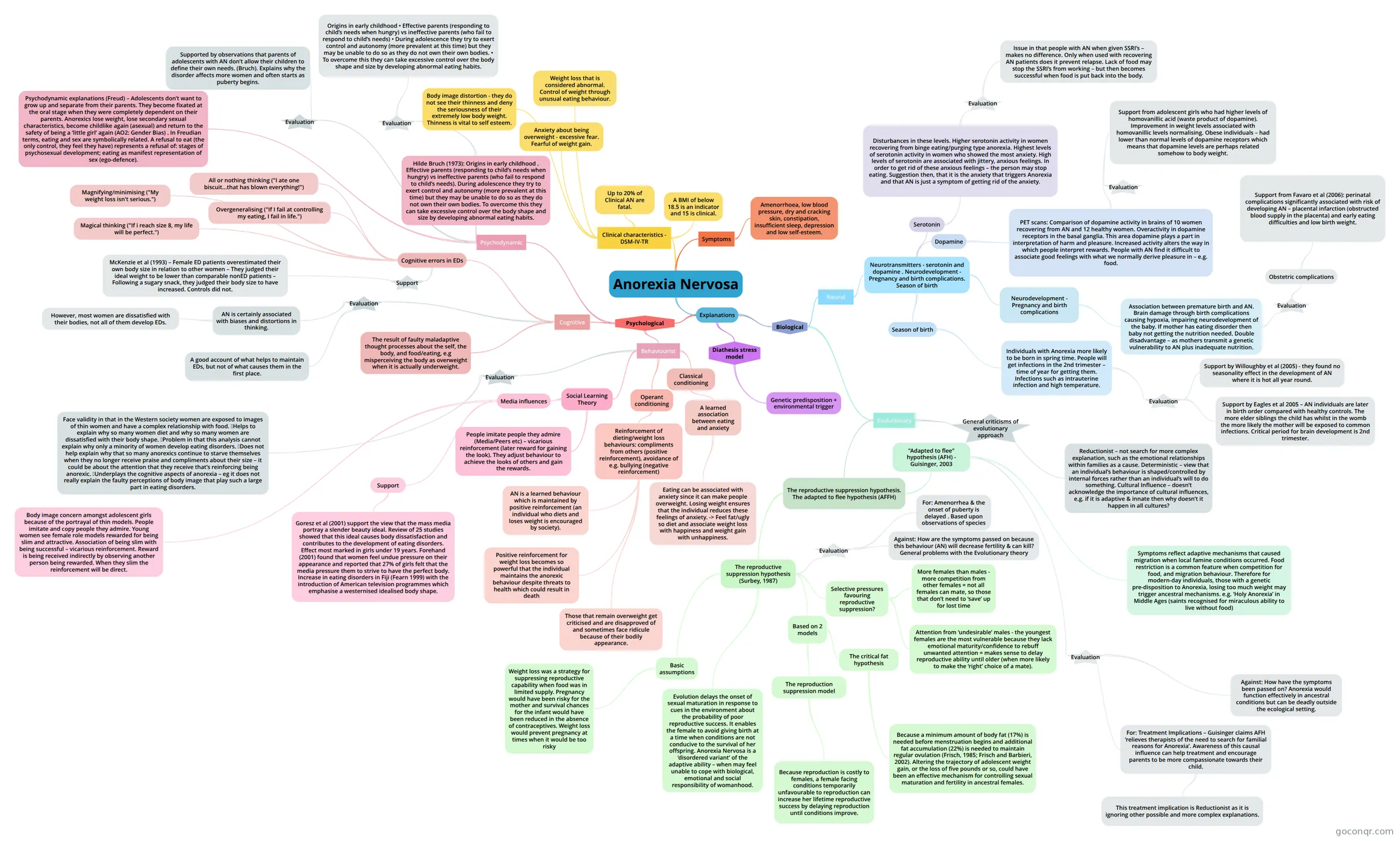 Mind map Anorexia Nervosa Explanations of Anorexia Nervosa
-
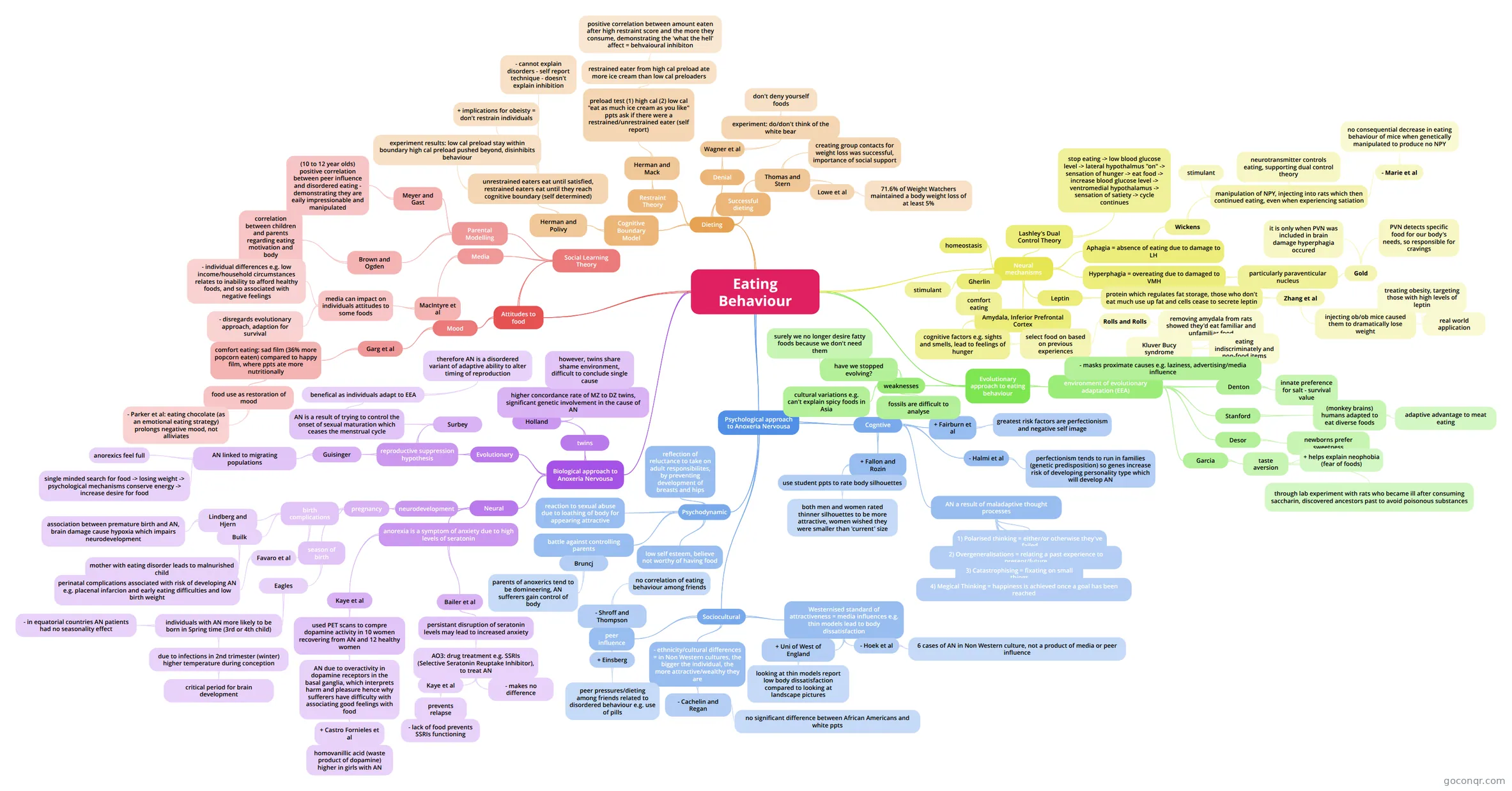 Mind map Eating Behaviour
-
46 cardsDiscuss Evolutionary Explanations of Food Preference In order to understand the adaptive problems faced by our ancestors we must understand the environment that...
-
 Mind map Attitudes towards food + eating Mind map outlining the A01 and A02 points for an essay
-
Mind map Success and failure of dieting Success and Failure of Dieting for AQA A A2 Psychology PSYA3 Eating Behaviour
-
11 cardsGuardia et al. (2012) 11 cards
-
Mind map biological explanations of anorexia nervosa
Quizzes
See all 19 quizzes-
42 questionsMH 433 Eating disorders The following are indicative of anorexia. Select all that apply.
-
18 questionsEating Behaviours What are four factors that influence attitudes to food and eating behaviours?
-
11 questionsBiological explanations of eating behaviour NEURAL MECHANISMS IN EATING BEHAVIOUR BRAIN STRUCTURES ASSOCIATED WITH EATING BEHAVIOUR - DUAL CONTROL THEO...
-
27 questionsPsychology - Eating Ghrelin and leptin are...
-
5 questionspara 5 ed
-
5 questionspara 4 ed
-
5 questionsintro ed
-
4 questionsed para 2
Mind maps
See all 350 mind maps-
Eating Behaviour Mindmap for AQA-A psychology unit 3 eating behaviour
-
Anorexia Nervosa Explanations of Anorexia Nervosa
-
Eating Behaviour
-
Attitudes towards food + eating Mind map outlining the A01 and A02 points for an essay
-
Success and failure of dieting Success and Failure of Dieting for AQA A A2 Psychology PSYA3 Eating Behaviour
-
biological explanations of anorexia nervosa
-
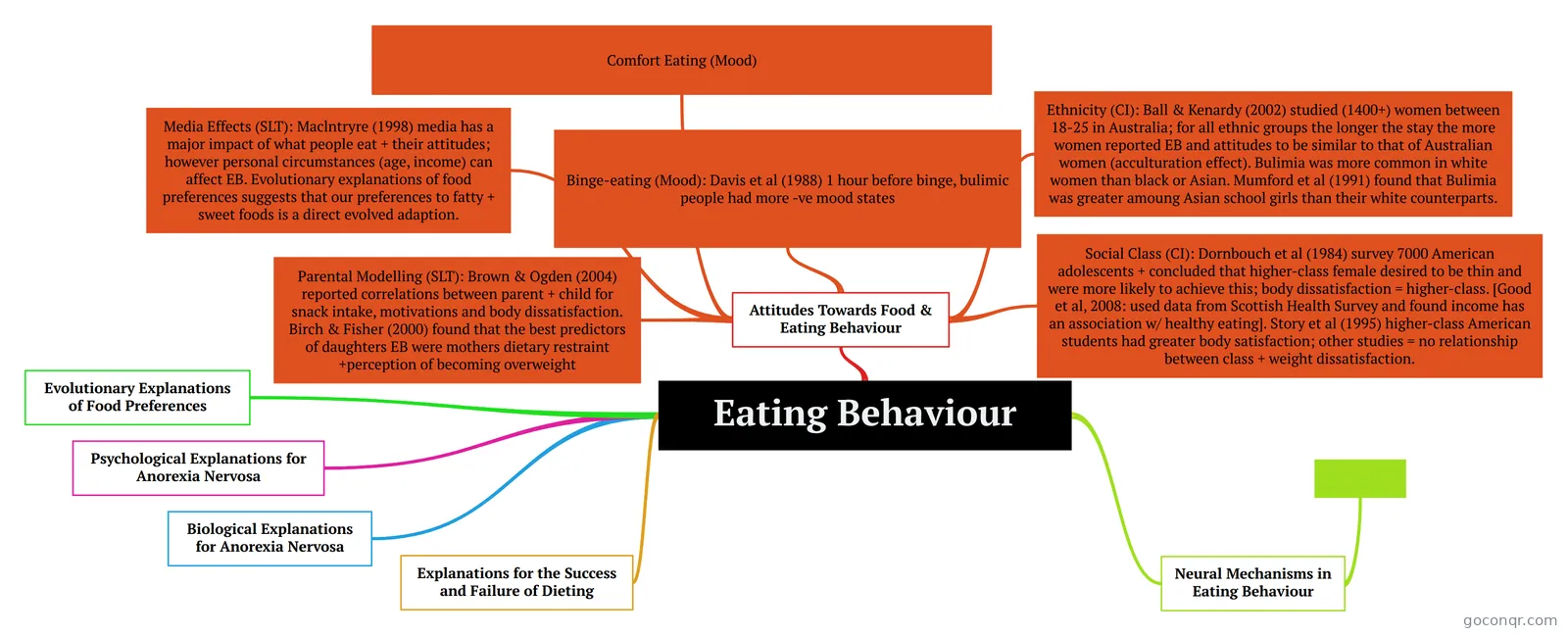 Eating Behaviour AQA A-Level Psychology Unit 3: Eating Behaviour
-
Eating Behaviour
Flashcards
See all 78 flashcards-
46 cardsDiscuss Evolutionary Explanations of Food Preference In order to understand the adaptive problems faced by our ancestors we must understand the environment that...
-
11 cardsGuardia et al. (2012) 11 cards
-
112 cardsEating Behaviours - psychology
-
86 cardsEating Disorders What is negative body image?
-
26 cardsEating Behaviour Essay 1: Factors That Affect Attitudes Towards Food Choice - AO1
-
11 cardsExplanations for the success and failure of dieting Restraint theory-Klesges et al
-
69 cardsPsychology what are the key main theories for failure for dieting?
-
38 cardsEating Behaviour Factor influencing attitudes to food and eating behaviors: Culture
Flowcharts
See all 16 flowchartsNotes
See all 22 notes-
Causes of Anorexia Nervosa Cognitive Approach - Based on irrational/faulty thinking , cognitive distortions, magic thinking (if i get to size 0 then my life will be perfect), magnifying/minimizing (my condition isn't that serious), all or nothi...
-
EVOLUTIONARY EXPLANATIONS - created from Mind Map IN THE EEA fatty foods high in calories preferred to provide energy to stay alive & find the next meal. in modern humans, we are concerned with nutrition of food but we still end up eating foods high in calories. frui...
-
ATTITUDES TO FOOD - created from Mind Map SOCIAL LEARNING media influences both what people eat & their attitudes to certain foods. many eating behaviours are also limited by personal circumstances such as age, income & family. people learn from the media abo...
-
SUCCESS/FAILURE OF DIETING - created from Mind Map RESTRAINT THEORY cause & consequences of cognitive restriction of food. attempting not to eat increases probability of overeating. the boundary level states that dieters set themselves a diet boundary & try to eat wit...
-
PSYCHOLOGICAL EXPLANATION OF AN - created from Mind Map CULTURAL IDEALS/MEDIA western standards of attractiveness are contributing to development of AN. teenagers, often girls, are dissatisfied with their body & have distorted view of body image. survey found 16% young UK ...
-
NEURAL MECHANISMS - created from Mind Map HOMEOSTASIS mechanisms detect the state of the internal environment & act to restore the environment to its optimal state. there is a time lag between mechanisms operating to restore equilibrium & the body registering...
-
McCabe, Ricciardelli (2004) Body image dissatisfaction among males across the lifespan: a review of past literature Body dissatisfaction in males is associated with: poor psychological adjustment eating disorders steroid use excessive dependence...
-
Vartanian and Hayward chapter Body dissatisfaction: negative thoughts and feeling that people have about their body weight, shape, size and overall appearance Body dissatisfaction is the most robust risk factor for the development and maintenance ...
Slides
Topics in Eating Behaviour and Eating Disorders
More Psychology topics
About Eating Behaviour and Eating Disorders
GoConqr OriginalWhat the resources cover
The unit follows the usual run of eating behaviour topics. Several mind maps called Eating Behaviour pull the whole topic onto one page, with branches for attitudes to food, neural mechanisms, evolutionary explanations, dieting and anorexia nervosa.
- Attitudes to food: social learning and parental modelling, including Brown & Ogden on parent and child snacking.
- Dieting: restraint theory and the role of denial, plus the point that 89% of UK women have dieted (Klesges et al., 1987).
- Anorexia nervosa: symptoms such as amenorrhoea and a BMI below 18.5, and biological explanations including serotonin levels.
- Other disorders: maps on bulimia nervosa and obesity, both biological and psychological.
Where to start
Begin with a broad map such as Eating Behaviour to see the shape of the topic. Then move to one theme at a time. The mind map Success and failure of dieting and the flashcard deck Evolutionary Explanations of Food Preference are good single-topic starting points.
Using quizzes and maps together
Read a map, then test yourself. The quizzes Attitudes to Food AO1 and Success and Failure of Dieting AO1 check the descriptive points. Where an answer is shaky, go back to the matching branch and rebuild it from memory.
For evidence, the flashcard deck on Guardia et al. (2012) walks through aim, procedure, results and conclusions. There is also a quiz on Powell and Khan (1995). Notes such as neural mechanism ESSAY show how an extended answer can be shaped.
Where it sits
This unit belongs to the Psychopathology and Treatment strand of Psychology. Most resources are aimed at secondary level, with a quarter at university level, such as the quizzes on eating disorders paragraphs.
Open a map or deck that suits you, and use it as a base for your own notes.
Frequently asked questions
Which resource should I open first?
Start with one of the mind maps called Eating Behaviour, which lays out attitudes to food, neural mechanisms, evolutionary explanations, dieting and anorexia nervosa on a single page. Once you know the layout, choose a single theme and move to its flashcards or quiz.
Are there quizzes on this page?
Yes, more than 15 quizzes. Some check descriptive knowledge, such as Attitudes to Food AO1 and Success and Failure of Dieting AO1. Others cover biological explanations of eating behaviour, eating disorders and a single study, Powell and Khan (1995).
Which exam is this suited to?
Many resources mention A-level Psychology, and about three quarters of the material is at secondary level. The rest suits university students, for example the quizzes on eating disorders. Check the content against your own course requirements.
Do the mind maps cover anorexia nervosa?
Yes. There are maps on symptoms, on biological explanations including neural and evolutionary ideas and serotonin, and flashcards on psychological explanations. There is also a flowchart on biological explanations for anorexia nervosa and a slide set on cognitive explanations.
Are the resources free, and who made them?
Every resource here is free to open, study and take, with no account needed. They were made by GoConqr users, not by GoConqr. A free account also saves your quiz scores and lets you make your own quizzes, mind maps, flashcards and notes.
What if the topic I need is missing?
Try a nearby title, as similar topics often appear under different names, such as attitudes to food and eating behaviour. You can also make your own mind map, deck or notes on the missing point and use it to revise.