
Mapa mental
Topic 4: How much is to much?
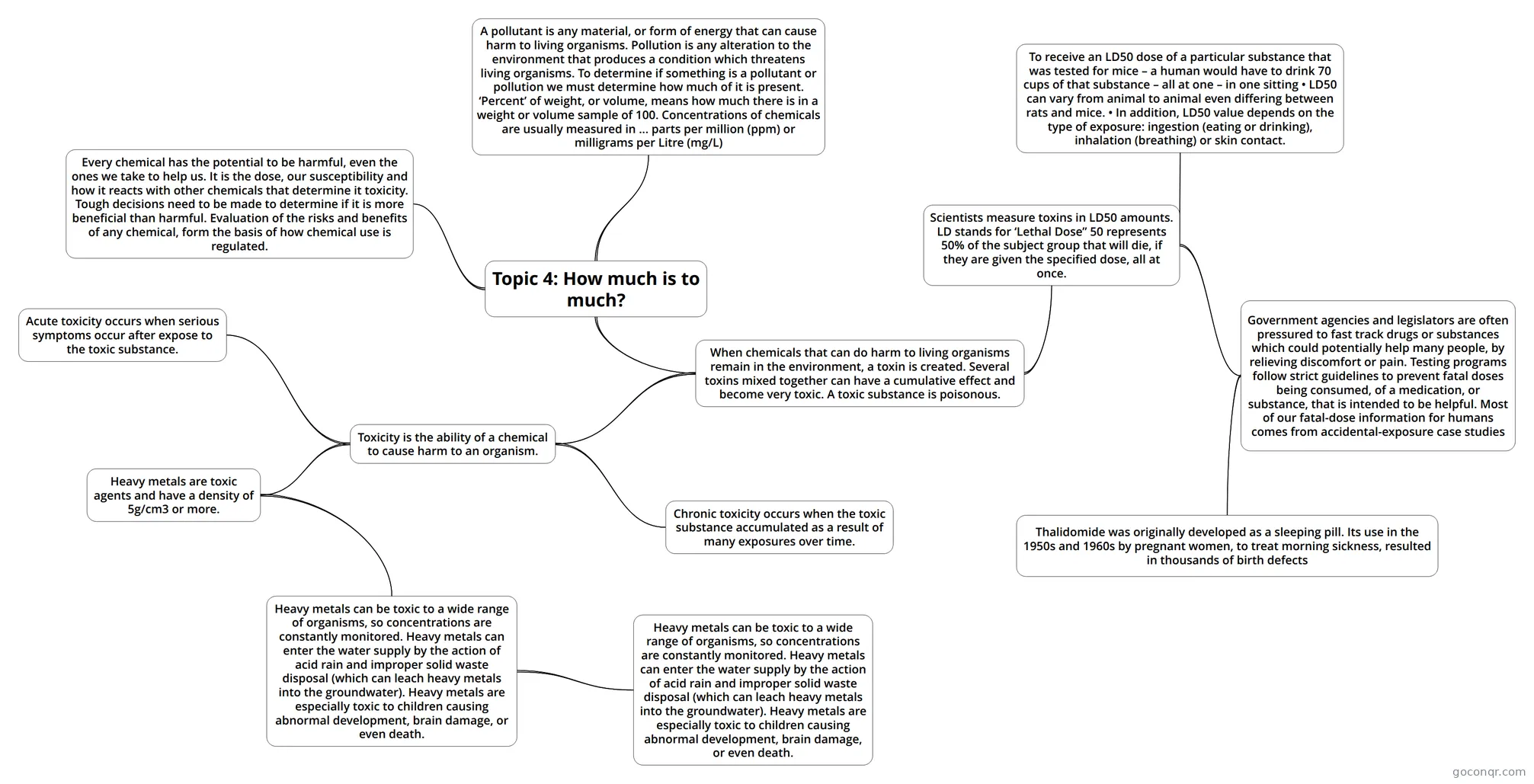
Mind map: pollutants and toxicity
Conteúdo do mapa
Topic 4: How much is to much?
A pollutant is any material, or form of energy that can cause harm to living organisms. Pollution is any alteration to the environment that produces a condition which threatens living organisms. To determine if something is a pollutant or pollution we must determine how much of it is present. ‘Percent’ of weight, or volume, means how much there is in a weight or volume sample of 100. Concentrations of chemicals are usually measured in ... parts per million (ppm) or milligrams per Litre (mg/L)
When chemicals that can do harm to living organisms remain in the environment, a toxin is created. Several toxins mixed together can have a cumulative effect and become very toxic. A toxic substance is poisonous.
- Toxicity is the ability of a chemical to cause harm to an organism.
- Acute toxicity occurs when serious symptoms occur after expose to the toxic substance.
- Chronic toxicity occurs when the toxic substance accumulated as a result of many exposures over time.
- Heavy metals are toxic agents and have a density of 5g/cm3 or more.
- Heavy metals can be toxic to a wide range of organisms, so concentrations are constantly monitored. Heavy metals can enter the water supply by the action of acid rain and improper solid waste disposal (which can leach heavy metals into the groundwater). Heavy metals are especially toxic to children causing abnormal development, brain damage, or even death.
- Heavy metals can be toxic to a wide range of organisms, so concentrations are constantly monitored. Heavy metals can enter the water supply by the action of acid rain and improper solid waste disposal (which can leach heavy metals into the groundwater). Heavy metals are especially toxic to children causing abnormal development, brain damage, or even death.
- Heavy metals can be toxic to a wide range of organisms, so concentrations are constantly monitored. Heavy metals can enter the water supply by the action of acid rain and improper solid waste disposal (which can leach heavy metals into the groundwater). Heavy metals are especially toxic to children causing abnormal development, brain damage, or even death.
- Scientists measure toxins in LD50 amounts. LD stands for ‘Lethal Dose” 50 represents 50% of the subject group that will die, if they are given the specified dose, all at once.
- Government agencies and legislators are often pressured to fast track drugs or substances which could potentially help many people, by relieving discomfort or pain. Testing programs follow strict guidelines to prevent fatal doses being consumed, of a medication, or substance, that is intended to be helpful. Most of our fatal-dose information for humans comes from accidental-exposure case studies
- Thalidomide was originally developed as a sleeping pill. Its use in the 1950s and 1960s by pregnant women, to treat morning sickness, resulted in thousands of birth defects
- To receive an LD50 dose of a particular substance that was tested for mice – a human would have to drink 70 cups of that substance – all at one – in one sitting • LD50 can vary from animal to animal even differing between rats and mice. • In addition, LD50 value depends on the type of exposure: ingestion (eating or drinking), inhalation (breathing) or skin contact.
- Government agencies and legislators are often pressured to fast track drugs or substances which could potentially help many people, by relieving discomfort or pain. Testing programs follow strict guidelines to prevent fatal doses being consumed, of a medication, or substance, that is intended to be helpful. Most of our fatal-dose information for humans comes from accidental-exposure case studies
- Toxicity is the ability of a chemical to cause harm to an organism.
Every chemical has the potential to be harmful, even the ones we take to help us. It is the dose, our susceptibility and how it reacts with other chemicals that determine it toxicity. Tough decisions need to be made to determine if it is more beneficial than harmful. Evaluation of the risks and benefits of any chemical, form the basis of how chemical use is regulated.
Informações
- Descrição
- Grade 9 Science Mapa Mental sobre Topic 4: How much is to much?, criado por Elizabeth Ewing em 10-06-2017.
- Criado por
- Elizabeth Ewing
- Visualizações
- 0
- Avaliação