
Mapa mental
UNIT 3 GENDER (PART B)
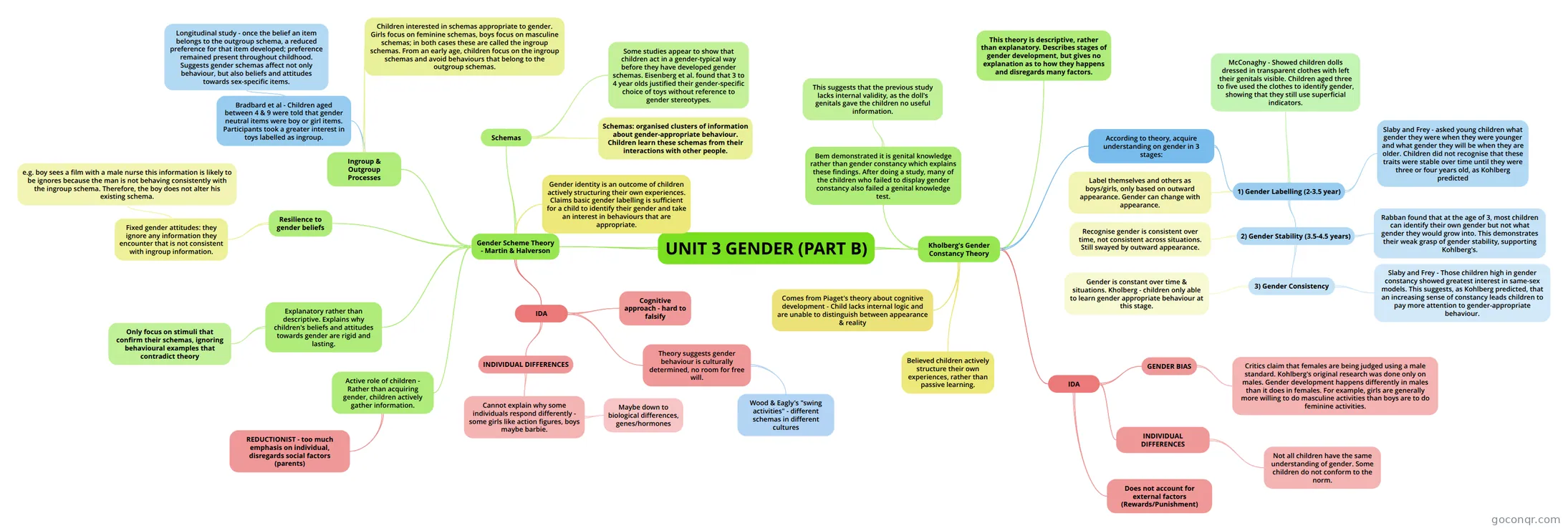
Mind map: gender scheme theory and gender constancy
Conteúdo do mapa
UNIT 3 GENDER (PART B)
Gender Scheme Theory - Martin & Halverson
- Gender identity is an outcome of children actively structuring their own experiences. Claims basic gender labelling is sufficient for a child to identify their gender and take an interest in behaviours that are appropriate.
- Schemas
- Schemas: organised clusters of information about gender-appropriate behaviour. Children learn these schemas from their interactions with other people.
- Some studies appear to show that children act in a gender-typical way before they have developed gender schemas. Eisenberg et al. found that 3 to 4 year olds justified their gender-specific choice of toys without reference to gender stereotypes.
- Ingroup & Outgroup Processes
- Children interested in schemas appropriate to gender. Girls focus on feminine schemas, boys focus on masculine schemas; in both cases these are called the ingroup schemas. From an early age, children focus on the ingroup schemas and avoid behaviours that belong to the outgroup schemas.
- Bradbard et al - Children aged between 4 & 9 were told that gender neutral items were boy or girl items. Participants took a greater interest in toys labelled as ingroup.
- Longitudinal study - once the belief an item belongs to the outgroup schema, a reduced preference for that item developed; preference remained present throughout childhood. Suggests gender schemas affect not only behaviour, but also beliefs and attitudes towards sex-specific items.
- Resilience to gender beliefs
- Fixed gender attitudes: they ignore any information they encounter that is not consistent with ingroup information.
- e.g. boy sees a film with a male nurse this information is likely to be ignores because the man is not behaving consistently with the ingroup schema. Therefore, the boy does not alter his existing schema.
- Fixed gender attitudes: they ignore any information they encounter that is not consistent with ingroup information.
- Explanatory rather than descriptive. Explains why children's beliefs and attitudes towards gender are rigid and lasting.
- Only focus on stimuli that confirm their schemas, ignoring behavioural examples that contradict theory
- IDA
- INDIVIDUAL DIFFERENCES
- Cannot explain why some individuals respond differently - some girls like action figures, boys maybe barbie.
- Maybe down to biological differences, genes/hormones
- Cannot explain why some individuals respond differently - some girls like action figures, boys maybe barbie.
- Cognitive approach - hard to falsify
- Theory suggests gender behaviour is culturally determined, no room for free will.
- Wood & Eagly's "swing activities" - different schemas in different cultures
- INDIVIDUAL DIFFERENCES
- Active role of children - Rather than acquiring gender, children actively gather information.
- REDUCTIONIST - too much emphasis on individual, disregards social factors (parents)
Kholberg's Gender Constancy Theory
- Comes from Piaget's theory about cognitive development - Child lacks internal logic and are unable to distinguish between appearance & reality
- Believed children actively structure their own experiences, rather than passive learning.
- According to theory, acquire understanding on gender in 3 stages:
- 1) Gender Labelling (2-3.5 year)
- 2) Gender Stability (3.5-4.5 years)
- 3) Gender Consistency
- Gender is constant over time & situations. Kholberg - children only able to learn gender appropriate behaviour at this stage.
- Slaby and Frey - Those children high in gender constancy showed greatest interest in same-sex models. This suggests, as Kohlberg predicted, that an increasing sense of constancy leads children to pay more attention to gender-appropriate behaviour.
- Recognise gender is consistent over time, not consistent across situations. Still swayed by outward appearance.
- Rabban found that at the age of 3, most children can identify their own gender but not what gender they would grow into. This demonstrates their weak grasp of gender stability, supporting Kohlberg's.
- 3) Gender Consistency
- Label themselves and others as boys/girls, only based on outward appearance. Gender can change with appearance.
- Slaby and Frey - asked young children what gender they were when they were younger and what gender they will be when they are older. Children did not recognise that these traits were stable over time until they were three or four years old, as Kohlberg predicted
- McConaghy - Showed children dolls dressed in transparent clothes with left their genitals visible. Children aged three to five used the clothes to identify gender, showing that they still use superficial indicators.
- 2) Gender Stability (3.5-4.5 years)
- 1) Gender Labelling (2-3.5 year)
- IDA
- GENDER BIAS
- Critics claim that females are being judged using a male standard. Kohlberg's original research was done only on males. Gender development happens differently in males than it does in females. For example, girls are generally more willing to do masculine activities than boys are to do feminine activities.
- INDIVIDUAL DIFFERENCES
- Not all children have the same understanding of gender. Some children do not conform to the norm.
- Does not account for external factors (Rewards/Punishment)
- GENDER BIAS
- Bem demonstrated it is genital knowledge rather than gender constancy which explains these findings. After doing a study, many of the children who failed to display gender constancy also failed a genital knowledge test.
- This suggests that the previous study lacks internal validity, as the doll's genitals gave the children no useful information.
- This theory is descriptive, rather than explanatory. Describes stages of gender development, but gives no explanation as to how they happens and disregards many factors.
Informações
- Descrição
- Mapa Mental sobre UNIT 3 GENDER (PART B), criado por itsmenickylee em 31-05-2014.
- Criado por
- itsmenickylee
- Visualizações
- 28
- Avaliação