
Mapa mental
C3c - Rate of Reactions 3
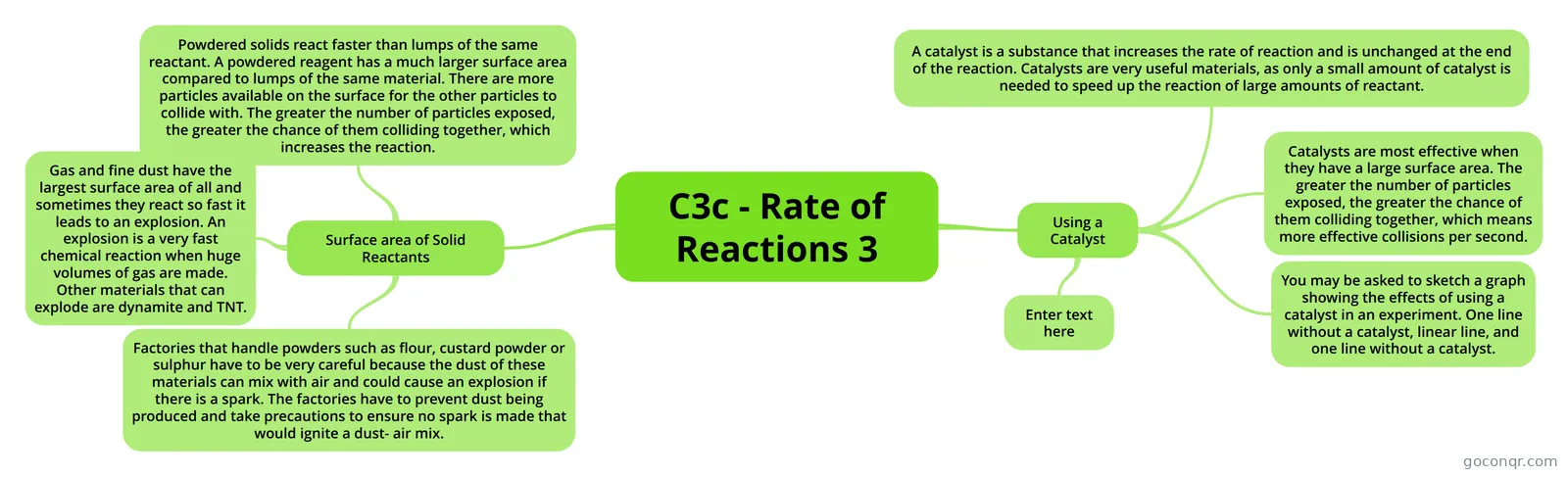
Mind map: rate of reactions surface area and catalysts
Conteúdo do mapa
C3c - Rate of Reactions 3
Surface area of Solid Reactants
- Powdered solids react faster than lumps of the same reactant. A powdered reagent has a much larger surface area compared to lumps of the same material. There are more particles available on the surface for the other particles to collide with. The greater the number of particles exposed, the greater the chance of them colliding together, which increases the reaction.
- Gas and fine dust have the largest surface area of all and sometimes they react so fast it leads to an explosion. An explosion is a very fast chemical reaction when huge volumes of gas are made. Other materials that can explode are dynamite and TNT.
- Factories that handle powders such as flour, custard powder or sulphur have to be very careful because the dust of these materials can mix with air and could cause an explosion if there is a spark. The factories have to prevent dust being produced and take precautions to ensure no spark is made that would ignite a dust- air mix.
Using a Catalyst
- A catalyst is a substance that increases the rate of reaction and is unchanged at the end of the reaction. Catalysts are very useful materials, as only a small amount of catalyst is needed to speed up the reaction of large amounts of reactant.
- Catalysts are most effective when they have a large surface area. The greater the number of particles exposed, the greater the chance of them colliding together, which means more effective collisions per second.
- You may be asked to sketch a graph showing the effects of using a catalyst in an experiment. One line without a catalyst, linear line, and one line without a catalyst.
- Enter text here
Informações
- Descrição
- GCSE CHEMISTRY (C3) Mapa Mental sobre C3c - Rate of Reactions 3, criado por Chloe.Sharland em 09-06-2014.
- Criado por
- Chloe.Sharland
- Visualizações
- 30
- Avaliação