
Mapa mental
Unit 1 Test
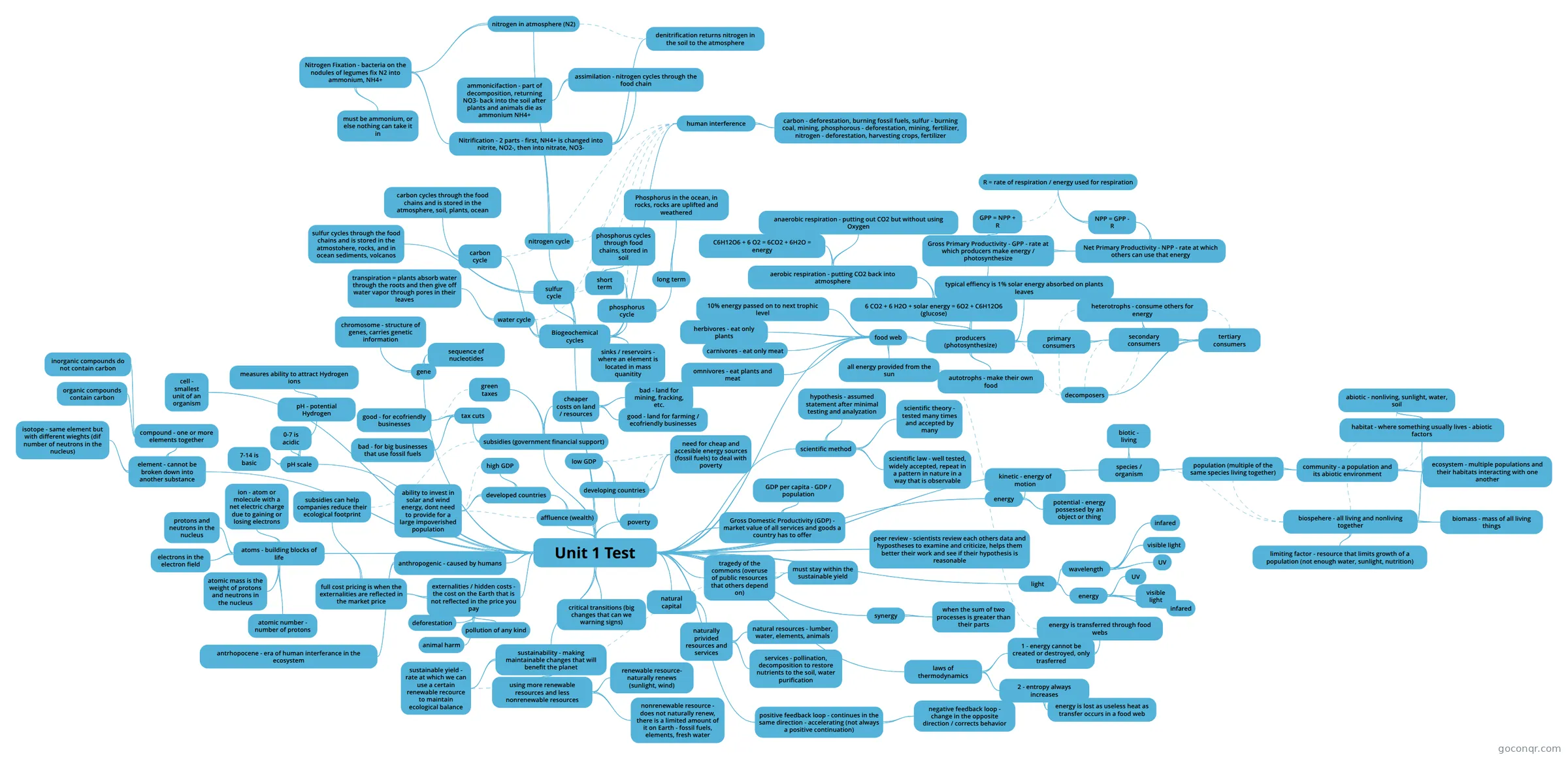
Mind map: environment unit 1 test
Conteúdo do mapa
Unit 1 Test
critical transitions (big changes that can we warning signs)
tragedy of the commons (overuse of public resources that others depend on)
- must stay within the sustainable yield
affluence (wealth)
- developed countries
- ability to invest in solar and wind energy, dont need to provide for a large impoverished population
- high GDP
- developed countries
poverty
- developing countries
- need for cheap and accesible energy sources (fossil fuels) to deal with poverty
- low GDP
- developing countries
anthropogenic - caused by humans
- antrhopocene - era of human interferance in the ecosystem
Gross Domestic Productivity (GDP) - market value of all services and goods a country has to offer
- GDP per capita - GDP / population
subsidies (government financial support)
- tax cuts
- good - for ecofriendly businesses
- bad - for big businesses that use fossil fuels
- cheaper costs on land / resources
- good - land for farming / ecofriendly businesses
- bad - land for mining, fracking, etc.
- green taxes
- tax cuts
externalities / hidden costs - the cost on the Earth that is not reflected in the price you pay
- pollution of any kind
- deforestation
- animal harm
- full cost pricing is when the externalities are reflected in the market price
- subsidies can help companies reduce their ecological footprint
natural capital
- naturally privided resources and services
- natural resources - lumber, water, elements, animals
- services - pollination, decomposition to restore nutrients to the soil, water purification
- naturally privided resources and services
sustainability - making maintainable changes that will benefit the planet
- using more renewable resources and less nonrenewable resources
- renewable resource- naturally renews (sunlight, wind)
- nonrenewable resource - does not naturally renew, there is a limited amount of it on Earth - fossil fuels, elements, fresh water
- sustainable yield - rate at which we can use a certain renewable recource to maintain ecological balance
- using more renewable resources and less nonrenewable resources
scientific method
- hypothesis - assumed statement after minimal testing and analyzation
- scientific theory - tested many times and accepted by many
- scientific law - well tested, widely accepted, repeat in a pattern in nature in a way that is observable
peer review - scientists review each others data and hypostheses to examine and criticize, helps them better their work and see if their hypothesis is reasonable
atoms - building blocks of life
- protons and neutrons in the nucleus
- electrons in the electron field
- atomic mass is the weight of protons and neutrons in the nucleus
- atomic number - number of protons
- ion - atom or molecule with a net electric charge due to gaining or losing electrons
pH scale
- 0-7 is acidic
- 7-14 is basic
- pH - potential Hydrogen
- measures ability to attract Hydrogen ions
element - cannot be broken down into another substance
- compound - one or more elements together
- organic compounds contain carbon
- inorganic compounds do not contain carbon
- isotope - same element but with different wieghts (dif number of neutrons in the nucleus)
- compound - one or more elements together
cell - smallest unit of an organism
gene
- sequence of nucleotides
- chromosome - structure of genes, carries genetic information
positive feedback loop - continues in the same direction - accelerating (not always a positive continuation)
- negative feedback loop - change in the opposite direction / corrects behavior
synergy
- when the sum of two processes is greater than their parts
laws of thermodynamics
- 1 - energy cannot be created or destroyed, only trasferred
- energy is transferred through food webs
- 2 - entropy always increases
- energy is lost as useless heat as transfer occurs in a food web
- 1 - energy cannot be created or destroyed, only trasferred
energy
- kinetic - energy of motion
- potential - energy possessed by an object or thing
light
- wavelength
- visible light
- infared
- UV
- energy
- visible light
- UV
- infared
- wavelength
species / organism
- population (multiple of the same species living together)
- community - a population and its abiotic environment
- ecosystem - multiple populations and their habitats interacting with one another
- biospehere - all living and nonliving together
- limiting factor - resource that limits growth of a population (not enough water, sunlight, nutrition)
- biomass - mass of all living things
- habitat - where something usually lives - abiotic factors
- abiotic - nonliving, sunlight, water, soil
- biospehere - all living and nonliving together
- ecosystem - multiple populations and their habitats interacting with one another
- community - a population and its abiotic environment
- biotic - living
- population (multiple of the same species living together)
food web
- producers (photosynthesize)
- primary consumers
- secondary consumers
- tertiary consumers
- decomposers
- heterotrophs - consume others for energy
- tertiary consumers
- secondary consumers
- 6 CO2 + 6 H2O + solar energy = 6O2 + C6H12O6 (glucose)
- aerobic respiration - putting CO2 back into atmosphere
- C6H12O6 + 6 O2 = 6CO2 + 6H2O = energy
- anaerobic respiration - putting out CO2 but without using Oxygen
- aerobic respiration - putting CO2 back into atmosphere
- typical effiency is 1% solar energy absorbed on plants leaves
- autotrophs - make their own food
- Gross Primary Productivity - GPP - rate at which producers make energy / photosynthesize
- Net Primary Productivity - NPP - rate at which others can use that energy
- NPP = GPP - R
- R = rate of respiration / energy used for respiration
- NPP = GPP - R
- GPP = NPP + R
- Net Primary Productivity - NPP - rate at which others can use that energy
- primary consumers
- all energy provided from the sun
- 10% energy passed on to next trophic level
- herbivores - eat only plants
- carnivores - eat only meat
- omnivores - eat plants and meat
- producers (photosynthesize)
Biogeochemical cycles
- water cycle
- transpiration = plants absorb water through the roots and then give off water vapor through pores in their leaves
- carbon cycle
- carbon cycles through the food chains and is stored in the atmosphere, soil, plants, ocean
- sulfur cycle
- sulfur cycles through the food chains and is stored in the atmostohere, rocks, and in ocean sediments, volcanos
- phosphorus cycle
- short term
- phosphorus cycles through food chains, stored in soil
- long term
- Phosphorus in the ocean, in rocks, rocks are uplifted and weathered
- short term
- nitrogen cycle
- nitrogen in atmosphere (N2)
- Nitrogen Fixation - bacteria on the nodules of legumes fix N2 into ammonium, NH4+
- Nitrification - 2 parts - first, NH4+ is changed into nitrite, NO2-, then into nitrate, NO3-
- denitrification returns nitrogen in the soil to the atmosphere
- assimilation - nitrogen cycles through the food chain
- ammonicifaction - part of decomposition, returning NO3- back into the soil after plants and animals die as ammonium NH4+
- must be ammonium, or else nothing can take it in
- Nitrification - 2 parts - first, NH4+ is changed into nitrite, NO2-, then into nitrate, NO3-
- Nitrogen Fixation - bacteria on the nodules of legumes fix N2 into ammonium, NH4+
- nitrogen in atmosphere (N2)
- sinks / reservoirs - where an element is located in mass quanitity
- human interference
- carbon - deforestation, burning fossil fuels, sulfur - burning coal, mining, phosphorous - deforestation, mining, fertilizer, nitrogen - deforestation, harvesting crops, fertilizer
- water cycle