
Mapa mental
Ionic Compounds
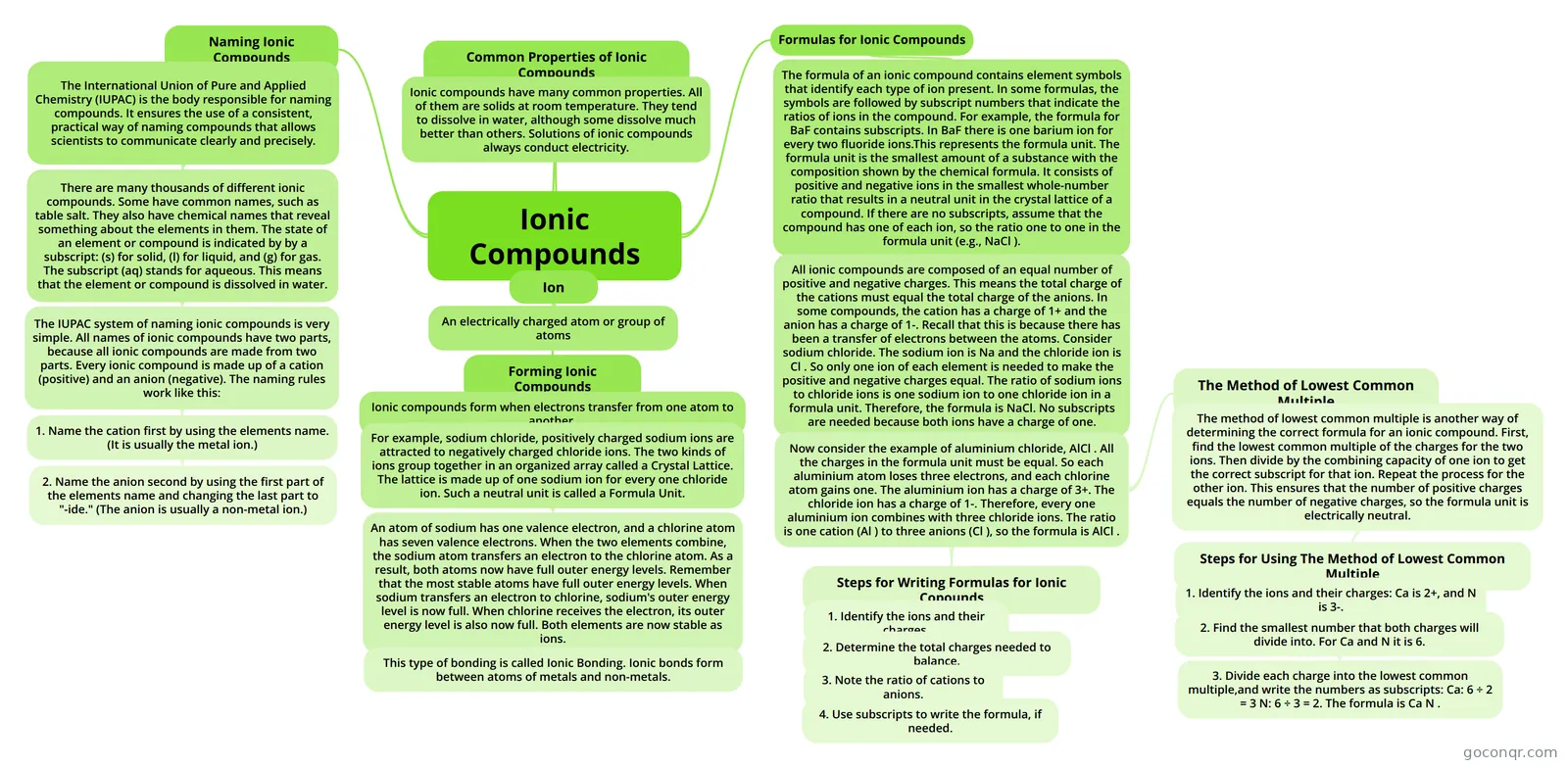
Mind map: Ionic compounds
Conteúdo do mapa
Ionic Compounds
Naming Ionic Compounds
- The International Union of Pure and Applied Chemistry (IUPAC) is the body responsible for naming compounds. It ensures the use of a consistent, practical way of naming compounds that allows scientists to communicate clearly and precisely.
- There are many thousands of different ionic compounds. Some have common names, such as table salt. They also have chemical names that reveal something about the elements in them. The state of an element or compound is indicated by by a subscript: (s) for solid, (l) for liquid, and (g) for gas. The subscript (aq) stands for aqueous. This means that the element or compound is dissolved in water.
- The IUPAC system of naming ionic compounds is very simple. All names of ionic compounds have two parts, because all ionic compounds are made from two parts. Every ionic compound is made up of a cation (positive) and an anion (negative). The naming rules work like this:
- 1. Name the cation first by using the elements name. (It is usually the metal ion.)
- 2. Name the anion second by using the first part of the elements name and changing the last part to "-ide." (The anion is usually a non-metal ion.)
- 1. Name the cation first by using the elements name. (It is usually the metal ion.)
- The IUPAC system of naming ionic compounds is very simple. All names of ionic compounds have two parts, because all ionic compounds are made from two parts. Every ionic compound is made up of a cation (positive) and an anion (negative). The naming rules work like this:
- There are many thousands of different ionic compounds. Some have common names, such as table salt. They also have chemical names that reveal something about the elements in them. The state of an element or compound is indicated by by a subscript: (s) for solid, (l) for liquid, and (g) for gas. The subscript (aq) stands for aqueous. This means that the element or compound is dissolved in water.
- The International Union of Pure and Applied Chemistry (IUPAC) is the body responsible for naming compounds. It ensures the use of a consistent, practical way of naming compounds that allows scientists to communicate clearly and precisely.
Ion
- An electrically charged atom or group of atoms
Forming Ionic Compounds
- Ionic compounds form when electrons transfer from one atom to another.
- For example, sodium chloride, positively charged sodium ions are attracted to negatively charged chloride ions. The two kinds of ions group together in an organized array called a Crystal Lattice. The lattice is made up of one sodium ion for every one chloride ion. Such a neutral unit is called a Formula Unit.
- An atom of sodium has one valence electron, and a chlorine atom has seven valence electrons. When the two elements combine, the sodium atom transfers an electron to the chlorine atom. As a result, both atoms now have full outer energy levels. Remember that the most stable atoms have full outer energy levels. When sodium transfers an electron to chlorine, sodium's outer energy level is now full. When chlorine receives the electron, its outer energy level is also now full. Both elements are now stable as ions.
- This type of bonding is called Ionic Bonding. Ionic bonds form between atoms of metals and non-metals.
- An atom of sodium has one valence electron, and a chlorine atom has seven valence electrons. When the two elements combine, the sodium atom transfers an electron to the chlorine atom. As a result, both atoms now have full outer energy levels. Remember that the most stable atoms have full outer energy levels. When sodium transfers an electron to chlorine, sodium's outer energy level is now full. When chlorine receives the electron, its outer energy level is also now full. Both elements are now stable as ions.
- For example, sodium chloride, positively charged sodium ions are attracted to negatively charged chloride ions. The two kinds of ions group together in an organized array called a Crystal Lattice. The lattice is made up of one sodium ion for every one chloride ion. Such a neutral unit is called a Formula Unit.
- Ionic compounds form when electrons transfer from one atom to another.
Common Properties of Ionic Compounds
- Ionic compounds have many common properties. All of them are solids at room temperature. They tend to dissolve in water, although some dissolve much better than others. Solutions of ionic compounds always conduct electricity.
Formulas for Ionic Compounds
- The formula of an ionic compound contains element symbols that identify each type of ion present. In some formulas, the symbols are followed by subscript numbers that indicate the ratios of ions in the compound. For example, the formula for BaF contains subscripts. In BaF there is one barium ion for every two fluoride ions.This represents the formula unit. The formula unit is the smallest amount of a substance with the composition shown by the chemical formula. It consists of positive and negative ions in the smallest whole-number ratio that results in a neutral unit in the crystal lattice of a compound. If there are no subscripts, assume that the compound has one of each ion, so the ratio one to one in the formula unit (e.g., NaCl ).
- All ionic compounds are composed of an equal number of positive and negative charges. This means the total charge of the cations must equal the total charge of the anions. In some compounds, the cation has a charge of 1+ and the anion has a charge of 1-. Recall that this is because there has been a transfer of electrons between the atoms. Consider sodium chloride. The sodium ion is Na and the chloride ion is Cl . So only one ion of each element is needed to make the positive and negative charges equal. The ratio of sodium ions to chloride ions is one sodium ion to one chloride ion in a formula unit. Therefore, the formula is NaCl. No subscripts are needed because both ions have a charge of one.
- Now consider the example of aluminium chloride, AlCl . All the charges in the formula unit must be equal. So each aluminium atom loses three electrons, and each chlorine atom gains one. The aluminium ion has a charge of 3+. The chloride ion has a charge of 1-. Therefore, every one aluminium ion combines with three chloride ions. The ratio is one cation (Al ) to three anions (Cl ), so the formula is AlCl .
- Steps for Writing Formulas for Ionic Copounds
- 1. Identify the ions and their charges.
- 2. Determine the total charges needed to balance.
- 3. Note the ratio of cations to anions.
- 4. Use subscripts to write the formula, if needed.
- 3. Note the ratio of cations to anions.
- 2. Determine the total charges needed to balance.
- 1. Identify the ions and their charges.
- The Method of Lowest Common Multiple
- The method of lowest common multiple is another way of determining the correct formula for an ionic compound. First, find the lowest common multiple of the charges for the two ions. Then divide by the combining capacity of one ion to get the correct subscript for that ion. Repeat the process for the other ion. This ensures that the number of positive charges equals the number of negative charges, so the formula unit is electrically neutral.
- Steps for Using The Method of Lowest Common Multiple
- 1. Identify the ions and their charges: Ca is 2+, and N is 3-.
- 2. Find the smallest number that both charges will divide into. For Ca and N it is 6.
- 3. Divide each charge into the lowest common multiple,and write the numbers as subscripts: Ca: 6 ÷ 2 = 3 N: 6 ÷ 3 = 2. The formula is Ca N .
- 2. Find the smallest number that both charges will divide into. For Ca and N it is 6.
- 1. Identify the ions and their charges: Ca is 2+, and N is 3-.
- Steps for Using The Method of Lowest Common Multiple
- The method of lowest common multiple is another way of determining the correct formula for an ionic compound. First, find the lowest common multiple of the charges for the two ions. Then divide by the combining capacity of one ion to get the correct subscript for that ion. Repeat the process for the other ion. This ensures that the number of positive charges equals the number of negative charges, so the formula unit is electrically neutral.
- Steps for Writing Formulas for Ionic Copounds
- Now consider the example of aluminium chloride, AlCl . All the charges in the formula unit must be equal. So each aluminium atom loses three electrons, and each chlorine atom gains one. The aluminium ion has a charge of 3+. The chloride ion has a charge of 1-. Therefore, every one aluminium ion combines with three chloride ions. The ratio is one cation (Al ) to three anions (Cl ), so the formula is AlCl .
- All ionic compounds are composed of an equal number of positive and negative charges. This means the total charge of the cations must equal the total charge of the anions. In some compounds, the cation has a charge of 1+ and the anion has a charge of 1-. Recall that this is because there has been a transfer of electrons between the atoms. Consider sodium chloride. The sodium ion is Na and the chloride ion is Cl . So only one ion of each element is needed to make the positive and negative charges equal. The ratio of sodium ions to chloride ions is one sodium ion to one chloride ion in a formula unit. Therefore, the formula is NaCl. No subscripts are needed because both ions have a charge of one.
- The formula of an ionic compound contains element symbols that identify each type of ion present. In some formulas, the symbols are followed by subscript numbers that indicate the ratios of ions in the compound. For example, the formula for BaF contains subscripts. In BaF there is one barium ion for every two fluoride ions.This represents the formula unit. The formula unit is the smallest amount of a substance with the composition shown by the chemical formula. It consists of positive and negative ions in the smallest whole-number ratio that results in a neutral unit in the crystal lattice of a compound. If there are no subscripts, assume that the compound has one of each ion, so the ratio one to one in the formula unit (e.g., NaCl ).
Informações
- Descrição
- Science 10 Mapa Mental sobre Ionic Compounds, criado por syylex403 em 25-05-2013.
- Criado por
- syylex403
- Visualizações
- 335
- Tags
- Avaliação