
Mapa mental
Development and aging
Conteúdo do mapa
Development and aging
Prinicpals of development
- Neurulation
- cell birth
- neurogenesis, gliogenesis
- cell migration
- cell differentiation
- cell maturation
- denritic and axonal growth
- Synaptogenesis
- Cell death and synaptic pruning
- Myelogenesis
The early brain
- Neurodevelopment begins 18 days post fertilization
- neural plate to neural tube = neurulation
- Neural tube
- becomes brain and spinal cord
- Grows in 3 ways
- Thickening and elongation
- Folding
- Convergence
- Dorso lateral hinge points form a tube
- Tube fuses in the middle then towards the edges
- Spina bifida
- Neural tube fails to close at ends
- Spinal cord protrudes from unclosed sections of spinal cord
- Can cause cerebellum to misposition
- Spinal cord protrudes from unclosed sections of spinal cord
- Neural tube fails to close at ends
- Spina bifida
- Neurodevelopment begins 18 days post fertilization
Neurogenesis
- Cells born then move
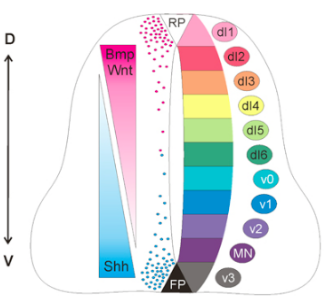
- Move due to concentration gradients
- Concentration gradients
- Attrative gradient
- Diffuse across area and attracts more cells to higher gradients
- Repulsive gradient
- Diffuse across area and repulses cells to lower gradients
- Supports growth and patterning of neurons
- Within neural tube
- Double gradient
- Shh
- Sonia Hedge hog
- Controls cell differenciation on ventral half of neural tube
- Holoprosencephaly
- Mutation of Shh can cause unified hemispheres
- Cyclopia
- Mutation of Shh can cause unified hemispheres
- Attrative gradient
- Concentration gradients
- Move due to concentration gradients
- First symmetrical cells then asymmetric neurons
- Adult neurogenesis
- Dentate gyrus in the hippocampus
- Subventricular zone (lines the ventricles)
- Olfactory bulbs
- Proliferate areas
- centre of neural tube
- Neurons and glial cells are created,
- Cells born then move
Neural Migration
- Leading and a trailing process
- Based on chemical cues
- Neural cells migrate along glial cells
- Based on chemical cues
- Ectopic
- Neurons = wrong place or layer
- Linked to Neurodevelopmental disorder
- Inside-out proliferation
- New neurons push past old to pial surface of the tube
- Some sit below old ones
- New neurons push past old to pial surface of the tube
- In adults
- Progenitor cells lay in white and grey matter
- Leading and a trailing process
Cell differenciation
- Axonal growth
- Tip of axon = growth cone
- Finger like processes = filopodia
- Search for chemical signals
- Allow neuron to move to final place
- Sensitive to whole brain and nearby cells
- Attracted or repulsed by them
- Layering of the cortex / neural architecture explained by this
- Attracted or repulsed by them
- Finger like processes = filopodia
- Tip of axon = growth cone
- Retinotopy
- Controlled by chemical gradients
- Cells = map what eye sees
- Cells that react same way = move and communicate
- Cells = map what eye sees
- Controlled by chemical gradients
- Hemisphere commisure
- Attracts commisure cells
- Repels others
- Acallosal Syndrome
- Corpus callosum starts with a few cells
- Those cells attract other callosum cells
- If this is disrupted early on, no corpus callosum forms
- Those cells attract other callosum cells
- Not 100% penetrant
- Not call children with gene will get Acallosal syndrome
- Corpus callosum starts with a few cells
- Attracts commisure cells
- Dendritic changes
- Axons = no move, dentrites = move
- Synaptogenesis and pruning
- Many cells present at birth
- This decreases over time
- Nurotropic factors
- Cell used = release NF
- Not used = no NF, no cell survival
- Only cells that are used / connections strengthened survive
- Regressive growth
- 50% of neurons die prenatally
- About getting most efficient amount
- Exuberant or transient connections
- Extra uncessary connections
- Common for exuberant connections then pruning
- Synaptic pruning
- Most synaptic pruning is due to learning and experiencing
- Chosen cell death through apoptosis
- Getting rid of unused cells
- Cancer cells do not die through apoptosis, which is why they are dangerous
- 50% of neurons die prenatally
- Many cells present at birth
- Axonal growth
Pruning
- Experience dependent cells
- Learning a skill
- Kicking a ball
- Easier to fom connections young
- Harder as we age
- Learning a skill
- Experience independent cells
- Sensory systems
- Visual system ready and waiting for input
- Sensory systems
- Experience dependent cells
Glial cells
- Astrocytes, microglia, oligodendroglia, satellite cells, schwann cells.
- Myelination
- Insulates the axon, increases velocity of electric signals
- Oligodendroglia - in the CNS, schwann are in the PNS
- Post-natal as most cells aren't developed yet
- Changes across time but it peaks generally at adulthood
Physical changes with age
- White matter loss
- Grey mater loss
- Loss of neuronal plasticity
- Ability to alter neurons related to memory
- Memory declines with age
- Ability to alter neurons related to memory
- Dendrite loss
- Causes of physical changes
- Accumulation of proteins
- Oxidative stress
- Toxins
- Cell death
- Cell breaks down into organelles
- Phagocytes clean this us
- Necrosis
- non-programmed cell death
- Cells bursts contents and harm other cells
- non-programmed cell death
- Cell breaks down into organelles
Pruning in aging
- Under-pruning and over-pruning
- Associated with disorder
- Not 1:1 link as pruning is normal
- Could be many protective factors that stop it becoming disordered
- Under-pruning and over-pruning
Imagens e arquivos do mapa
Informações
- Descrição
- Mapa Mental sobre Development and aging, criado por Sam Webb em 21-11-2017.
- Criado por
- Sam Webb
- Visualizações
- 3
- Tags
- Avaliação