
Mapa mental
sea to land
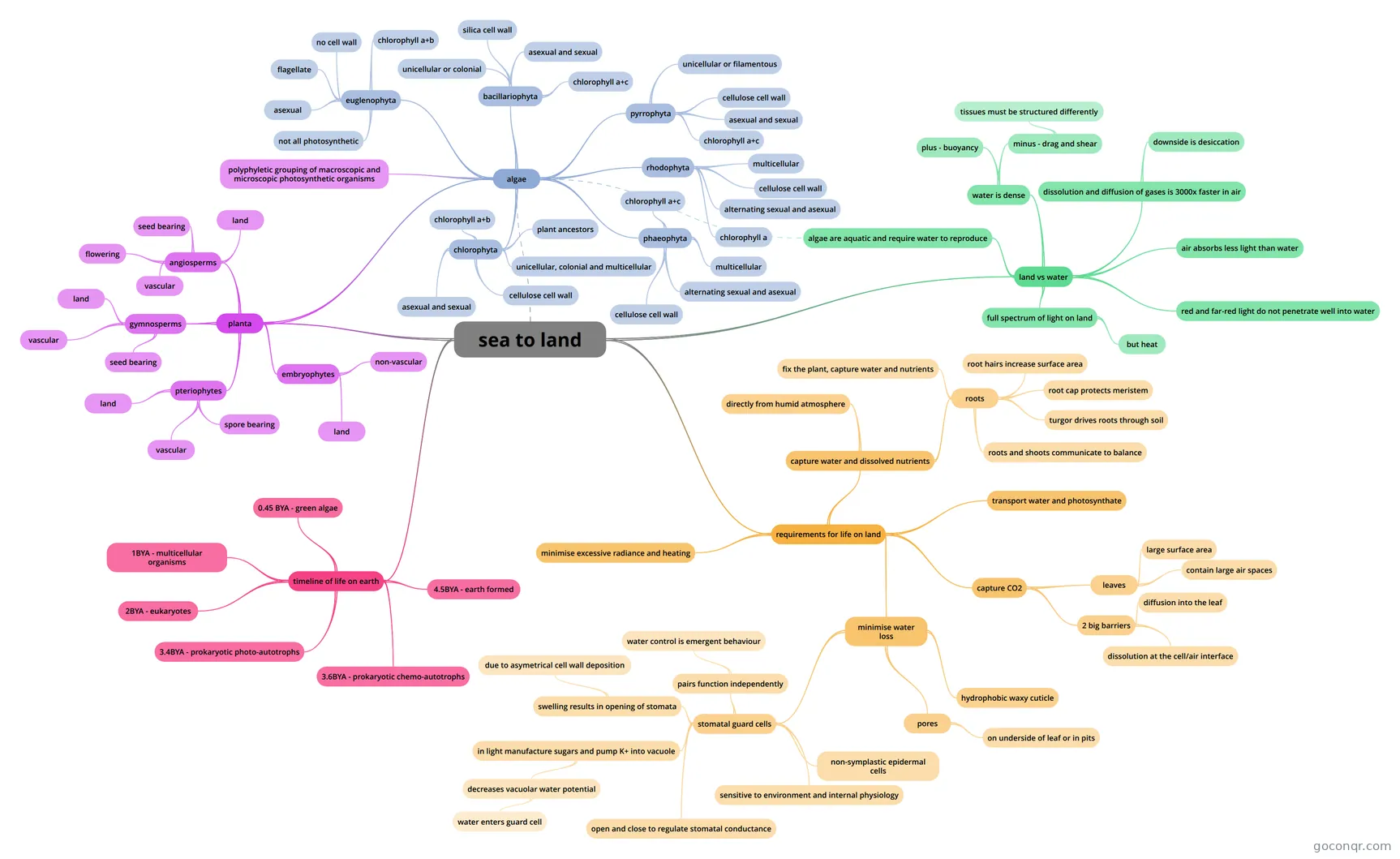
Mind map: sea to land plant evolution
Conteúdo do mapa
sea to land
timeline of life on earth
- 4.5BYA - earth formed
- 3.6BYA - prokaryotic chemo-autotrophs
- 3.4BYA - prokaryotic photo-autotrophs
- 2BYA - eukaryotes
- 1BYA - multicellular organisms
- 0.45 BYA - green algae
planta
- algae
- polyphyletic grouping of macroscopic and microscopic photosynthetic organisms
- euglenophyta
- no cell wall
- flagellate
- asexual
- not all photosynthetic
- chlorophyll a+b
- bacillariophyta
- unicellular or colonial
- silica cell wall
- asexual and sexual
- chlorophyll a+c
- pyrrophyta
- unicellular or filamentous
- cellulose cell wall
- asexual and sexual
- chlorophyll a+c
- rhodophyta
- multicellular
- cellulose cell wall
- alternating sexual and asexual
- chlorophyll a
- phaeophyta
- multicellular
- cellulose cell wall
- alternating sexual and asexual
- chlorophyll a+c
- chlorophyta
- unicellular, colonial and multicellular
- cellulose cell wall
- asexual and sexual
- chlorophyll a+b
- plant ancestors
- embryophytes
- non-vascular
- land
- pteriophytes
- spore bearing
- vascular
- land
- gymnosperms
- seed bearing
- vascular
- land
- angiosperms
- flowering
- vascular
- seed bearing
- land
- algae
land vs water
- algae are aquatic and require water to reproduce
- water is dense
- plus - buoyancy
- minus - drag and shear
- tissues must be structured differently
- dissolution and diffusion of gases is 3000x faster in air
- downside is desiccation
- air absorbs less light than water
- red and far-red light do not penetrate well into water
- full spectrum of light on land
- but heat
requirements for life on land
- capture water and dissolved nutrients
- directly from humid atmosphere
- roots
- fix the plant, capture water and nutrients
- root hairs increase surface area
- turgor drives roots through soil
- roots and shoots communicate to balance
- root cap protects meristem
- transport water and photosynthate
- capture CO2
- leaves
- large surface area
- contain large air spaces
- 2 big barriers
- diffusion into the leaf
- dissolution at the cell/air interface
- leaves
- minimise water loss
- hydrophobic waxy cuticle
- pores
- on underside of leaf or in pits
- stomatal guard cells
- non-symplastic epidermal cells
- sensitive to environment and internal physiology
- open and close to regulate stomatal conductance
- in light manufacture sugars and pump K+ into vacuole
- decreases vacuolar water potential
- water enters guard cell
- decreases vacuolar water potential
- swelling results in opening of stomata
- due to asymetrical cell wall deposition
- pairs function independently
- water control is emergent behaviour
- minimise excessive radiance and heating
- capture water and dissolved nutrients