
Mapa mental
Cog Neuro: Attention 1
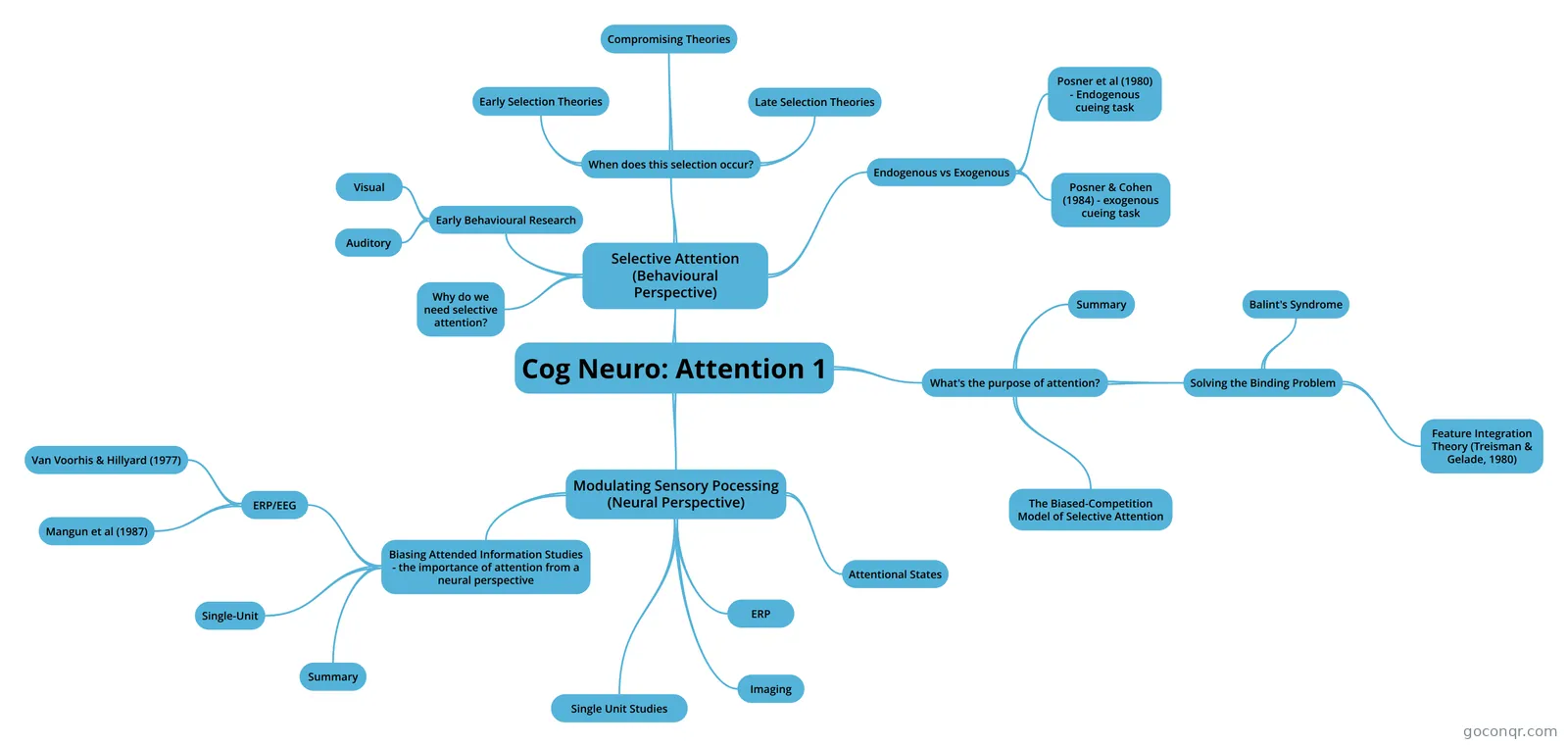
Mind map: Cog Neuro: Attention 1
Conteúdo do mapa
Cog Neuro: Attention 1
- Attention is not a unitary concept, but is used to describe and explain a variety of psychological data (not always well). A classic starting point comes from William James (1890) "Everyone knows what attention is. It is the taking possession of mind in clear and vivid form...it implies the withdrawal from some things in order to deal effectively with others."
- Attention is not a single concept, but an umbrella term. Shiffrin (1988): "Attention has been used to refer to all those aspects of human cognition that the subject can control...and to all aspects of cognition having to do with limited resources or capacity, and methods of dealing with such constraints."
Selective Attention (Behavioural Perspective)
- Definition: the allocation of processing resources to the analysis of certain stimuli or aspects of the environment, at the expense of resources allocated to other concurrent stimuli or aspects.
- Most research in this area has been devoted to selective attention typically in the context of sensory processing.
- Early Behavioural Research
- Research began after second world war. Welford (1952) carried out an experiment that showed that when two signals are presented in rapid succession and the subject must make a speeded response to both, reaction time to the second stimulus depends on the stimulus onset asynchrony (SOA) between presentation of the first and second stimulus. When the second stimulus is presented after a very short SOA, reaction time to the second stimulus is slower than when there is a long SOA. Welford called this delay in response the "pscyhological refractory period" (PRP). He showed that for every msec decrease in SOA there was a corresponding increase in reaction time to the second stimulus. He argued that this was evidence of a "bottleneck"- processing of first stimulus must be completed before arrival of second stimulus. Welford's work provided some of the first evidence for a central limit on human processing capacity.
- Auditory
- Cherry (1953) - Dichotic listening task. Some of the first empirical evidence for the cocktail party effect. He presented two simultaneous streams of different auditory stimuli to the two ears via headphones and asked the subject to attend to just one of the inputs, and ignore the other, whilst immediately repeating the content of the attended stream (known as 'shadowing'). This mimics the cocktail party situation, where you selectively listen to one speaker instead of another. After the subjects had performed the task, they were tested on their ability to report the content of the two vocal inputs. He found that they could accurately report the content of the attended stream, but accurately report very little from the unattended one. This sort of observation was taken as indicating that unattended inputs are filtered out at low levels of perceptual processing, on the basis of very basic physical characteristics. Very little memory for content of unattended stream (did not notice when speaker changed from speaking English to German), but did notice if voice changed from man to a woman, or a bleep tone was presented. It also made clear that subjects cannot attend to two input streams effectively at the same time, illustrating a fundamental limitation of attentional processing capacity.
- However, following studies (such as Moray, 1959) found that it wasn't quite this simple: e.g. subjects tended to notice when their name (or another personally important word or phrase) was mentioned in the unattended auditory stream. Such observations indicate that at least some information is being processed up to the level of semantic meaning, and is not being completely filtered out at a lower level.
- Visual
- Sperling (1960) investigated people's ability to selectively report items from very brief visual displays, presenting information using a tachistoscope. When subjects were presented with visual arrays lasting 50msec, containing 12 letters, they were only able to report about four or five items. But subjects reported they could 'see' the display for a short time after it was removed, suggesting that although items were initially represented in a brief visual memory, there was a limit at which the items could be retrieved before they decayed. Sperling believed that the pattern of results were evidence for a high capacity, fast decay visual memory store that faded over a short time and that unless this rapidly fading store was transformed into another, more permanent state, it was lost. Subsequently named iconic memory (Neisser, 1967) and is analogous to the sensory store located between the senses and the selective filter in Broadbent's model.
- Sperling later introduced an important modification. Instead of asking the subject to report the whole display, the gave them a cue immediately after the display offset, which indicated the row they were to report. When the cue was a tone, subjects could report virtually all the items from the cued row. They had no idea which row would be asked for: this showed that they must have perceived all items on the display. He then introduced a delay between display offset and tone presentation. As the delay increased, the proportion of items that could be reported decreased - until after a delay of 500msec, the participants' performance was no better than the whole report condition, presumably because the iconic memory had completely decayed. The advantage the cueing gives is called the Partial Report Superiority Effect and suggests that the cue allows a subset of items to be transferred to a later stage of processing.
- Why do we need selective attention?
- When does this selection occur?
- The major goal of behavioural studies was to gain more insight into the stage or stages at which attention affects the processing of sensory input. During the development of this research, models of attention became divided into those proposing early levels of attentional selection and those proposing later levels.
- Early Selection Theories
- Models of early selection postulate that there is a low-level gating system that can filter out or attenuate irrelevant information before the completion of sensory and perceptual analysis.
- Broadbent (1958) - attentional selection occurs very early in perceptual processing. - sensory input is gated on the basis of fundamental physical characteristics of the stimuli, which determines which information proceeds to the higher levels of analysis - only physical properties (such as location, colour, pitch, etc) are detected and it is these properties that guide the setting of the filter - short-term buffer store precedes the selective filter - a temporary memory store in which unselected information can be held in parallel for short periods of time (Sperling's findings) - Model became known as Broadbent's "Filter theory"
- Late Selection Theories
- Theories of late selection, at least the strong versions of such models, proposed that all stimuli are processed through the completion of sensory and perceptual processing before any selection occurs.
- Deutsch and Deutsch (1963): all stimuli are analysed unconsciously in terms of their physical characteristics and high-level meanings (semantics).
- Compromising Theories
- Treisman (1960) - altered Broadbent's early selection theory of an early-stage gate that is simply open or closed to a more adaptable early filtering system that could attenuate the inputs from concurrent sensory channels in a flexible manner. In this model, some unattended semantic information reaches high levels, although it might be substantially attenuated. Accordingly, in an unattenuated channel, only highly salient information (such as ones name) would exceed the threshold to be selected, reach conscious awareness, and be reported by the individual.
- Perceptual Load Theory (Lavie, 1995) - whether selection is early or late depends upon the perceptual load of the environment. High perceptual load - unattended stimuli only processed in terms of physical characteristics. Low perceptual load: unattended items processed in terms of semantic information, too.
- Many recent theories recognise the importance of top-down control in attentional selection: the influence of task goals and expectations.
- Endogenous vs Exogenous
- Endogenous attention: voluntary attentional control, of internal cause/origin. In experimental tasks, to follow the instruction of an experimenter or to fulfill an intrinsic desire, subjects consciously direct attention to a particular aspect of the environment, such as a specific voice or location in the visual space. More specifically, endogenous attention is the ability to voluntarily direct attention depending on one's goals, expectations and/or knowledge.
- Exogenous attention: involuntarily attention - numerous stimuli in our everyday environment attract our attention automatically. A major distinction has been made in attention research between these two ways in which processing resources are induced to be directed towards objects or events in the environment.
- Difference can be specifically observed with behavioural experiments usual visual spatial selective attention.
- Posner et al (1980) - Endogenous cueing task
- Posner et al (1980) - later became known as the Posner task/Posner paradigm. - participants are asked to maintain eye gaze on a central fixation point, and on each trial a centrally presented cue is given which indicates either: where the target stimulus will most likely be subsequently presented in the visual field (valid cue), where it will be least likely be presented (invalid cue) or gives no relevant information on the location of the coming target (neutral cue). It was found that participants typically responded faster in the validly cued trials, and slower to the invalidly cued trials, compared to the neutrally cued trials as a baseline. This task reflects the benefits and costs of attending/not attending to the relevant target location. Varying the cue-to-target delay in such experiments has shown that these behavioural attention effects can begin by 300msec after the cue and be held for seconds afterwards. General interpretation of such studies is that the behavioural effects observed reflect the influence of attention on the processing of the targets in the cued location. This facilitation in the valid trials has been interpreted as arising from attentional modulation of the relevant sensory processing, in accordance with early selection models.
- Posner & Cohen (1984) - exogenous cueing task
- The Posner task has also been used to investigate exogenous visual spacial attention. Posner and Cohen (1984), using a brief flash of light, found that participants are again quicker to respond to the target when the flash of light cued the target location when the target followed about 75-200 ms after the cue. However, at longer intervals (400-800msec), there is actually a decrement in reaction time for the cued locations, which is not demonstrated in endogenous attention tasks. This phenomenon is called the inhibition of return. Although why the inhibition occurs is not yet known, the principle demonstrates that the effects of attentional shift differ between exogenously and endogenously driven factors. (it's been speculated that the inhibition may promote exploration of new/previously unattended places or objects in the environment by slowing down the return of attention to recently attended ones).
What's the purpose of attention?
- Capacity limits (cognitive/behavioural): -> information bottleneck: - selective attention serves to compensate for our limited capacity to cope with the wealth of incoming stimuli (Raichle, 2010)
- -> Metabolic capacity limits: - brain consumes ~20% of the total energy - only about ~1% of neurons can be used simultaneously (Laughlin, 2001) Therefore attention serves to optimize the bottleneck in information processing. -> evolutionary Most early research dedicated to finding where the bottleneck is, and when then selective attention had to operate.
- ->There is an output limit, too: action is inherently sequential, and we can only carry out a certain number of things at once.(Duncan, 2013)
- Binding/Integration function: - attention helps us solve the binding problem in perception. - in visual perception, perception proceeds through loose hierarchies within perceptual areas, and then multisensory areas, with information becoming increasingly integrated and abstracted in assemblies of neurons with diverse functional specialisations with increasingly larger receptive fields. Neurons with large receptive fields will be stimulated by features/attributes coming from multiple objects, and the spatial mapping of these features/objects is increasingly lost. - by prioritising the processing of task-relevant, expected events will facilitate extracting those events from the incoming stimulation and inhibiting inference from other events. Extraction of features/attributes from only task-relevant events in turn facilitates the integration of those events. -Feature integration theory (Treisman and Gelade, 1980)
- The Biased-Competition Model of Selective Attention
- By Desimone & Duncan (1995) - The most well-known theoretical model of perceptual modulation by attention that is based on the cellular mechanisms for sensory processing. At the centre of this model is the notion that stimuli compete for driving the outputs of neurons, since in most cases the neuronal receptive fields are large enough to fit multiple items. There are two types of biasing signals: top-down signals carrying information about task goals and expectations, and bottom-up signals related to salient transient events. Selective attention is the biasing of perceptual competition so that the relevant (top-down) or inherently salient (bottom-up) events will be more likely to emerge as winners.
- The mechanisms in this model have been proposed to help solve the binding problem (Reynolds and DeSimone, 1999).
- The biased-competition model is based upon visual perception, however the same principles can be applied to other sensory modalities. Other models exist that emphasise the spatial/object-based/feature biasing and competitive mechanisms to different extents, e.g. Feature Integration Theory by Treisman and Gelade (1980) also proposes a role of selective attention in integrating features into cohesive object and scene representations.
- Solving the Binding Problem
- Feature Integration Theory (Treisman & Gelade, 1980)
- Another model for the perception of objects. Constantly being updated, but first proposed by Treisman and Gelade. Detection of single features represented in maps (e.g. colour map, orientation map) take place pre-attentively in parallel, but if we need to know, for example, that there is a line of a particular colour and orientation in the visual scene, the separately coded features must be accurately combined into a conjunction.
- Two stages to visual perception: 1. Pre-attentive stage: different parts of the brain automatically collect information about basic features in the visual field (colour, shape, movement). This happens before conscious awareness. 2. Focussed attention stage: individual features of an object combine in order to perceive the whole object. This stage requires attention and selection of that object within a 'master map' of locations. When attention is focused to that particular location on the map, it allows retrieval of whatever features are currently active in that location and creates a temporary representation of that object in an 'object file'. The contents of the object file can be used for recognising the object by matching the contents with information in stored knowledge. In support of this second stage, Balint's syndrome is often quoted: damage to parietal lobe and patients are unable to focus attention for long enough to combine features and perceive individual objects.
- If attention is not used, features may conjoin on their own and although sometimes is correct, it will often be wrong and produce illusory conjunctions.
- Evidence comes from studies using feature searches and conjunction searches by Treisman and Gelade (1980). When target possesses a single feature difference from rest of array, the target appears to 'pop-out' of the visual array (parallel search - feature only). When target is defined by two or more features, both of which are present singularly as distractors, the search time increases linearly with number of distractors, suggesting that attention is directed serially towards each object until the right combination of features is found.
- Balint's Syndrome
- Neuropsychological Impairment, usually associated with bilateral lesions to the posterior parietal cortex. A triad of impairments: inability to perceive the visual field as a whole (simultanagnosia), difficulty in fixating the eyes (oculomotor apraxia), inability to move the hand to a specific object guided by vision (optic ataxia).
- Feature Integration Theory (Treisman & Gelade, 1980)
- Summary
- In guiding selection and integration of task-relevant objects/events, attention: - operates at several levels of perceptual analysis- helps solve the binding problem - reduces the amount of stimulation that gets processed to avoid sensory overload.
- It is proposed that the biased-competition model by spatial attention (as well as feature-based and object-based attention) provides a mechanism for selecting and integrating information related to task-relevant objects/events on order to guide our decisions and actions (DeSimone and Duncan, 1995)
Modulating Sensory Pocessing (Neural Perspective)
- -> Boosting attended (relevant) information -> Suppressing unattended (irrelevant) input
- Neuroscience approaches: how the neural processing of stimuli are modulated by attention under different circumstances; and determining the sets of higher-level control regions of the brain that coordinate this modulation, and the mechanisms they use to do so.
- Biasing Attended Information Studies - the importance of attention from a neural perspective
- Posner paradigm (endogenous) showed that the effect of attention on the modulation of the sensory input is: a faster and more accurate behavioural response. What are the neural effects of selective attention?
- Single-Unit
- Treue & Trujillo (1999): Biasing attended information produces a more selective neural response. (non-spatial visual motion processing) - single unit recordings of two macaques in area MT whilst using displays of coherently moving random dot patterns to determine what effect attention might have on the direction tuning curves of these direction-selective neurons - MT (medial temporal visual area) neurons are known to be important in the perception of visual motion and motor planning- found that attention increases the gain of direction-selective neurons in visual cortical areas without narrowing the tuning curves -> increased selectivity
- Fries et al (2001): Biasing attended information produces increased neuronal synchronisation. - recorded activity of select V4 neurons in macaque monkeys whilst they attended to behaviourally relevant stimuli and ignored distractors - neurons activated by the attended stimulus showed increased gamma-frequency synchronisation but reduced low-frequency synchronisation compared to other neurons at V4 activated by distractors. - these localised changes in synchronisation may serve to amplify behaviourally relevant signals in the cortex
- Cohen & Maunsell (2009): Attention improves performance by reducing interneuronal correlations. - recorded dozens of V4 neurons simultaneously and found that changes in individual neurons accounted for only a fraction of the improvement in selectivity of the population of the neurons corresponding to the attended stimulus - found instead that over 80% of attentional improvement in population signal was caused by decreases in correlations between the trial-to-trial fluctuations in the responses of pairs of neurons - suggests that the way in which attention affects the sensitivity of a neuron population may best be understood by considering the interactions between neurons, instead of focusing on the collective activity of single neurons
- ERP/EEG
- Van Voorhis & Hillyard (1977)
- Van Voorhis and Hillyard (1977) - Visual Spatial Attention: Biasing attended information = bigger neural ERP response when stimulus is presented on the attended side. - Recorded Visual Evoked Potentials (VEPs) during ongoing EEG on the participant's scalp whilst sequences of flashes were delivered to the right and left visual fields in a number of behavioural conditions. Subjects either had to respond to designated stimuli in one field at a time (focused attention), in both field at once (divided attention), or to neither field (passive control condition). They found that VEPs to the attended-field stimuli were enhanced at both their occipital and central scalp recording sites under all stimulus sequences. The first prominent wave was the P1 wave: a positive wave peaking at about 100ms over the occipital sites contralateral to the visual field of the stimulus. The visual P1 wave derives mainly from neural activity in the low level extrastriate vosual cotrical areas (V2, V3, V4), with some contribution on it's earliest portion from the primary visual cortex (V1). P1 wave is followed by visual N1 component, which peaks around 180ms after the stimulus and is thought to reflect sensory processing activity in a combination of extrastriate and parietal visual areas.
- The VEPs were greatest in response to flashes in either given field in the focused attention condition, smallest when attention was focused on the opposite field to the stimulus, and intermediate in amplitude in the divided attention condition, in comparison to the neural baseline. It was suggested that the P1 VEP at the occipital site may reflect modality specific processing events, while the N1 response at the parietal site may be dedicated to more general aspects of selective attention -> in the consideration of Eason et al 91969) in which an auditory homologue of N1 was found.
- Results could not be attributed to selective motor responding, as the tasks were not using motor responses. These results are hence evidence that selective attention to spatial location can be associated with distinct modifications of neuropsychological processing as reflected in the evoked potential.
- Mangun et al (1987)
- Found similar results to Van Voorhis and Hillyard by using a Posner Task.
- However, it is difficult to measure early modulation of processing in V1 and impossible to measure from the LGN or superior colliculus using ERP techniques as ERPs can only be recorded from cortical regions.
- Van Voorhis & Hillyard (1977)
- Summary
- Behaviourally: attention improves processing of relevant information. Neurally: attention creates an increased magnitude of stimulus response; a more selective neural response; increased synchronisation (gamma); and increased variance/covariance by decreased interneuronal correlations.
- Attentional States
- Single Unit Studies
- Recordings from single neurons have provided important insights into the ceullular mechanisms of selective attention. Moran and DeSimone (1985) were among the first to investigate the modulation of neuronal responses in visual areas. They capitalised on the differential responses in cells specific to stimulus features, and showed that when two stimuli were placed within one receptive field, the output of the neuron was determined by the stimulus at the location that was relevant to the monkey's task -> biasing relevant information. The findings showed that information related to task-irrelevant items is filtered out of neuronal receptive fields in extrastriate visual areas: V2, V4, IT. (It was not possible to run these experiments on V1 as receptive fields are too small). When effective and ineffective stimuli specific to the cell were both presented within the cell's RF, the effective stimulus was attended to and the cell fired strongly. When the ineffective stimulus was attended to, the stimulus gave a much weaker response, despite the fact that the effective stimulus was presented simultaneously. Therefore, individual neuron responses depend on the direction of attention within the visual field, at least in V4. Was a precursor study to the biased competition model of attention.
- Imaging
- FMRI studies have revealed that spatial attention modulates neural processing along several visual areas, including earlier visual areas. Tootell et al (1998) found that V1 is affected by attentional modulation, and O'Connor et al (2002) also found evidence of this in the LGN. (Although still not possible through Fmri to discover whether modulation happens early or late).
- Corbetta et al (1993) was among the first to investigate the voluntary orienting of attention using PET. Participants had to switch attention repeatedly from one location to another in either the right or left visual field to detect a target stimulus. They found attentional shifting elicited increased activity in the posterior parietal and superior frontal regions, in line with previous neuropsychological and ERP findings. Nobre et al (1997) used PET and found specific activation in the frontal eye fields and intraparietal sulcus, and noted a close relationship between oculomotor control. She suggested a fronto-parietal network is involved in biasing attention.
- ERP
- Van Voorhis and Hillyard (1977) and Mangun et al (1987) -> see Biasing Attended Information Studies
Informações
- Descrição
- Cognitive Neuroscience Mapa Mental sobre Cog Neuro: Attention 1, criado por Rachel Cross em 25-02-2018.
- Criado por
- Rachel Cross
- Visualizações
- 2
- Avaliação
Mais sobre Theories and Types of Attention