
Mapa mental
Deep Vein Thrombosis_1
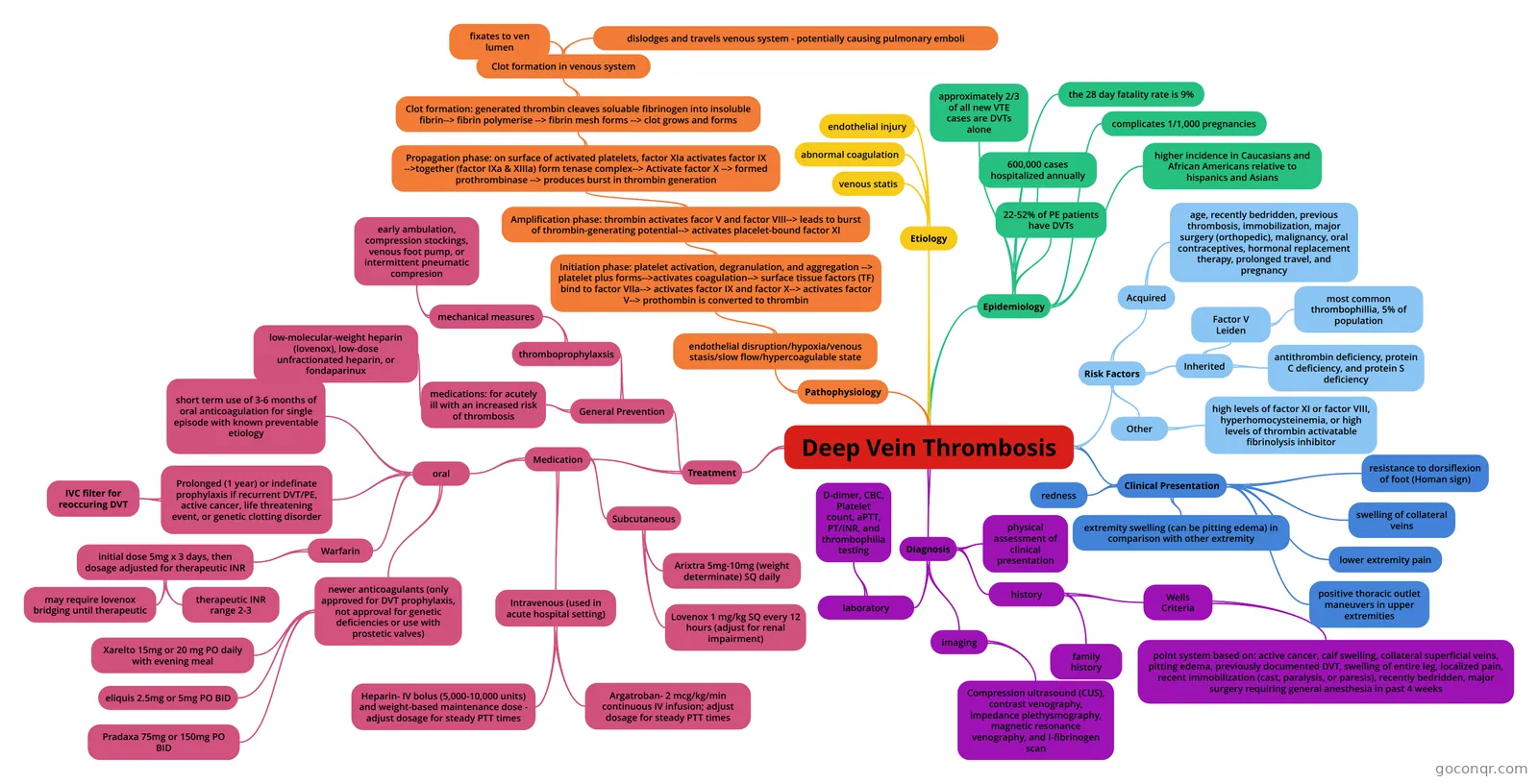
Mind map: Deep vein thrombosis
Conteúdo do mapa
Deep Vein Thrombosis
Pathophysiology
- endothelial disruption/hypoxia/venous stasis/slow flow/hypercoagulable state
- Initiation phase: platelet activation, degranulation, and aggregation --> platelet plus forms-->activates coagulation--> surface tissue factors (TF) bind to factor VIIa--> activates factor IX and factor X--> activates factor V--> prothombin is converted to thrombin
- Amplification phase: thrombin activates facor V and factor VIII--> leads to burst of thrombin-generating potential--> activates placelet-bound factor XI
- Propagation phase: on surface of activated platelets, factor XIa activates factor IX -->together (factor IXa & XIIIa) form tenase complex--> Activate factor X --> formed prothrombinase --> produces burst in thrombin generation
- Clot formation: generated thrombin cleaves soluable fibrinogen into insoluble fibrin--> fibrin polymerise --> fibrin mesh forms --> clot grows and forms
- Clot formation in venous system
- fixates to ven lumen
- dislodges and travels venous system - potentially causing pulmonary emboli
- Clot formation in venous system
- Clot formation: generated thrombin cleaves soluable fibrinogen into insoluble fibrin--> fibrin polymerise --> fibrin mesh forms --> clot grows and forms
- Propagation phase: on surface of activated platelets, factor XIa activates factor IX -->together (factor IXa & XIIIa) form tenase complex--> Activate factor X --> formed prothrombinase --> produces burst in thrombin generation
- Amplification phase: thrombin activates facor V and factor VIII--> leads to burst of thrombin-generating potential--> activates placelet-bound factor XI
- Initiation phase: platelet activation, degranulation, and aggregation --> platelet plus forms-->activates coagulation--> surface tissue factors (TF) bind to factor VIIa--> activates factor IX and factor X--> activates factor V--> prothombin is converted to thrombin
- endothelial disruption/hypoxia/venous stasis/slow flow/hypercoagulable state
Etiology
- venous statis
- endothelial injury
- abnormal coagulation
Epidemiology
- higher incidence in Caucasians and African Americans relative to hispanics and Asians
- complicates 1/1,000 pregnancies
- the 28 day fatality rate is 9%
- 22-52% of PE patients have DVTs
- approximately 2/3 of all new VTE cases are DVTs alone
- 600,000 cases hospitalized annually
Risk Factors
- Acquired
- age, recently bedridden, previous thrombosis, immobilization, major surgery (orthopedic), malignancy, oral contraceptives, hormonal replacement therapy, prolonged travel, and pregnancy
- Inherited
- Factor V Leiden
- most common thrombophillia, 5% of population
- antithrombin deficiency, protein C deficiency, and protein S deficiency
- Factor V Leiden
- Other
- high levels of factor XI or factor VIII, hyperhomocysteinemia, or high levels of thrombin activatable fibrinolysis inhibitor
- Acquired
Clinical Presentation
- resistance to dorsiflexion of foot (Homan sign)
- swelling of collateral veins
- positive thoracic outlet maneuvers in upper extremities
- redness
- extremity swelling (can be pitting edema) in comparison with other extremity
- lower extremity pain
Diagnosis
- history
- Wells Criteria
- point system based on: active cancer, calf swelling, collateral superficial veins, pitting edema, previously documented DVT, swelling of entire leg, localized pain, recent immobilization (cast, paralysis, or paresis), recently bedridden, major surgery requiring general anesthesia in past 4 weeks
- family history
- Wells Criteria
- laboratory
- D-dimer, CBC, Platelet count, aPTT, PT/INR, and thrombophilia testing
- physical assessment of clinical presentation
- imaging
- Compression ultrasound (CUS), contrast venography, impedance plethysmography, magnetic resonance venography, and I-fibrinogen scan
- history
Treatment
- General Prevention
- thromboprophylaxsis
- mechanical measures
- early ambulation, compression stockings, venous foot pump, or intermittent pneumatic compresion
- mechanical measures
- medications: for acutely ill with an increased risk of thrombosis
- low-molecular-weight heparin (lovenox), low-dose unfractionated heparin, or fondaparinux
- thromboprophylaxsis
- Medication
- Intravenous (used in acute hospital setting)
- Heparin- IV bolus (5,000-10,000 units) and weight-based maintenance dose - adjust dosage for steady PTT times
- Argatroban- 2 mcg/kg/min continuous IV infusion; adjust dosage for steady PTT times
- oral
- Warfarin
- initial dose 5mg x 3 days, then dosage adjusted for therapeutic INR
- therapeutic INR range 2-3
- may require lovenox bridging until therapeutic
- initial dose 5mg x 3 days, then dosage adjusted for therapeutic INR
- short term use of 3-6 months of oral anticoagulation for single episode with known preventable etiology
- newer anticoagulants (only approved for DVT prophylaxis, not approval for genetic deficiencies or use with prostetic valves)
- eliquis 2.5mg or 5mg PO BID
- Xarelto 15mg or 20 mg PO daily with evening meal
- Pradaxa 75mg or 150mg PO BID
- Prolonged (1 year) or indefinate prophylaxis if recurrent DVT/PE, active cancer, life threatening event, or genetic clotting disorder
- IVC filter for reoccuring DVT
- Warfarin
- Subcutaneous
- Lovenox 1 mg/kg SQ every 12 hours (adjust for renal impairment)
- Arixtra 5mg-10mg (weight determinate) SQ daily
- Intravenous (used in acute hospital setting)
- General Prevention
Informações
- Descrição
- Mapa Mental sobre Deep Vein Thrombosis_1, criado por lindy.vakoc em 28-09-2014.
- Criado por
- lindy.vakoc
- Visualizações
- 11
- Histórico
-
- Criado por lindy.vakoc · 28 set 2014
- Copiado por lindy.vakoc · 28 set 2014
- Avaliação
Mais sobre Hemodynamic Disorders