
Mapa mental
Enter text here
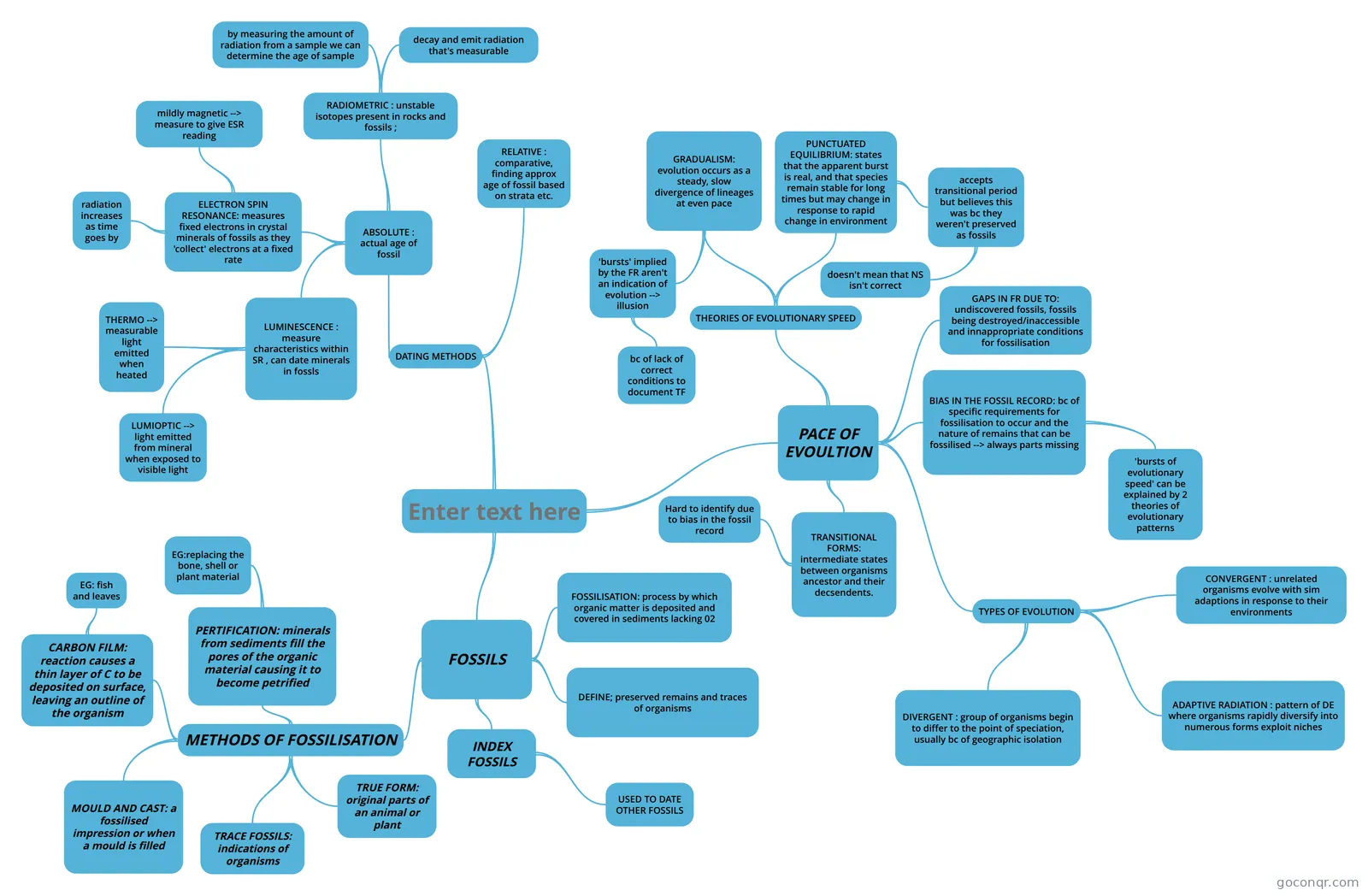
Mind map: fossils and evolution
Conteúdo do mapa
Enter text here
FOSSILS
- DEFINE; preserved remains and traces of organisms
- FOSSILISATION: process by which organic matter is deposited and covered in sediments lacking 02
- INDEX FOSSILS
- USED TO DATE OTHER FOSSILS
- METHODS OF FOSSILISATION
- CARBON FILM: reaction causes a thin layer of C to be deposited on surface, leaving an outline of the organism
- EG: fish and leaves
- PERTIFICATION: minerals from sediments fill the pores of the organic material causing it to become petrified
- EG:replacing the bone, shell or plant material
- MOULD AND CAST: a fossilised impression or when a mould is filled
- TRUE FORM: original parts of an animal or plant
- TRACE FOSSILS: indications of organisms
- CARBON FILM: reaction causes a thin layer of C to be deposited on surface, leaving an outline of the organism
PACE OF EVOULTION
- TRANSITIONAL FORMS: intermediate states between organisms ancestor and their decsendents.
- Hard to identify due to bias in the fossil record
- BIAS IN THE FOSSIL RECORD: bc of specific requirements for fossilisation to occur and the nature of remains that can be fossilised --> always parts missing
- 'bursts of evolutionary speed' can be explained by 2 theories of evolutionary patterns
- GAPS IN FR DUE TO: undiscovered fossils, fossils being destroyed/inaccessible and innappropriate conditions for fossilisation
- THEORIES OF EVOLUTIONARY SPEED
- GRADUALISM: evolution occurs as a steady, slow divergence of lineages at even pace
- 'bursts' implied by the FR aren't an indication of evolution --> illusion
- bc of lack of correct conditions to document TF
- 'bursts' implied by the FR aren't an indication of evolution --> illusion
- PUNCTUATED EQUILIBRIUM: states that the apparent burst is real, and that species remain stable for long times but may change in response to rapid change in environment
- accepts transitional period but believes this was bc they weren't preserved as fossils
- doesn't mean that NS isn't correct
- accepts transitional period but believes this was bc they weren't preserved as fossils
- GRADUALISM: evolution occurs as a steady, slow divergence of lineages at even pace
- TYPES OF EVOLUTION
- DIVERGENT : group of organisms begin to differ to the point of speciation, usually bc of geographic isolation
- ADAPTIVE RADIATION : pattern of DE where organisms rapidly diversify into numerous forms exploit niches
- CONVERGENT : unrelated organisms evolve with sim adaptions in response to their environments
- TRANSITIONAL FORMS: intermediate states between organisms ancestor and their decsendents.
DATING METHODS
- RELATIVE : comparative, finding approx age of fossil based on strata etc.
- ABSOLUTE : actual age of fossil
- RADIOMETRIC : unstable isotopes present in rocks and fossils ;
- decay and emit radiation that's measurable
- by measuring the amount of radiation from a sample we can determine the age of sample
- ELECTRON SPIN RESONANCE: measures fixed electrons in crystal minerals of fossils as they 'collect' electrons at a fixed rate
- mildly magnetic --> measure to give ESR reading
- radiation increases as time goes by
- LUMINESCENCE : measure characteristics within SR , can date minerals in fossls
- THERMO --> measurable light emitted when heated
- LUMIOPTIC --> light emitted from mineral when exposed to visible light
- RADIOMETRIC : unstable isotopes present in rocks and fossils ;
Informações
- Descrição
- Mapa Mental sobre Enter text here, criado por Samantha Moir em 16-05-2018.
- Criado por
- Samantha Moir
- Visualizações
- 0
- Avaliação