
Mapa mental
Sociology Unit 2
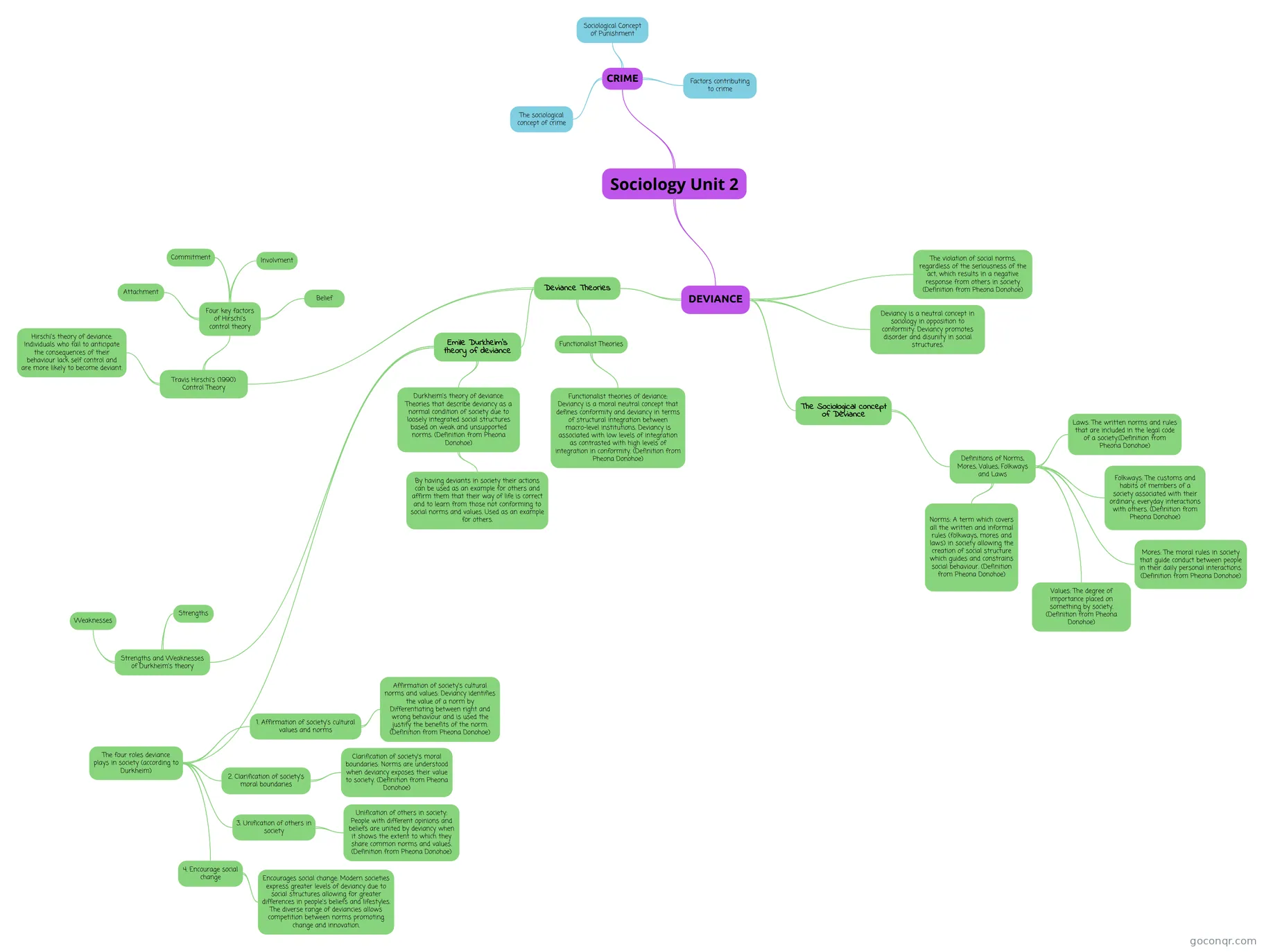
Mind map: Sociology Unit 2
Conteúdo do mapa
Sociology Unit 2
DEVIANCE
- The Sociological concept of Deviance
- Definitions of Norms, Mores, Values, Folkways and Laws
- Norms: A term which covers all the written and informal rules (folkways, mores and laws) in society allowing the creation of social structure which guides and constrains social behaviour. (Definition from Pheona Donohoe)
- Values: The degree of importance placed on something by society. (Definition from Pheona Donohoe)
- Mores: The moral rules in society that guide conduct between people in their daily personal interactions. (Definition from Pheona Donohoe)
- Folkways: The customs and habits of members of a society associated with their ordinary, everyday interactions with others. (Definition from Pheona Donohoe)
- Laws: The written norms and rules that are included in the legal code of a society.(Definition from Pheona Donohoe)
- Definitions of Norms, Mores, Values, Folkways and Laws
- The violation of social norms, regardless of the seriousness of the act, which results in a negative response from others in society (Definition from Pheona Donohoe)
- Deviancy is a neutral concept in sociology in opposition to conformity. Deviancy promotes disorder and disunity in social structures.
- Deviance Theories
- Emile Durkheim's theory of deviance
- Durkheim's theory of deviance: Theories that describe deviancy as a normal condition of society due to loosely integrated social structures based on weak and unsupported norms. (Definition from Pheona Donohoe)
- By having deviants in society their actions can be used as an example for others and affirm them that their way of life is correct and to learn from those not conforming to social norms and values. Used as an example for others.
- The four roles deviance plays in society (according to Durkheim)
- 1. Affirmation of society's cultural values and norms
- Affirmation of society's cultural norms and values: Deviancy identifies the value of a norm by Differentiating between right and wrong behaviour and is used the justify the benefits of the norm. (Definition from Pheona Donohoe)
- 2. Clarification of society's moral boundaries
- Clarification of society's moral boundaries: Norms are understood when deviancy exposes their value to society. (Definition from Pheona Donohoe)
- 3. Unification of others in society
- Unification of others in society: People with different opinions and beliefs are united by deviancy when it shows the extent to which they share common norms and values. (Definition from Pheona Donohoe)
- 4. Encourage social change
- Encourages social change: Modern societies express greater levels of deviancy due to social structures allowing for greater differences in people's beliefs and lifestyles. The diverse range of deviancies allows competition between norms promoting change and innovation.
- 1. Affirmation of society's cultural values and norms
- Strengths and Weaknesses of Durkheim's theory
- Strengths
- Weaknesses
- Durkheim's theory of deviance: Theories that describe deviancy as a normal condition of society due to loosely integrated social structures based on weak and unsupported norms. (Definition from Pheona Donohoe)
- Functionalist Theories
- Functionalist theories of deviance: Deviancy is a moral neutral concept that defines conformity and deviancy in terms of structural integration between macro-level institutions. Deviancy is associated with low levels of integration as contrasted with high levels of integration in conformity. (Definition from Pheona Donohoe)
- Travis Hirschi's (1990) Control Theory
- Hirschi's theory of deviance: Individuals who fail to anticipate the consequences of their behaviour lack self control and are more likely to become deviant.
- Four key factors of Hirschi's control theory
- Attachment
- Commitment
- Involvment
- Belief
- Emile Durkheim's theory of deviance
- The Sociological concept of Deviance
CRIME
- The sociological concept of crime
- Factors contributing to crime
- Sociological Concept of Punishment
Informações
- Descrição
- Mapa Mental sobre Sociology Unit 2, criado por Mikayla_B em 16-10-2014.
- Criado por
- Mikayla_B
- Visualizações
- 19
- Avaliação