
Mapa mental
(Wk. 5-6) Phase 2: Risk Response
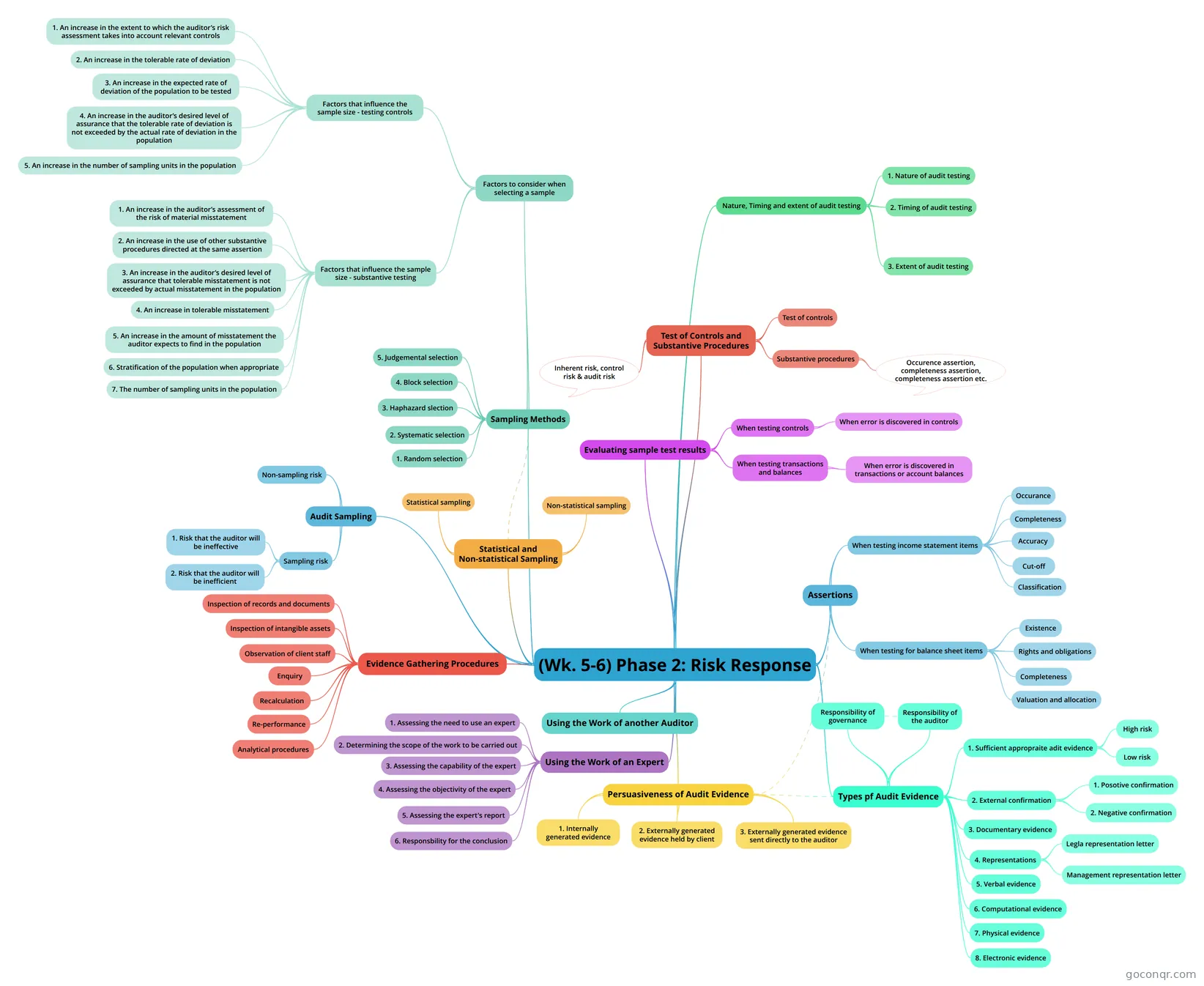
Mind map: Audit Evidence and Risk Response Procedures
Conteúdo do mapa
(Wk. 5-6) Phase 2: Risk Response
Assertions
- When preparing the financial report, management makes assertions about each account and related disclosures in the notes. Auditors use assertions for transactions, account balances, and presentations and disclosures when assessing the risk of material misstatement and when designing their audit procedures. Example: when reporting on inventory, management should ensure that the items disclosed exist, are owned by the entity, represent a complete list of the inventory owned and are valued appropriately. Example: When reporting on sales, management should ensure that the amount disclosed represents sales of the entity that occurred during the accounting period. They should also ensure that sales are recorded at the correct amount, represent a complete list of all sales and are classified correctly.
- When testing income statement items
- Occurance
- When testing for completeness, an auditor searches for transactions or events and makes sure these have been recorded. Example: This assertion is particularly important when the auditor believes that there is a risk of overstatement and that some transactions or events are recorded but did not actually occur.
- Completeness
- All transactions and events that should have been recorded have been recorded. Example: This assertion is particularly important when the auditor believes there is a risk of understatement and that some transactions or events that should have been recorded have not been recorded.
- Accuracy
- Amounts and other data relating to recorded transactions and events have been recorded appropraitely. Example: This assertion is particularly important when the auditor believes there is a risk that the reported amounts are not accurate.
- Cut-off
- Transactions and events have been recorded in the correct accounting period. Example: This assertion is particularly important for transactions close to year-end. For example, a client may record a sale before year-end that occurred after year-end. Or, a client may record an expense after year-end that was incurred before year-end.
- Classification
- Transactions and events have been recorded in the proper acocunts.
- Occurance
- When testing for balance sheet items
- Existence
- When testing for existence, an auditor searches for evidence to verify that asset, liability and equity items included in the balances that appear in the financial report actually exist.
- Rights and obligations
- The entity holds or controls the rights to assets, and liabilities are the obligations of the entity. Example: This assertion is particularly important when the auditor believes there is a risk that recorded assets or liabilities are not owned by the entity.
- Completeness
- All assets, liabilites and equity interests that should have been recorded have been recorded. Example: This assertion is particularly important when the auditor believes there is a risk of understatement and the client has omitted some items from the balance sheet.
- Valuation and allocation
- An auditor searches for evidence that assets, liabilities and equity items have been recorded at appropriate amounts and allocated to the correct general ledger accounts. Example: This assertion is particularly important when the auditor believes there is a risk of over or undervaluation.
- Existence
Types pf Audit Evidence
- Evidence: - Audit evidence is the information that an auditor uses when arriving at their opinion on the truth and fairness of their client’s financial report.
- Responsibility of governance
- Those in charge with governance (BOD) must ensure that the financial reports are in line with the accounting standards. They are also responsible for ensuring that accurate accounting records are maintained and free from error.
- Responsibility of the auditor
- It is the responsbility of the auditor to gather sufficient evidence to arrive at their opinion. Basiacally means to ensure that those in charge with governance are acutally doing their job.
- 1. Sufficient appropraite adit evidence
- Sufficient: - rekates to the quantity Appropriateness: - relates to the quality of audit evidence gathered. These are interelated as the quantity and quality affect each other during the risk response phase. There is a direct relationship between the risk of material misstatement (inherent and control risk) and the extent of quality evidence gathered when testing transactions and balances.
- By identifying the key risk areas for the client, an auditor is able to focus on gathering more (sufficient) high-quality (appropriate) evidence where the risk of material misstatement is believed to be most significant.
- High risk
- When there is a high risk that accounts will be misstated: Inherent risk = high Control risk = high Detection risk = low Evidence = high High quality evidence is gathered when conducting substantive testing of that account.
- Low risk
- When there is a high risk that accounts will be misstated: Inherent risk = low Control risk = low Detection risk = high Evidence = low less high quality evidence is gathered when conducting substantive testing of that account.
- 2. External confirmation
- External confirmation is when an auditor seeks confirmation from exernal users that the client has dealt with. External confirmation can be sent to: Bank confirmation - request information about the amount of cash held in the bank account to ensure that the appropriate amount is recorded. Lawyer confirmation - lawyers may hold documents on behalf of the client that are of relevance to the audit. Payable (suppliers) confirmation - auditor may confirm details of amounts owed to creditors, what is outstanding and what was paid/left to pay by the client. Receivable (debtors) confirmation - auditor must ensure that debtors exist and clients must provide some evidence of ownership as debtors confirm that they owe money to the client.
- There are 2 types of confirmation: 1. Positive confirmation 2. Negative confirmation
- 1. Posotive confirmation
- This asks the recipient to reply in all circumstances. Positive confirmations provide superior evidence as a non-response from a negative confirmation request may provide false reassurance. Example: a client may record fake sales to customers that do not exist close to year-end to boost revenue. A non-response from a non-existent customer may be interpreted by an auditor as confirmation that the customer agrees with the amount outstanding. In this case the conclusion would be unjustified.
- 2. Negative confirmation
- This asks the recipient to reply only if they disagree with the informaiton provided; reciepient will not respond if they agree with the information provided.
- 3. Documentary evidence
- Documentary evidence includes invoices, suppliers’ statements, bank statements, minutes of meetings, correspondence and legal agreements. It may be internally generated or externally generated. Internally generated documents are produced by the client. Externally generated documents are generated by third parties. An auditor can match details recorded in a client's accounting records with external supporting documents to verify the existence, accuracy and completeness in the internal documents.
- 4. Representations
- When an auditor has reason to believe that legal issues exist which may affect the financial report such as the client being sued by a third party, or when a legal firm is engaged by the client for the first time, a representation letter is requested from the legal firm(s) that their client deals with.
- Legla representation letter
- A legal representation letter is generally sent by the client to its lawyers asking them to complete the representation letter and send it directly to the auditor.
- Management representation letter
- Management representation letter generally includes an acknowledgement that management is responsible for the preparation of the financial report. Management is responsible for ensuring that the report is prepared in accordance with the Corporations Act giving a true and fair view of the company’s financial position and complying with Australian Accounting Standards. The letter will include written details of any verbal representations made by management during the course of the audit. As verbal evidence is weaker than written evidence, an auditor will seek written confirmation of any significant discussions in the management representation letter.
- 5. Verbal evidence
- Verbal evidence is used when gaining an understanding of the client and its internal controls system. It can be used to corroborate other forms of evidence. Verbal evidence is documented in the auditor’s working papers so that a record is kept of all key discussions with the client.
- 6. Computational evidence
- Computational evidence is gathered when an auditor checks the mathematical accuracy of the numbers that appear in the financial report (accuracy and valuation and allocation assertions). This involves: - re-adding the entries included in a client’s journals and ledgers; or - recomputing more complex calculations such as foreign currency translation, fringe benefits tax, interest of loans outstanding and fair value modelling etc.
- 7. Physical evidence
- An auditor gathers physical evidence through inspection of a client’s tangible assets, such as its inventory and fixed assets. An auditor vouches recorded amounts to assets to gain evidence that the assets exist (existence assertion).
- 8. Electronic evidence
- Electronic evidence includes data held on a client’s computer, files sent via email to the auditor, and scanned and faxed items. Transactions are commonly initiated and stored electronically. They leave no paper trail. To access the details of these transactions, an auditor must access their client’s computer system, where details are kept. The extent to which an auditor can rely on electronic evidence produced by their client’s computer system will depend a great deal on the internal controls in place.
Persuasiveness of Audit Evidence
- The auditor searches for corroborating evidence to prove that their clients records are accurate. Corobrating evidence is basically the "types of audit evidence" that the auditor uses to verify amounts recorded in the client's records. There are 3 catagories of corroborating evidence which vary in persuasiveness: 1. Internally generated evidence 2. Externally generated evidence held by client 3. Exernally generated evidence sent directly to the auditor
- 1. Internally generated evidence
- Internally generated evidence (cheques, invoices, statements, journals etc.) held by the client in both electronically (soft copy) and paper form (hard copy). Internally generated evidence is the least persuasive as it can only be used to verify that a client has accurately converted this information into the financial report. That is, as the client generates and holds this evidence, it is possible that evidence may be manipulated or omitted.
- 2. Externally generated evidence held by client
- These sources of evidence are quite persuasive as they are produced by third parties. It is, however, possible that the client can manipulate these documents, which reduces their reliability to the auditor. Also, if the client provides the auditor with photocopies of information from these external sources, rather than originals, the reliability is reduced.
- 3. Externally generated evidence sent directly to the auditor
- These sources of evidence are considered to be the most reliable and best quality as they are independent of the client. As this evidence is generated by third parties and sent directly to the auditor, the client does not have an opportunity to alter it. Further, externally generated evidence is considered the most persuasive when the source of that evidence is considered to be reliable, trustworthy and independent of the client.
Using the Work of an Expert
- It may be necessary to engage the services of an expert if an auditor does not have the requisite skills and knowledge to assess the validity of an account or a transaction. Expert: Someone with the skill, knowledge and experience required to aid the auditor when gathering evidence. E.g. - member of another audit firm - employee of the client - independent person
- ASA 620 provides guidelines on whether an auditor really need to use the work of an expert.
- 1. Assessing the need to use an expert
- The less knowledge an audit team has of the item under consideration, the greater the risk of material misstatement and the less corroborating evidence available, the more likely an auditor will conclude that an expert opinion is required.
- 2. Determining the scope of the work to be carried out
- Once it has been determined that an expert opinion is required, the scope of the work to be carried out is determined by the auditor and communicated to the expert. This involves setting the nature, timing and extent of work to be completed by the expert.
- 3. Assessing the capability of the expert
- Before contacting an expert, an auditor assesses their capacity to complete the work required. This involves: - evaluation of the epxert's qualification - reputation of the expert within the firld - expert's knowledge and experiance are appropriate
- 4. Assessing the objectivity of the expert
- Objectivity refers to the ability to form an opinion or arrive at a conclusion without the influence of personal preferences. An expert is expected to be more objective if they are not associated with the client. When an expert is an employee of the client or in some other way connected with the client, an auditor assesses the objectivity of the expert with reference to their professional status, their reputation and the auditor’s prior experience with the expert. If an expert’s opinion has proven to be accurate in the past, it increases the reliability the auditor may place on the expert’s opinion in the current audit. Nevertheless, the less independent the expert is from the client, the more corroborating evidence the auditor will require.
- 5. Assessing the expert's report
- It is important that an expert’s report be written in such a way that an auditor, who is not an expert in the field being reported on, can understand the technical content of the report.
- 6. Responsbility for the conclusion
- It is the responsibility of the auditor to assess the quality of the evidence provided by an expert and determine whether it is reliable and objective. This is done by the following process outlined above. The auditor will determine the need for an expert, the scope of the expert’s work and the competence and objectivity of the expert. Finally, the auditor will assess the quality of the expert’s report and the reliability of the information included in it.
Using the Work of another Auditor
- The auditor who is responsible for signing the audit report (the group engagement partner) may need to rely on evidence provided by another auditor for certain components of a client’s financial report. This occurs when a client operates in a number of locations, has divisions or subsidiaries spread around the country or the globe, or has significant assets in other locations. When making a client acceptance or continuance decision an auditor will consider their capacity to undertake the audit and the proportion of the financial report for which they will have to rely on another auditor (component auditor). The group engagement partner’s firm should audit the majority of a client’s financial report and be knowledgeable about the components of the financial report that they do not audit themselves. If this is not the case, the firm should not accept or continue to audit the client.
Evidence Gathering Procedures
- Inspection of records and documents
- Auditor will inspect records and documents for a variety of reasons: - calculations have been checked; - balances have been reconciled; - inputs have been agreed to outputs; and - management have authorised significant purchases.
- Inspection of intangible assets
- Tangible assets are inspected to provide evidence that they exist (existence assertion) and appear to be in good repair or damaged or past their use-by date (valuation and allocation assertion).
- Observation of client staff
- Client staff are observed undertaking various procedures when there is no other way of establishing that a process is being used by their client. For example, an auditor will observe the opening of mail and the conduct of a stocktake to determine whether the appropriate procedures are being followed. Importantly, observation only provides evidence of a process at the time the auditor observes it being carried out.
- Enquiry
- Enquiry is used when gaining an understanding of the client and to corroborate other evidence gathered throughout the audit. The results of enquiries of client personnel and third parties are documented by the auditor.
- Recalculation
- Recalculations are used to check the mathematical accuracy of client files and records. This will involve checking additions and more complex computations.
- Re-performance
- Re-performance means following a process used by a client.
- Analytical procedures
- Analytical procedures are used to appraise relationships between financial and non-financial information.
- Inspection of records and documents
Audit Sampling
- •Sampling is required whenever auditor does not test entire group of transactions or all items in a balance (ASA 530; ISA 530). •In many cases, there are too many items to test, or auditor decides that it is not necessary to test all items. •Sample of items tested should be representative of the population. •Audit risk impacted by sampling risk and non-sampling risk (risk that an auditor expresses an inappropriate audit opinion when a financial report is materially misstated).
- Sampling risk
- Sampling risk is the risk that the sample chosen by the auditor is not representative of the population of transactions or items within an account balance available for testing and, as a consequence, the auditor arrives at an inappropriate conclusion. This can happen when the items selected for testing the effectiveness of the internal controls are not representative of all items available for testing. Two consequences of a sampling risk: 1. risk that the auditor will be ineffective. 2. risk that the auditor will be inefficient.
- Example of ineffective and inefficient risk: When an auditor concludes that their client’s system of internal controls is ineffective at preventing and detecting potential material misstatements, control risk will be assessed as high and the audit strategy will be to increase reliance on detailed substantive testing of transactions and balances. By conducting more substantive procedures when control risk is lower than assessed, the audit will be inefficient as more time will be spent conducting substantive procedures than is necessary.
- 1. Risk that the auditor will be ineffective
- Sampling risk and test of controls example: - The risk that the auditor concludes that the client’s system of internal controls is effective when it is ineffective. > An increased audit risk (i.e. there is a risk that the audit will be ineffective). Sampling risk and substantive procedures example: - The risk that the auditor concludes that a material misstatement does not exist when it does. >An increased audit risk (i.e. there is a risk that the audit will be ineffective)
- 2. Risk that the auditor will be inefficient
- Sampling risk and test of controls example: - The risk that the auditor concludes that the client’s system of internal controls is ineffective when it is effective. > An increase in audit effort when not required (i.e. there is a risk that the audit will be inefficient). Sampling risk and substantive procedures example: - The risk that the auditor concludes that a material misstatement exists when it does not. > An increase in audit effort when not required (i.e. there is a risk that the audit will be inefficient).
- Non-sampling risk
- Non-sampling risk is the risk that an auditor arrives at an inappropriate conclusion for a reason unrelated to sampling issues. This can occur when: - an auditor uses an inappropriate audit procedure; - relies too heavily on unreliable evidence; or - spends too little time testing the accounts most at risk of material misstatement.
Statistical and Non-statistical Sampling
- Statistical sampling
- –Involves random selection of sample and probability theory to evaluate the results, including sampling risk (ASA 530; ISA 530). –Advantage: allows measurement of sampling risk. –Disadvantage: can be costly to use. Generally used for high-risk accounts, where limited or no corroborating evidence is available.
- Non-statistical sampling
- Non-statistical sampling is easier than statistical sampling as it requires: - less staff training; - lower cost; and - allows an auditor to select a sample that they believe is appropriate using their professional judgement. Generally used when an account is considered to be low risk and the auditor has access to adequate corroborating evidence.
- Statistical sampling
Sampling Methods
- 1. Random selection
- Random selection requires that the person selecting the sample does not influence the choice of items selected. The resulting sample is then free from bias and each item within the population has an equal chance of being selected for testing. Random number generators can be used to select a sample.
- Stratify: - (subdivide) population of transactions into different size ranges, then take different size samples from each stratum. - Stratification can reduce total sample size required for test.
- 2. Systematic selection
- Systematic selection involves the selection of a sample for testing by dividing the number of items in a population by the sample size, resulting in the sampling interval (n). Once the sampling interval has been determined a starting point is selected, which is an item in the population below the sampling interval, and then the sample is selected by selecting the first item and then every nth item after that. Example: Sample internal = population size/ sample size = 600/ 20 = 30 This means that every 30th item will be selected for testing.
- 4. Block selection
- Block selection involves the selection of items that are grouped together within the population of items available. This is a non-statistical technique as many populations of items are sorted in a sequence, which makes the selection of groups of items in a block inappropriate. For example, transactions are generally grouped in date order; by using block selection the items selected will not be representative of transactions made throughout the year.
- 3. Haphazard slection
- Haphazard selection involves the selection of a sample by an auditor without using a methodical technique. While this technique appears to have much in common with random selection, there is a risk that an auditor will avoid selecting some items or ensure other items are included in the sample due to bias influence.
- 5. Judgemental selection
- Block selection involves the selection of items that are grouped together within the population of items available. This is a non-statistical technique as many populations of items are sorted in a sequence, which makes the selection of groups of items in a block inappropriate. For example, transactions are generally grouped in date order; by using block selection the items selected will not be representative of transactions made throughout the year.
- Factors to consider when selecting a sample
- When selecting a sample, the auditor must consider the sample size which include: - control risk - detection risk - planning materiality > the lower the control risk, the larger the sample size when testing controls. > the lower detection risk, the larger the sample size when conducting detailed substantive procedures.
- Factors that influence the sample size - testing controls
- 1. An increase in the extent to which the auditor’s risk assessment takes into account relevant controls
- If an auditor believes that a control will be effective in reducing an identified risk of material misstatement, their audit strategy will be to increase testing of that control to ensure it is effective. When concluding that a control is effective, an auditor will rely on that control to prevent and detect a material misstatement, and reduce their detailed substantive procedures.
- 2. An increase in the tolerable rate of deviation
- If an auditor intends to rely on a control to prevent and detect a material misstatement, a lower tolerable error rate will be set and the sample size will be increased to provide the auditor with the evidence required to demonstrate that the control is effective. If an auditor expects to place relatively more reliance on their substantive procedures and reduce their reliance on an internal control, they will increase the tolerable rate of deviation and reduce the sample size when testing the control.
- 3. An increase in the expected rate of deviation of the population to be tested
- If an auditor believes that the rate of deviation has increased when compared to prior audits, they will increase the sample size to accurately evaluate the impact of the changed circumstances.
- 4. An increase in the auditor’s desired level of assurance that the tolerable rate of deviation is not exceeded by the actual rate of deviation in the population
- When control risk is assessed as low for a risk factor, an auditor’s required level of confidence in the effectiveness of their client’s internal control is higher than when control risk is assessed as medium to high. If an auditor is to rely on their client’s internal control procedures to prevent or detect an identified material misstatement, their required confidence level in that control increases and they will increase the sample size when testing that control.
- 5. An increase in the number of sampling units in the population
- When a population is large and fairly homogenous, there is little benefit from continuing to increase the sample size as the results from continued testing should confirm early findings.
- 1. An increase in the extent to which the auditor’s risk assessment takes into account relevant controls
- Factors that influence the sample size - substantive testing
- 1. An increase in the auditor’s assessment of the risk of material misstatement
- This risk is influenced by the auditor’s assessment of inherent and control risk. The higher the inherent and control risk, the greater the risk that a material misstatement exists in a client’s financial report, the more an auditor must rely on their substantive tests of transactions and balances to identify potential material misstatements. When an auditor decides to increase their reliance on their substantive procedures, they will increase the sample size when conducting substantive tests.
- 2. An increase in the use of other substantive procedures directed at the same assertion
- When testing transactions and balances, an auditor will use a number of audit procedures. The more procedures that are directed to the same audit assertion, the less an auditor will need to rely on the evidence provided by one test alone and the smaller the sample size required.
- 3. An increase in the auditor’s desired level of assurance that tolerable misstatement is not exceeded by actual misstatement in the population
- The greater the inherent and control risk, the lower the detection risk set by the auditor, the greater the confidence level required when conducting substantive tests of transactions and balances. When an auditor requires more confidence from the results of their testing, they will increase the sample size when conducting substantive tests.
- 4. An increase in tolerable misstatement
- When an auditor increases the tolerable error rate, they are indicating that they are not relying on that particular test to provide all of the evidence required for a particular assertion. In that case they will reduce the sample size. The tolerable error is equal to or less than the materiality level set for the class of transactions or balances being tested.
- 5. An increase in the amount of misstatement the auditor expects to find in the population
- When an auditor believes that there is likely to be a material misstatement in the population of transactions or amounts making up an account balance, they will increase their sample size to gain a better estimate of the actual misstatement in the population.
- 6. Stratification of the population when appropriate
- Stratification of the population will result in more efficient sampling and reduce the sample required.
- 7. The number of sampling units in the population
- When a population is large and fairly homogenous, there is little benefit from continuing to increase the sample size as the results from continued testing should confirm early findings.
- 1. An increase in the auditor’s assessment of the risk of material misstatement
- 1. Random selection
Evaluating sample test results
- When testing controls
- When testing controls, an auditor will consider whether the results of their tests applied to a sample provide evidence that the control tested is effective within the entire population.
- When error is discovered in controls
- When an error is discovered when testing controls, a deviation rate will be calculated. Deviation rate: - The deviation rate is the proportion of departures within the sample. > Deviation rate should equal for the sample should equal the deviation rate for the population.
- When testing transactions and balances
- When conducting tests of transactions and balances, an auditor will consider whether the results of their tests applied to a sample provide evidence that the class of transactions or account balance tested is fairly stated (that is, does not contain a material misstatement).
- When error is discovered in transactions or account balances
- When testing controls
Test of Controls and Substantive Procedures
- An audit strategy is developed after gaining an understanding of a client’s business and its internal control structure. Once an auditor has a thorough knowledge of their client’s business and controls they can determine the overall risk of material misstatement, which is the inherent risk (the risk a material misstatement could occur) and control risk (the risk that a client’s system of internal controls will not prevent or detect a material misstatement) combined. The risk of material misstatement affects audit risk (the risk that an auditor expresses an inappropriate audit opinion when a financial report is materially misstated). When control risk is assessed as being high: - An auditor will adopt a predominantly substantive approach. This means that the audit strategy is to gain a minimum knowledge of the client’s system of internal controls, conduct limited or no tests of controls (or controls testing) and conduct extensive detailed substantive procedures. When control risk is assessed as medium to low: - An auditor will adopt a lower assessed level of control risk approach. This means that the audit strategy is to gain a detailed understanding of their client’s system of internal controls, conduct extensive tests of controls and if those controls prove effective, conduct less detailed substantive procedures.
- Inherent risk, control risk & audit risk
- Test of controls
- Auditor tests the effectiveness of the internal controls identified when gaining an understanding of the client's internal controls. An auditor tests the controls to check their effectiveness before coming to a conclusion: - If the controls prove effective the auditor can reduce their reliance on detailed substantive procedures; - If the controls prove ineffective, the auditor reassesses control risk as higher than before and increases their reliance on detailed substantive procedures
- Tests of controls are conducted to establish that controls: • operate effectively, meaning that the rate of deviation from prescribed control procedures are minimised and controls effectively prevent and detect material misstatements • operate consistently throughout the accounting period.
- Substantive procedures
- When conducting detailed substantive procedures (also called substantive testing or tests of details), an auditor searches for evidence that recorded transactions occurred and relate to the client (occurrence assertion), that all transactions have been recorded (completeness assertion), that all transactions have been recorded at appropriate carrying amounts (accuracy assertion), that all transactions have been recorded in the correct accounting period (cut-off assertion) and that all transactions have been recorded in the correct accounts (classification assertion).
- When conducting detailed substantive procedures, an auditor searches for evidence that recorded accounts such as assets, liabilities and equity accounts exist (existence assertion), that all accounts that should have been recorded have been recorded (completeness assertion), that recorded accounts represent items owned by the client or amounts owed by the client to third parties (rights and obligations assertion) and that recorded accounts appear at appropriate carrying amounts (valuation and allocation assertion).
- Occurence assertion, completeness assertion, completeness assertion etc.
Nature, Timing and extent of audit testing
- 1. Nature of audit testing
- The nature of audit testing refers to the purpose of the test (that is, to test controls, transactions or account balances) and the procedure used (that is, inspection, observation, enquiry, confirmation, recalculation, re-performance or analytical procedures).
- 2. Timing of audit testing
- Timing of audit testing refers to the stage of the audit when procedures are performed and the date, such as within or outside the accounting period. For low-risk accounts it is common to conduct more work during the interim audit, testing controls and conducting substantive tests of transactions. For high-risk accounts the timing of most audit procedures will be at, or after, year-end.
- 3. Extent of audit testing
- The extent of audit testing refers to the sufficiency (quantity) of audit evidence gathered when testing controls and conducting detailed substantive procedures. When control risk is low, the audit strategy is to increase reliance on tests of controls and reduce reliance on substantive testing of transactions and account balances. When control risk is high, the audit strategy is to do little or no tests of controls and increase reliance on substantive testing of transactions and account balances.
- 1. Nature of audit testing
Informações
- Descrição
- AUDITING Mapa Mental sobre (Wk. 5-6) Phase 2: Risk Response, criado por Micky Marshall em 23-08-2018.
- Criado por
- Micky Marshall
- Visualizações
- 3
- Avaliação
Mais sobre Audit Procedures and Tests