
Mapa mental
software development cycle
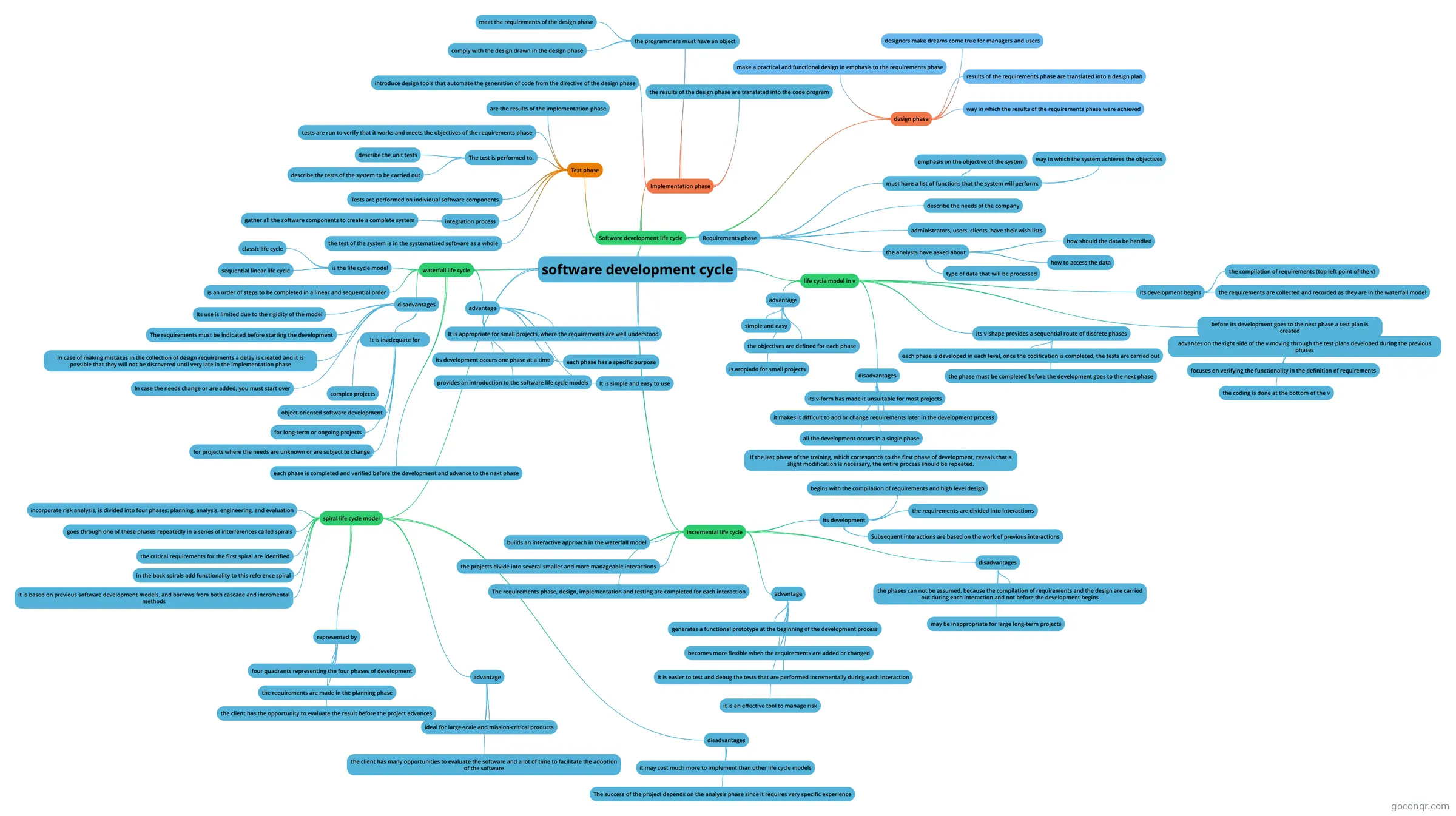
Mind map: software development cycle
Conteúdo do mapa
software development cycle
Software development life cycle
- Requirements phase
- describe the needs of the company
- administrators, users, clients, have their wish lists
- the analysts have asked about
- type of data that will be processed
- how should the data be handled
- how to access the data
- must have a list of functions that the system will perform:
- emphasis on the objective of the system
- way in which the system achieves the objectives
- design phase
- results of the requirements phase are translated into a design plan
- way in which the results of the requirements phase were achieved
- designers make dreams come true for managers and users
- make a practical and functional design in emphasis to the requirements phase
- Implementation phase
- the results of the design phase are translated into the code program
- the programmers must have an object
- meet the requirements of the design phase
- comply with the design drawn in the design phase
- introduce design tools that automate the generation of code from the directive of the design phase
- Test phase
- are the results of the implementation phase
- tests are run to verify that it works and meets the objectives of the requirements phase
- The test is performed to:
- describe the unit tests
- describe the tests of the system to be carried out
- Tests are performed on individual software components
- integration process
- gather all the software components to create a complete system
- the test of the system is in the systematized software as a whole
- Requirements phase
waterfall life cycle
- is the life cycle model
- classic life cycle
- sequential linear life cycle
- is an order of steps to be completed in a linear and sequential order
- each phase is completed and verified before the development and advance to the next phase
- advantage
- provides an introduction to the software life cycle models
- It is simple and easy to use
- each phase has a specific purpose
- its development occurs one phase at a time
- It is appropriate for small projects, where the requirements are well understood
- disadvantages
- Its use is limited due to the rigidity of the model
- The requirements must be indicated before starting the development
- In case the needs change or are added, you must start over
- in case of making mistakes in the collection of design requirements a delay is created and it is possible that they will not be discovered until very late in the implementation phase
- It is inadequate for
- complex projects
- object-oriented software development
- for long-term or ongoing projects
- for projects where the needs are unknown or are subject to change
- is the life cycle model
life cycle model in v
- its v-shape provides a sequential route of discrete phases
- the phase must be completed before the development goes to the next phase
- each phase is developed in each level, once the codification is completed, the tests are carried out
- its development begins
- the compilation of requirements (top left point of the v)
- the requirements are collected and recorded as they are in the waterfall model
- before its development goes to the next phase a test plan is created
- focuses on verifying the functionality in the definition of requirements
- the coding is done at the bottom of the v
- advances on the right side of the v moving through the test plans developed during the previous phases
- advantage
- simple and easy
- the objectives are defined for each phase
- is aropiado for small projects
- disadvantages
- its v-form has made it unsuitable for most projects
- it makes it difficult to add or change requirements later in the development process
- all the development occurs in a single phase
- If the last phase of the training, which corresponds to the first phase of development, reveals that a slight modification is necessary, the entire process should be repeated.
- its v-shape provides a sequential route of discrete phases
incremental life cycle
- builds an interactive approach in the waterfall model
- the projects divide into several smaller and more manageable interactions
- The requirements phase, design, implementation and testing are completed for each interaction
- its development
- begins with the compilation of requirements and high level design
- the requirements are divided into interactions
- Subsequent interactions are based on the work of previous interactions
- advantage
- generates a functional prototype at the beginning of the development process
- becomes more flexible when the requirements are added or changed
- It is easier to test and debug the tests that are performed incrementally during each interaction
- it is an effective tool to manage risk
- disadvantages
- the phases can not be assumed, because the compilation of requirements and the design are carried out during each interaction and not before the development begins
- may be inappropriate for large long-term projects
spiral life cycle model
- incorporate risk analysis, is divided into four phases: planning, analysis, engineering, and evaluation
- goes through one of these phases repeatedly in a series of interferences called spirals
- the critical requirements for the first spiral are identified
- in the back spirals add functionality to this reference spiral
- it is based on previous software development models. and borrows from both cascade and incremental methods
- represented by
- four quadrants representing the four phases of development
- the requirements are made in the planning phase
- the client has the opportunity to evaluate the result before the project advances
- advantage
- ideal for large-scale and mission-critical products
- the client has many opportunities to evaluate the software and a lot of time to facilitate the adoption of the software
- disadvantages
- it may cost much more to implement than other life cycle models
- The success of the project depends on the analysis phase since it requires very specific experience