
Mapa mental
The Progressive Era
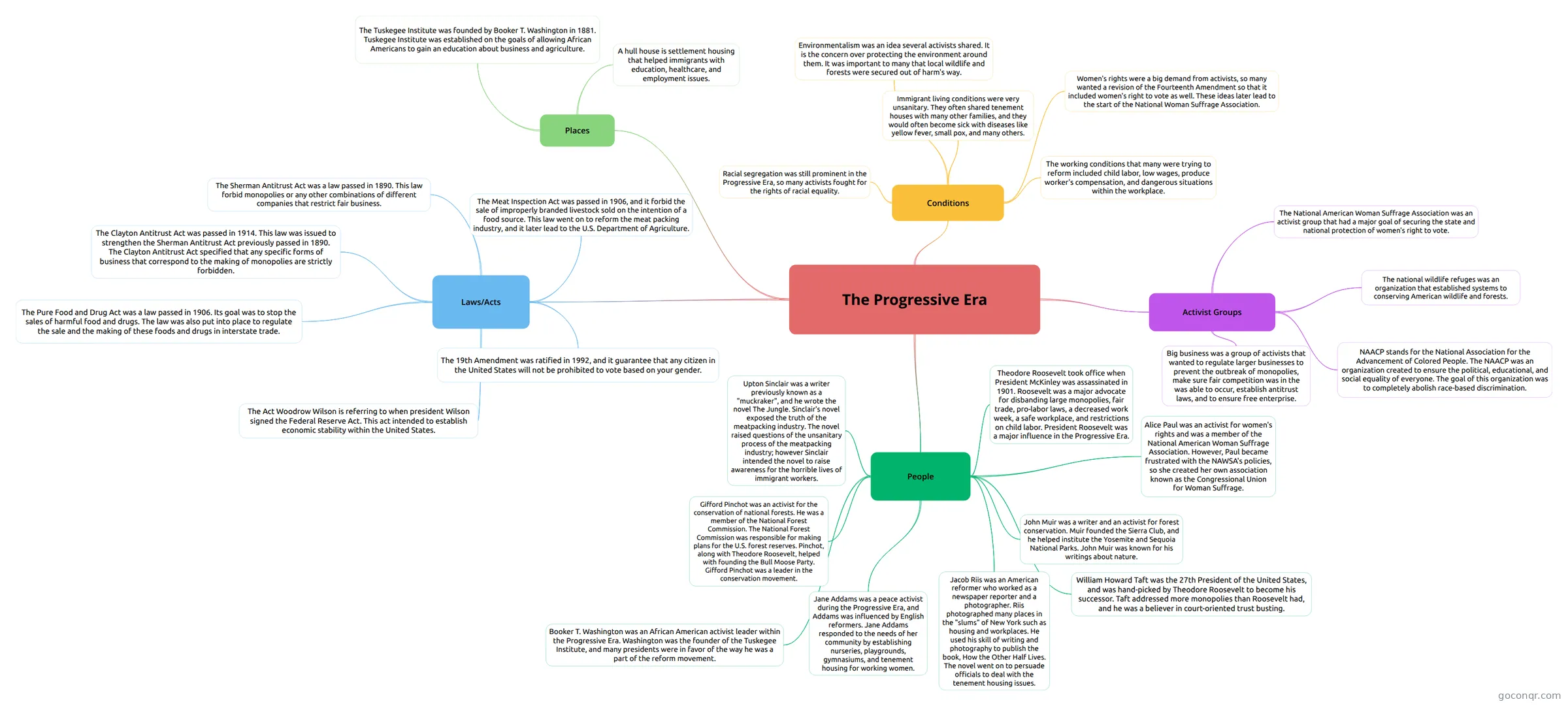
Mind map: The Progressive Era
Conteúdo do mapa
The Progressive Era
People
- Theodore Roosevelt took office when President McKinley was assassinated in 1901. Roosevelt was a major advocate for disbanding large monopolies, fair trade, pro-labor laws, a decreased work week, a safe workplace, and restrictions on child labor. President Roosevelt was a major influence in the Progressive Era.
- Upton Sinclair was a writer previously known as a "muckraker", and he wrote the novel The Jungle. Sinclair's novel exposed the truth of the meatpacking industry. The novel raised questions of the unsanitary process of the meatpacking industry; however Sinclair intended the novel to raise awareness for the horrible lives of immigrant workers.
- Jane Addams was a peace activist during the Progressive Era, and Addams was influenced by English reformers. Jane Addams responded to the needs of her community by establishing nurseries, playgrounds, gymnasiums, and tenement housing for working women.
- Jacob Riis was an American reformer who worked as a newspaper reporter and a photographer. Riis photographed many places in the "slums" of New York such as housing and workplaces. He used his skill of writing and photography to publish the book, How the Other Half Lives. The novel went on to persuade officials to deal with the tenement housing issues.
- Alice Paul was an activist for women's rights and was a member of the National American Woman Suffrage Association. However, Paul became frustrated with the NAWSA's policies, so she created her own association known as the Congressional Union for Woman Suffrage.
- John Muir was a writer and an activist for forest conservation. Muir founded the Sierra Club, and he helped institute the Yosemite and Sequoia National Parks. John Muir was known for his writings about nature.
- Gifford Pinchot was an activist for the conservation of national forests. He was a member of the National Forest Commission. The National Forest Commission was responsible for making plans for the U.S. forest reserves. Pinchot, along with Theodore Roosevelt, helped with founding the Bull Moose Party. Gifford Pinchot was a leader in the conservation movement.
- Booker T. Washington was an African American activist leader within the Progressive Era. Washington was the founder of the Tuskegee Institute, and many presidents were in favor of the way he was a part of the reform movement.
- William Howard Taft was the 27th President of the United States, and was hand-picked by Theodore Roosevelt to become his successor. Taft addressed more monopolies than Roosevelt had, and he was a believer in court-oriented trust busting.
Conditions
- The working conditions that many were trying to reform included child labor, low wages, produce worker's compensation, and dangerous situations within the workplace.
- Immigrant living conditions were very unsanitary. They often shared tenement houses with many other families, and they would often become sick with diseases like yellow fever, small pox, and many others.
- Racial segregation was still prominent in the Progressive Era, so many activists fought for the rights of racial equality.
- Environmentalism was an idea several activists shared. It is the concern over protecting the environment around them. It was important to many that local wildlife and forests were secured out of harm's way.
- Women's rights were a big demand from activists, so many wanted a revision of the Fourteenth Amendment so that it included women's right to vote as well. These ideas later lead to the start of the National Woman Suffrage Association.
Activist Groups
- NAACP stands for the National Association for the Advancement of Colored People. The NAACP was an organization created to ensure the political, educational, and social equality of everyone. The goal of this organization was to completely abolish race-based discrimination.
- The National American Woman Suffrage Association was an activist group that had a major goal of securing the state and national protection of women's right to vote.
- The national wildlife refuges was an organization that established systems to conserving American wildlife and forests.
- Big business was a group of activists that wanted to regulate larger businesses to prevent the outbreak of monopolies, make sure fair competition was in the was able to occur, establish antitrust laws, and to ensure free enterprise.
Places
- A hull house is settlement housing that helped immigrants with education, healthcare, and employment issues.
- The Tuskegee Institute was founded by Booker T. Washington in 1881. Tuskegee Institute was established on the goals of allowing African Americans to gain an education about business and agriculture.
Laws/Acts
- The Sherman Antitrust Act was a law passed in 1890. This law forbid monopolies or any other combinations of different companies that restrict fair business.
- The Clayton Antitrust Act was passed in 1914. This law was issued to strengthen the Sherman Antitrust Act previously passed in 1890. The Clayton Antitrust Act specified that any specific forms of business that correspond to the making of monopolies are strictly forbidden.
- The Meat Inspection Act was passed in 1906, and it forbid the sale of improperly branded livestock sold on the intention of a food source. This law went on to reform the meat packing industry, and it later lead to the U.S. Department of Agriculture.
- The Pure Food and Drug Act was a law passed in 1906. Its goal was to stop the sales of harmful food and drugs. The law was also put into place to regulate the sale and the making of these foods and drugs in interstate trade.
- The 19th Amendment was ratified in 1992, and it guarantee that any citizen in the United States will not be prohibited to vote based on your gender.
- The Act Woodrow Wilson is referring to when president Wilson signed the Federal Reserve Act. This act intended to establish economic stability within the United States.
Informações
- Descrição
- Mapa Mental sobre The Progressive Era, criado por Adison Harcrow em 01-10-2018.
- Criado por
- Adison Harcrow
- Visualizações
- 1
- Avaliação