
Mapa mental
Cooperative Language Learning
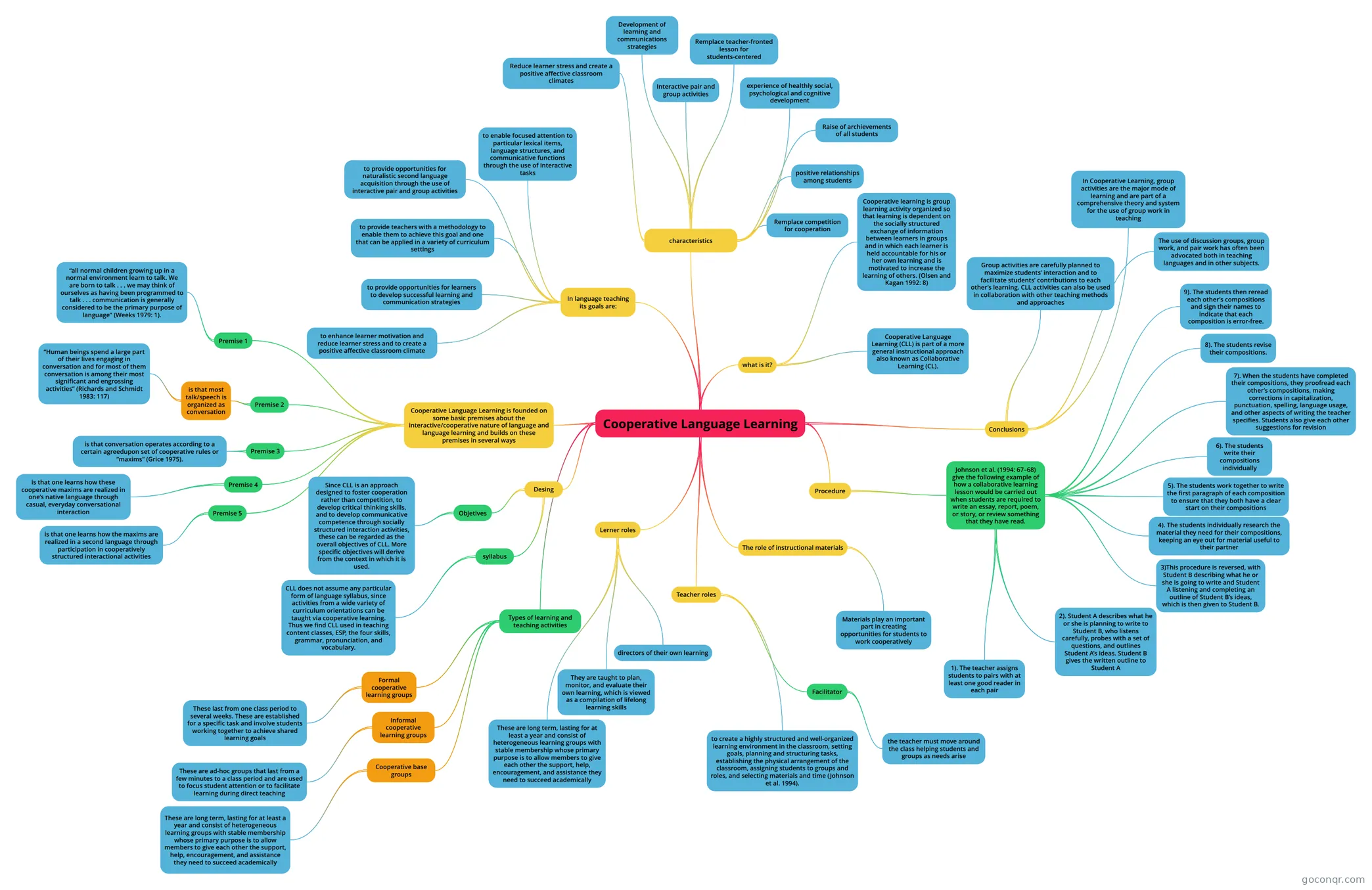
Mind map: Cooperative Language Learning
Conteúdo do mapa
Cooperative Language Learning
characteristics
- Raise of archievements of all students
- positive relationships among students
- experience of healthly social, psychological and cognitive development
- Remplace competition for cooperation
- Remplace teacher-fronted lesson for students-centered
- Interactive pair and group activities
- Development of learning and communications strategies
- Reduce learner stress and create a positive affective classroom climates
what is it?
- Cooperative Language Learning (CLL) is part of a more general instructional approach also known as Collaborative Learning (CL).
- Cooperative learning is group learning activity organized so that learning is dependent on the socially structured exchange of information between learners in groups and in which each learner is held accountable for his or her own learning and is motivated to increase the learning of others. (Olsen and Kagan 1992: 8)
In language teaching its goals are:
- to provide opportunities for naturalistic second language acquisition through the use of interactive pair and group activities
- to provide teachers with a methodology to enable them to achieve this goal and one that can be applied in a variety of curriculum settings
- to enable focused attention to particular lexical items, language structures, and communicative functions through the use of interactive tasks
- to provide opportunities for learners to develop successful learning and communication strategies
- to enhance learner motivation and reduce learner stress and to create a positive affective classroom climate
Cooperative Language Learning is founded on some basic premises about the interactive/cooperative nature of language and language learning and builds on these premises in several ways
- Premise 1
- “all normal children growing up in a normal environment learn to talk. We are born to talk . . . we may think of ourselves as having been programmed to talk . . . communication is generally considered to be the primary purpose of language” (Weeks 1979: 1).
- Premise 2
- is that most talk/speech is organized as conversation
- “Human beings spend a large part of their lives engaging in conversation and for most of them conversation is among their most significant and engrossing activities” (Richards and Schmidt 1983: 117)
- is that most talk/speech is organized as conversation
- Premise 3
- is that conversation operates according to a certain agreedupon set of cooperative rules or “maxims” (Grice 1975).
- Premise 4
- is that one learns how these cooperative maxims are realized in one’s native language through casual, everyday conversational interaction
- Premise 5
- is that one learns how the maxims are realized in a second language through participation in cooperatively structured interactional activities
- Premise 1
Desing
- Objetives
- Since CLL is an approach designed to foster cooperation rather than competition, to develop critical thinking skills, and to develop communicative competence through socially structured interaction activities, these can be regarded as the overall objectives of CLL. More specific objectives will derive from the context in which it is used.
- syllabus
- CLL does not assume any particular form of language syllabus, since activities from a wide variety of curriculum orientations can be taught via cooperative learning. Thus we find CLL used in teaching content classes, ESP, the four skills, grammar, pronunciation, and vocabulary.
- Objetives
Types of learning and teaching activities
- Formal cooperative learning groups
- These last from one class period to several weeks. These are established for a specific task and involve students working together to achieve shared learning goals
- Informal cooperative learning groups
- These are ad-hoc groups that last from a few minutes to a class period and are used to focus student attention or to facilitate learning during direct teaching
- Cooperative base groups
- These are long term, lasting for at least a year and consist of heterogeneous learning groups with stable membership whose primary purpose is to allow members to give each other the support, help, encouragement, and assistance they need to succeed academically
- Formal cooperative learning groups
Lerner roles
- These are long term, lasting for at least a year and consist of heterogeneous learning groups with stable membership whose primary purpose is to allow members to give each other the support, help, encouragement, and assistance they need to succeed academically
- directors of their own learning
- They are taught to plan, monitor, and evaluate their own learning, which is viewed as a compilation of lifelong learning skills
Teacher roles
- to create a highly structured and well-organized learning environment in the classroom, setting goals, planning and structuring tasks, establishing the physical arrangement of the classroom, assigning students to groups and roles, and selecting materials and time (Johnson et al. 1994).
- Facilitator
- the teacher must move around the class helping students and groups as needs arise
The role of instructional materials
- Materials play an important part in creating opportunities for students to work cooperatively
Procedure
- Johnson et al. (1994: 67–68) give the following example of how a collaborative learning lesson would be carried out when students are required to write an essay, report, poem, or story, or review something that they have read.
- 1). The teacher assigns students to pairs with at least one good reader in each pair
- 2). Student A describes what he or she is planning to write to Student B, who listens carefully, probes with a set of questions, and outlines Student A’s ideas. Student B gives the written outline to Student A
- 3)This procedure is reversed, with Student B describing what he or she is going to write and Student A listening and completing an outline of Student B’s ideas, which is then given to Student B.
- 4). The students individually research the material they need for their compositions, keeping an eye out for material useful to their partner
- 5). The students work together to write the first paragraph of each composition to ensure that they both have a clear start on their compositions
- 6). The students write their compositions individually
- 7). When the students have completed their compositions, they proofread each other’s compositions, making corrections in capitalization, punctuation, spelling, language usage, and other aspects of writing the teacher specifies. Students also give each other suggestions for revision
- 8). The students revise their compositions.
- 9). The students then reread each other’s compositions and sign their names to indicate that each composition is error-free.
- Johnson et al. (1994: 67–68) give the following example of how a collaborative learning lesson would be carried out when students are required to write an essay, report, poem, or story, or review something that they have read.
Conclusions
- The use of discussion groups, group work, and pair work has often been advocated both in teaching languages and in other subjects.
- In Cooperative Learning, group activities are the major mode of learning and are part of a comprehensive theory and system for the use of group work in teaching
- Group activities are carefully planned to maximize students’ interaction and to facilitate students’ contributions to each other’s learning. CLL activities can also be used in collaboration with other teaching methods and approaches
Informações
- Descrição
- Magisterio (Educación) Mapa Mental sobre Cooperative Language Learning, criado por yeinner jair gutierrez perdomo em 24-10-2018.
- Criado por
- yeinner jair gutierrez perdomo
- Visualizações
- 1
- Avaliação
Mais sobre Cooperative and Learner-Centred Language Teaching