
Mapa mental
Labour - Case Study 2019
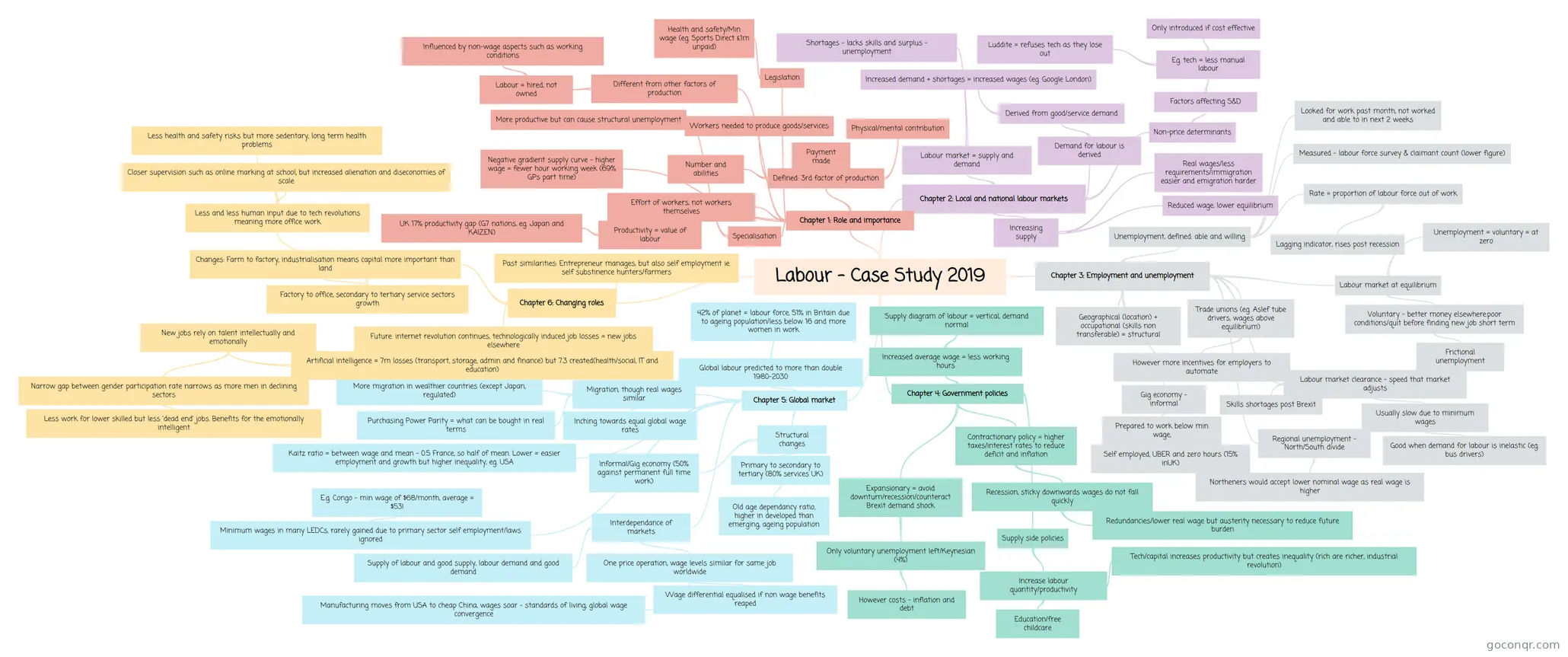
Mind map: Labour case study
Conteúdo do mapa
Labour - Case Study 2019
Chapter 2: Local and national labour markets
- Labour market = supply and demand
- Shortages - lacks skills and surplus - unemployment
- Demand for labour is derived
- Derived from good/service demand
- Increased demand + shortages = increased wages (eg. Google London)
- Derived from good/service demand
- Non-price determinants
- Factors affecting S&D
- Eg. tech = less manual labour
- Only introduced if cost effective
- Luddite = refuses tech as they lose out
- Eg. tech = less manual labour
- Factors affecting S&D
- Increasing supply
- Real wages/less requirements/immigration easier and emigration harder
- Reduced wage, lower equilibrium
- Labour market = supply and demand
Chapter 1: Role and importance
- Defined: 3rd factor of production
- Workers needed to produce goods/services
- Number and abilities
- Physical/mental contribution
- Payment made
- Effort of workers, not workers themselves
- Productivity = value of labour
- UK 17% productivity gap (G7 nations, eg. Japan and KAIZEN)
- Productivity = value of labour
- Specialisation
- More productive but can cause structural unemployment
- Different from other factors of production
- Labour = hired, not owned
- Influenced by non-wage aspects such as working conditions
- Labour = hired, not owned
- Negative gradient supply curve - higher wage = fewer hour working week (69% GPs part time)
- Legislation
- Health and safety/Min wage (eg. Sports Direct £1m unpaid)
- Defined: 3rd factor of production
Chapter 5: Global market
- Global labour predicted to more than double 1980-2030
- 42% of planet = labour force, 51% in Britain due to ageing population/less below 16 and more women in work
- Structural changes
- Primary to secondary to tertiary (80% services UK)
- Old age dependancy ratio, higher in developed than emerging, ageing population
- Informal/Gig economy (50% against permanent full time work)
- Primary to secondary to tertiary (80% services UK)
- Interdependance of markets
- Supply of labour and good supply, labour demand and good demand
- One price operation, wage levels similar for same job worldwide
- Wage differential equalised if non wage benefits reaped
- Manufacturing moves from USA to cheap China, wages soar - standards of living, global wage convergence
- Minimum wages in many LEDCs, rarely gained due to primary sector self employment/laws ignored
- E.g. Congo - min wage of $68/month, average = $53!
- Kaitz ratio = between wage and mean - 0.5 France, so half of mean. Lower = easier employment and growth but higher inequality, eg. USA
- Migration, though real wages similar
- Purchasing Power Parity = what can be bought in real terms
- More migration in wealthier countries (except Japan, regulated)
- Inching towards equal global wage rates
- Global labour predicted to more than double 1980-2030
Chapter 3: Employment and unemployment
- Unemployment, defined: able and willing
- Looked for work past month, not worked and able to in next 2 weeks
- Measured - labour force survey & claimant count (lower figure)
- Rate = proportion of labour force out of work
- Lagging indicator, rises post recession
- Labour market at equilibrium
- Unemployment = voluntary = at zero
- Voluntary - better money elsewhere.poor conditions/quit before finding new job short term
- Frictional unemployment
- Geographical (location) + occupational (skills non transferable) = structural
- Labour market clearance - speed that market adjusts
- Usually slow due to minimum wages
- Good when demand for labour is inelastic (eg. bus drivers)
- Skills shortages post Brexit
- Usually slow due to minimum wages
- Trade unions (eg. Aslef tube drivers, wages above equilibrium)
- However more incentives for employers to automate
- Gig economy - informal
- Prepared to work below min wage,
- Self employed, UBER and zero hours (15% inUK)
- Prepared to work below min wage,
- Regional unemployment - North/South divide
- Northeners would accept lower nominal wage as real wage is higher
- Unemployment, defined: able and willing
Chapter 4: Government policies
- Increased average wage = less working hours
- Supply diagram of labour = vertical, demand normal
- Contractionary policy = higher taxes/interest rates to reduce deficit and inflation
- Recession, sticky downwards wages do not fall quickly
- Redundancies/lower real wage but austerity necessary to reduce future burden
- Recession, sticky downwards wages do not fall quickly
- Expansionary = avoid downturn/recession/counteract Brexit demand shock
- Only voluntary unemployment left/Keynesian (4%)
- However costs - inflation and debt
- Only voluntary unemployment left/Keynesian (4%)
- Supply side policies
- Increase labour quantity/productivity
- Education/free childcare
- Tech/capital increases productivity but creates inequality (rich are richer, industrial revolution)
- Increase labour quantity/productivity
- Increased average wage = less working hours
Chapter 6: Changing roles
- Past similarities: Entrepreneur manages, but also self employment ie. self substinence hunters/farmers
- Changes: Farm to factory, industrialisation means capital more important than land
- Factory to office, secondary to tertiary service sectors growth
- Less and less human input due to tech revolutions meaning more office work
- Closer supervision such as online marking at school, but increased alienation and diseconomies of scale
- Less health and safety risks but more sedentary, long term health problems
- Less and less human input due to tech revolutions meaning more office work
- Factory to office, secondary to tertiary service sectors growth
- Future: internet revolution continues, technologically induced job losses = new jobs elsewhere
- Artificial intelligence = 7m losses (transport, storage, admin and finance) but 7.3 created(health/social, IT and education)
- New jobs rely on talent intellectually and emotionally
- Narrow gap between gender participation rate narrows as more men in declining sectors
- Less work for lower skilled but less 'dead end' jobs. Benefits for the emotionally intelligent
- Narrow gap between gender participation rate narrows as more men in declining sectors
- New jobs rely on talent intellectually and emotionally
- Artificial intelligence = 7m losses (transport, storage, admin and finance) but 7.3 created(health/social, IT and education)
Informações
- Descrição
- A level Economics B Mapa Mental sobre Labour - Case Study 2019, criado por Roberta Hadgraft em 17-02-2019.
- Criado por
- Roberta Hadgraft
- Visualizações
- 4
- Avaliação