
Mapa mental
B3: Living Together
Conteúdo do mapa
B3: Living Together
Enzymes
- Catalysts Produced by Living Things
- Catalyst - Increases the speed of a reaction
- Living things have thousands of chemical reactions inside them at all times. These reactions need to have the right amounts of substances (controlled). Can make a reaction happen faster by raising the temperature, which would speed up the useful reactions but the unwanted ones too. Living things produce enzymes which act as catalysts and they reduce the need for high temperatures. They speed up reactions in plants and animals.
- Special Shapes to Speed up Reactions
- Chemical reactions involve things either splitting apart or joined together. The substrate is the molecule changed in the reaction. Every enzyme has an active sit where it joins onto its substrate to speed up reaction and they work with one substrate, which has a high specificity for their substrate. For the enzyme to work, the substrate has to fit into the active site and if it doesn't the reaction won't speed up.
- Temperature, pH and Substrate Concentration Affect the Rate of Reaction
- Temperature
- A higher temperature increases the rate and has more energy, which means they move about more and collide. But if it gets too hot, some of the bonds holding the enzyme together breaks and the substrate won't fit into the active site. Enzymes work best at an optimum temperature.
- pH
- If it's too high or too low , the pH interferes with the bonds holding the enzyme together. Have an optimum pH that they work best at (often pH 7)
- Substrate Concentration
- The higher the concentration, the faster the reaction which means the higher energy and collisions.
- Temperature
- Catalysts Produced by Living Things
Photosynthesis
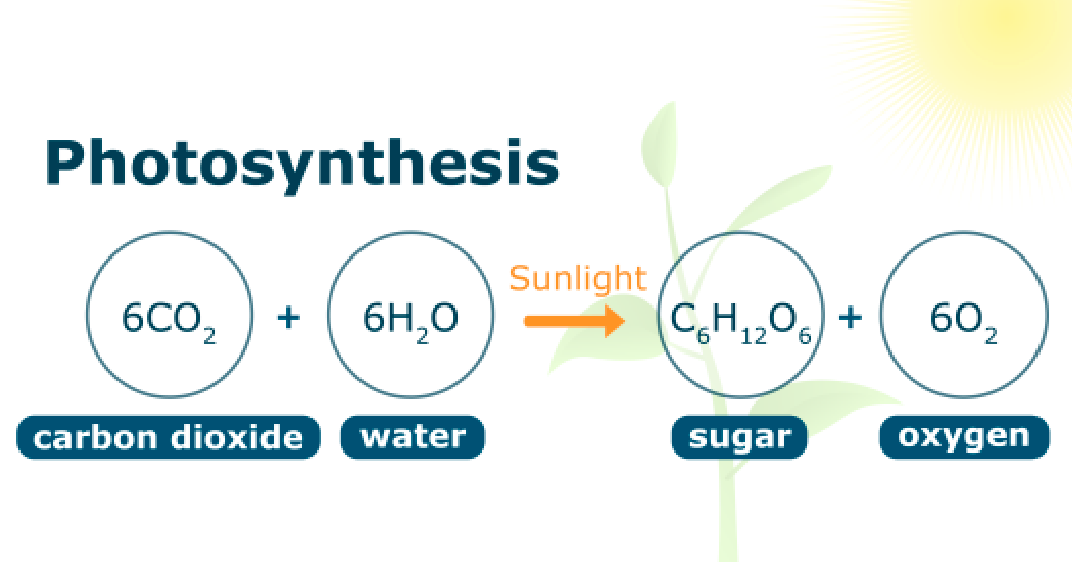
- During, green plants use energy from the sun to make glucose. Some of it is converted to starch and stored and some larger molecules that the plants need to grow E.G. Proteins and carbohydrates (makes up organism's biomass). It happens inside chloroplasts, which contain enzymes to speed up the reaction, and chlorophyll, which absorbs light. It is endothermic and lots of chemical reactions happens in the process.
Diffusion, Osmosis and Active Transport
- Active Transport
- The movement of particles across a membrane against a concentration gradient (area of lower to an area of higher concentration) using energy transferred during respiration
- Osmosis
- Net movement of water molecules across a partially permeable membrane from a region of higher to a region of lower water concentration.
- Water molecules pass both ways through membrane, because the molecules move around randomly at all times. But because there are more water molecules on one side than on the other, there's a steady net flow of water into the region with fewer molecules I.E. stronger sugar solution. The strong sugar solution gets more dilute and the water acts like it's trying to even the concentration on both sides.
- Diffusion
- The net (overall) movement of particles from an are of high to an area of low concentration.
- Happens in liquids and gases. It continues until the concentration of the diffusing particles in even in both areas
- Active Transport
Xylem and Phloem
- Xylem
- Made of dead cells joined end to end with no connecting cell between them, and a hole down the middle. Thick side walls are made of cellulose, strong and stiff, which gives the plant support. Xylem tubes carry water and mineral ions from the roots up the stem to the leaves in the transpiration stream.
- Phloem
- Transport food substances. Made of living cells called sieve tube elements. They have no nucleus which means they can't survive on their own, so each tube has a companion cell.
- Xylem
Stomata
- Open and Close Automatically
- They open and close to control the amount of water lost from the leaves. Stomata are surrounded by guard cell, changes shape to control size of pore. When they're swollen with water they open, and when they're low on water they close. They close automatically when the water starts to dry up. If it's short of water, the cytoplasm starts to shrink and the membrane pulls away from cell wall.
- Open and Close Automatically
Ecosystems
- Individual
- A single organism
- Population
- All organisms of one species in a habitat
- Community
- All organisms (different species) living in a habitat
- Ecosytem
- A community of organisms with all the abiotic conditions
- Individual
Imagens e arquivos do mapa
Informações
- Descrição
- GCSE Core Science Mapa Mental sobre B3: Living Together, criado por Blerta Morina em 07-04-2019.
- Criado por
- Blerta Morina · abr 2019
- Atualizado
- 1 mai 2019
- Visualizações
- 10
- Tags
- Avaliação