
Mapa mental
week 3: language development
Conteúdo do mapa
week 3: language development
critical age hypothesis = certain types of behaviour develop within a set period. to develop normally, must occur within this period
- demers 1988= song birds display hemispheric specialisation.
- Lenneberg 1967 - language is innate, need language input during CP, Genie could not develop normal language as missed CP
maturational state hypothesis = early in life = superior capacity to learn languages which drops later in life. CHILDREN ALWAYS BETTER THAN ADULTS.
- Flege & Hillenbrand 1984 - adults more likely to retain a foreign accent
- strong version can be rejected. weak version = syntax and phonology develop better when younger.
exercise hypothesis = no difference, but exercise or lose the language
- 5% of adults can learn a new language perfectly, adults better initially- children better long term, continuous decline with age
- Johnson and Newport 1989- native chinese / korean speakers moved to US, measured on grammatical errors. AGE ON ARRIVAL: 0-16 = negative correlation between age and accuracy. 16-40 no correlation. When the language was learned is more important > length of exposure
Language Acquisition Device LAD: innate device which guides language, universal grammar (UG) = provides rules and allows a child to learn any language
- UG = limited number of principles common to all languages. Provides a limited range of options/ parameters. explains variation amongst languages
pidgin and creole language - Bickerton 1981. pidgin = simplified language, words, sounds, body language, allows ppl to communicate from diverse linguistic backgrounds. Creole = next generation Pidgin with grammatical rules, more sophistictaed.
- spontaneous sign language - Kegel et al 1999. Nicaraguan deaf children develop own sign language with own rules
LANGUAGE ACQUISITION THEORIES: behaviourists (Skinner) = children learn through imitation and reinforcement. Nativist account (Chomsky) = LAD, UG is innate. children do not need explicit instruction or reinforcement. Cognitive account (Piaget/Vygotsky) = driven by cognitve development
- social hypothesis Brunner, Language Acquisition system (LASS). mere exposure to language is not sufficient, must experience language in social contexts, turn taking - mutual gaze, these skills might be innate.
- children use ungrammatical language they have never heard before, parents rarley correct them. Truth value > well formedness is reinforcement from parents
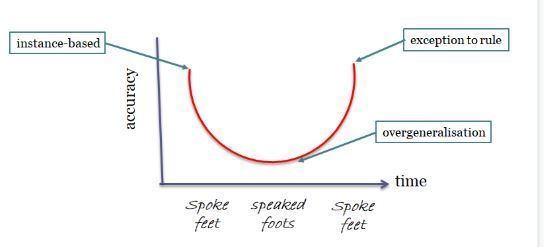
- U-Shaped learning = overgeneralisation of a rule they learned e.g. adding 'ed' for past tense
- social hypothesis Brunner, Language Acquisition system (LASS). mere exposure to language is not sufficient, must experience language in social contexts, turn taking - mutual gaze, these skills might be innate.
poverty of stimulus and child-directed speech. Chomsky ''linguistic input is inadequate'
- input = DEGENERATIVE (full of dysfluencies, mispronounciations, slips of tongue) INSUFFICIENT (children not exposed to enough examples of grammatical constructions to work out underlying meaning of grammar
- child directed speech = phonological differences, exageratted, higher pitch. high repitition.
before birth: foetuses can hear impoverished sounds in the womb. DeCasper & Spence 1986- cat in the hat 2x a day for last 6 weeks of pregnancy- new borns preferred the familiar story
- early speech perception = young infants listen to speech sounds are aware of fine distinctions between them. sensitive to speech distinctions from other languages too. Sensitivity to foreign languages diminishes around 1.
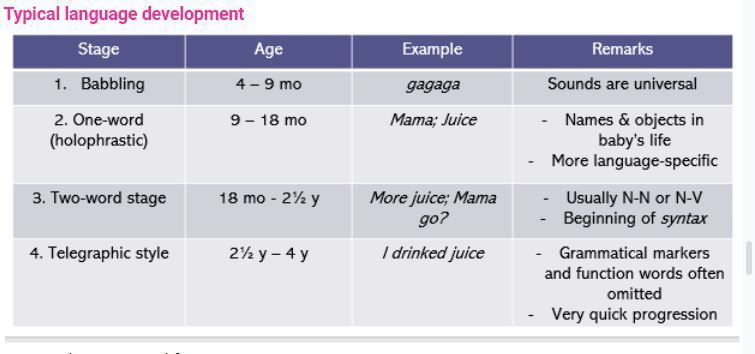
- early speech production: crying, cooing, babbling. universal - found in deaf children. deaf children showed sign babble with their hands. 1 word stage from 9-18 mo >>> rapid explosion 18 mo with 10-20 new words a day. fast mapping after only 1 exposure can learn word
learning word meaning. whole object = assumes the label refers to the WHOLE thing. mutual exclusivity assumption = an object can only have 1 label. Taxonomic constraint = a word refers to a category of similar things. Basic level category = the word refers to basic level oppose to superordinate (animal) or subordinate (poodle)
- syntactic clues to word naming- bootstrapping. children can use their knowledge of word formation to derive word meanings. A SIB = CONTAINER, SIBBING = ACTION, SIBS = CONFETTI
LEARNING GRAMMAR: 1-word stage = naming function, might sometimes convey more complex message e.g. JUICE = i want more juice
- 2 word stage = 2 word utternances with syntactic and semantic rels. syntactic markers. can serve grammatical rels. MOMMY SOCK - this is her sock, put my sock on
telegraphic speech = children mean length of utterance of 2.5-3.5 morphemes seem to be at stage of grammar acquisition.
- how do children learn syntax? Pinker 1989 - innateness account - semantic bootstrapping, innate distinction between nouns and verbs.
- rule based linguistic morphological development. Berko-Gleason 1958. demonstrated rule application. WUG (nonsense animal), now there is 2 - WUGS. children ages 5-7 applied to plural rule and produced phonologically correct form
Imagens e arquivos do mapa
Informações
- Descrição
- Psycholinguistics Mapa Mental sobre week 3: language development, criado por Katie gavriel em 08-04-2019.
- Criado por
- Katie gavriel
- Visualizações
- 1
- Avaliação